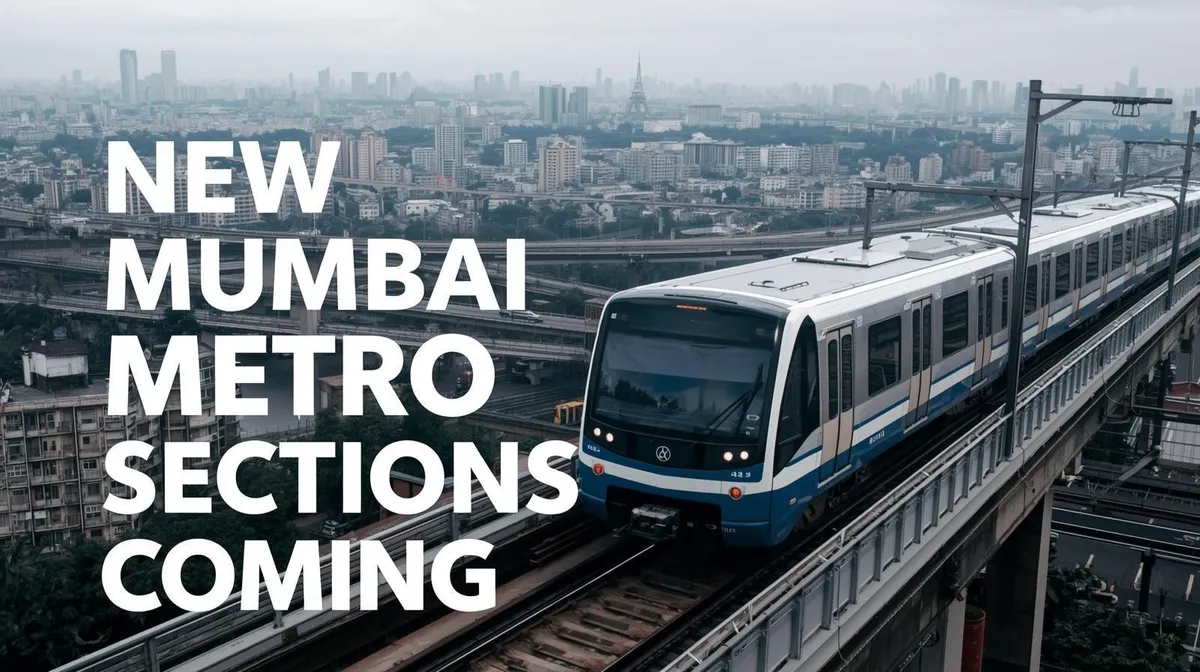
Mumbai’s long-stretched suburbs are set to see a major shift in daily mobility as two metro corridors—Metro Line 9 and Metro Line 2B—move closer to partial operations. Together, the projects are expected to significantly reduce travel times for commuters in Dahisar, along the Western Express Highway corridor, and across Chembur and eastern suburbs, reinforcing the city’s transition towards a more connected and low-carbon transport network.
Metro Line 9, part of the city’s Red Line system, spans nearly 13.6 km, combining elevated and underground sections. Designed as an extension linking Mira Bhayandar to Mumbai’s core metro grid, the line integrates directly with Metro Line 7 and Metro Line 2A, creating a continuous north–south and east–west travel spine. Officials have indicated that Phase 1, covering the Dahisar to Kashigaon stretch, is expected to open by the end of the year, while the full corridor is projected for completion by late 2026. Urban transport planners say the impact on daily commuting could be substantial. Travel between Mira Road and Andheri—often exceeding 90 minutes during peak hours—could be reduced to under an hour through seamless interchanges. With vehicle volumes on the Western Express Highway running into several million daily, the metro is expected to absorb a significant share of commuter demand. Estimates suggest Metro Line 9 could carry more than eight lakh passengers daily at launch, rising steadily over the next decade.
Running parallel to this development is Mumbai Metro Line 2B, the fully elevated Yellow Line stretching over 23.6 km from Andheri West to Mankhurd. The upcoming opening of the Diamond Garden to Mandale section will bring metro access deeper into eastern neighbourhoods that have historically relied on congested road corridors and suburban rail. Industry experts note that Line 2B’s strength lies in its multiple interchanges—with suburban rail, monorail, and several metro lines—allowing smoother multi-modal journeys across the city. For commuters travelling between employment hubs such as Andheri, Bandra Kurla Complex, Chembur and the harbour belt, the combined effect of Lines 9 and 2B could cut travel times by over half. Transport officials also point to broader benefits, including lower emissions, improved road safety and more predictable travel for women and shift workers who depend on reliable public transport.
As Mumbai continues to expand outward, the success of these corridors will be closely watched. Their timely delivery is seen as essential not just for easing congestion, but for shaping a more inclusive, energy-efficient urban future where growth is matched by accessible and sustainable mobility.
Mumbai, Dahisar, WEH, Chembur Commuters Get Two Metro Lines By December 31