


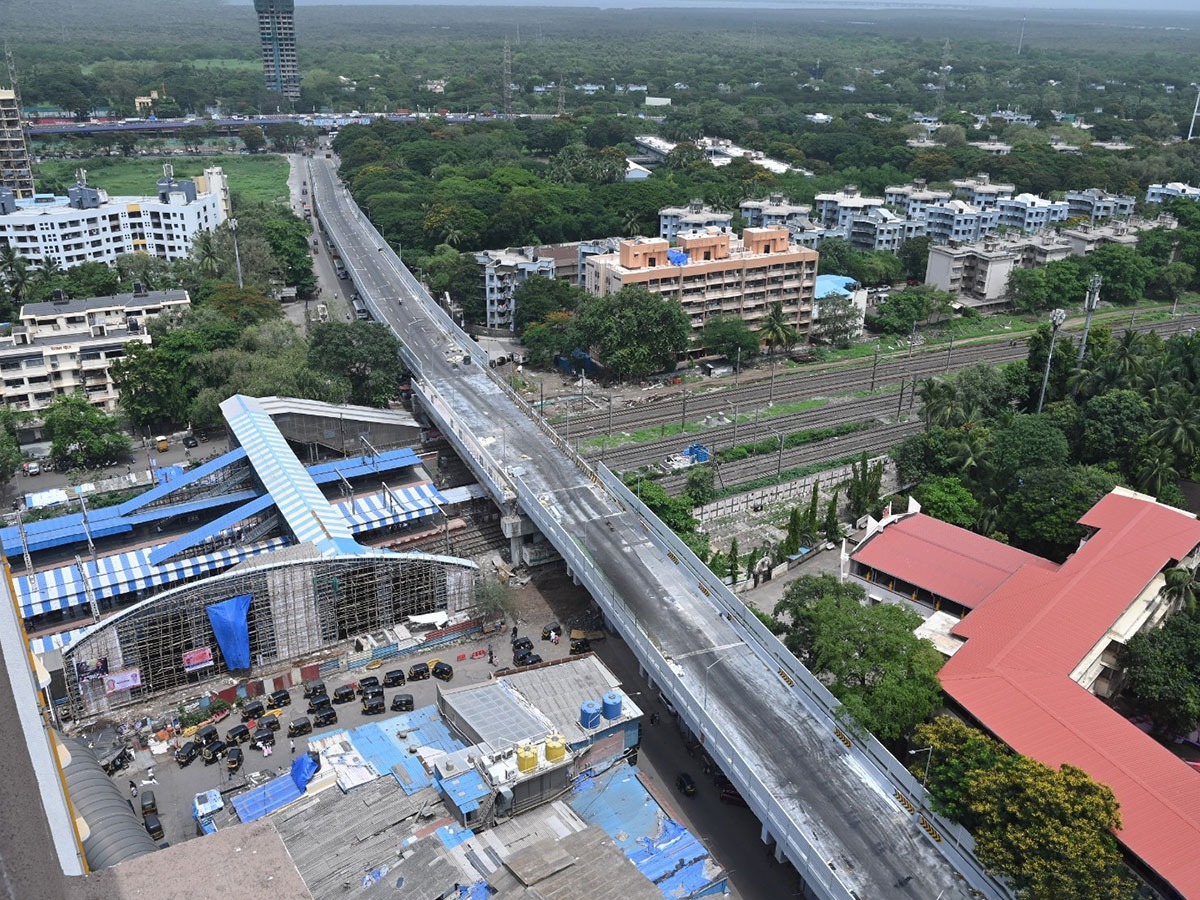
Mumbai’s newly inaugurated Vikhroli bridge, intended to ease east–west connectivity between LBS Marg and the Eastern Express Highway (EEH), is drawing widespread criticism from commuters just weeks after opening. The 615-metre-long, three-lane structure—hailed as a traffic decongestion measure—has instead added to delays and sparked frustration over its flawed design and poor integration with adjoining roads.
Since the bridge became operational, daily commuters have reported frequent and prolonged traffic snarls, particularly at both entry and exit points. At the LBS Marg end, vehicles pile up during peak hours as motorists wait for a traffic signal to disembark. The situation worsens as congestion spills into the adjacent lane meant for oncoming traffic, creating bi-directional chaos.
The eastern end of the bridge, which connects directly to the EEH, has emerged as a major choke point. The junction there lacks a traffic signal and is a convergence point for vehicles from Tagore Nagar, Kannamwar Nagar, and the Vikhroli railway station. Officials from the Brihanmumbai Municipal Corporation (BMC) admitted the area’s road network was already under strain and has become more congested since the bridge opened.
Commuters and transport observers have pointed out serious flaws in the bridge’s design. With no median to separate traffic flowing in opposite directions and five speed breakers disrupting flow, the bridge has turned into a bottleneck rather than a solution. A local road safety advocate shared on social media that it took him 20 minutes to travel just 300 metres from the EEH to the bridge ramp, followed by an additional 11 minutes to cross the bridge. He also observed autorickshaws dangerously overtaking on the lane meant for oncoming traffic, further underlining the absence of proper lane discipline and road safety infrastructure.The BMC’s decision to construct a three-lane, median-less, bi-directional bridge has faced backlash not just for congestion, but also for safety. Additional Municipal Commissioner (Roads and Bridges) acknowledged the issues, explaining that the design was meant to allow flexible lane usage based on traffic flow. However, in practice, the bridge has struggled to meet basic expectations of order, efficiency, and safety.
Residents of nearby Kannamwar Nagar are among the most impacted. They now face increased travel times due to restricted U-turn access and must navigate longer detours to reach routine destinations like the railway station. Sanjay Yelve, a resident representative and president of Vikhrolikar Vikas Manch, expressed disappointment, stating that both the BMC and traffic police had been forewarned about the potential traffic chaos but did not act preemptively.
In response to the rising public discontent, BMC and Mumbai Traffic Police have deployed five officers at the eastern junction during morning and evening peak hours to regulate vehicle flow manually. However, officials agree this is only a temporary fix. Long-term measures under consideration include widening the approach road, introducing a roundabout, and installing traffic signals. The delay in implementing these improvements has been attributed to a beautification wall at the junction, which the traffic department has now requested to be shifted to allow space for road expansion.
The situation has reignited conversations about the need for human-centric urban infrastructure planning that prioritises commuter safety and practical utility over rigid engineering solutions. With mounting complaints and increasing political pressure, civic authorities are now racing to mitigate the unintended consequences of a bridge that was supposed to simplify commutes but has instead complicated them.
Also Read : DGCA Flags Lapses at Major Indian Airports
