


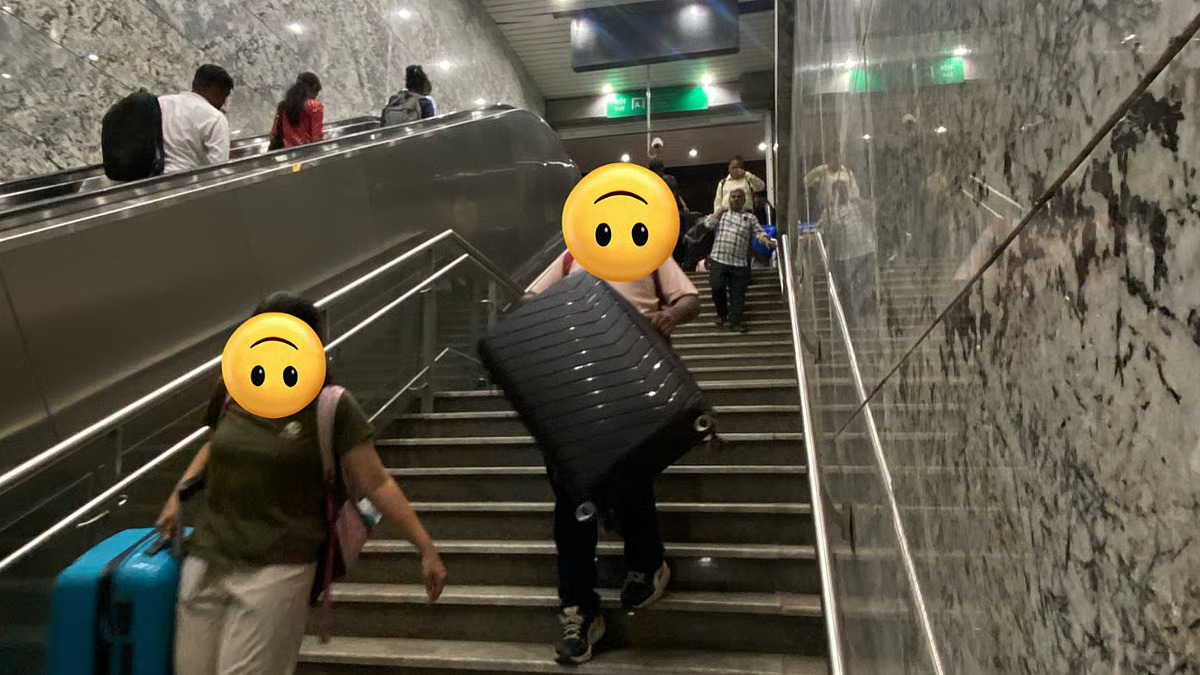
Mumbai’s newly inaugurated Metro Line 3, celebrated as a milestone in sustainable urban transport, is facing growing public criticism for its lack of accessibility infrastructure at key airport stations. Commuters have voiced frustration over the absence of descending escalators and non-functional elevators at the Chhatrapati Shivaji Maharaj International Airport (CSMIA) terminals, calling the situation inconvenient and unsafe, especially for travellers carrying heavy luggage or those with limited mobility.
The 33.5 km Aqua Line, connecting South Mumbai to the international airport, was designed to enhance last-mile connectivity and reduce carbon emissions by shifting commuters from road to rail. However, within weeks of its launch, users have taken to social media to express anger over what they see as a major design oversight. Flyers have reported being forced to haul suitcases down long flights of stairs at both Terminal 1 and Terminal 2 stations, contradicting the project’s promise of world-class, inclusive infrastructure. According to commuters, escalators at both airport metro stations currently operate only in the upward direction. Passengers descending from the concourse to exit areas are left to manage their luggage manually, often while navigating steep staircases. Travellers using the T-2 station must also walk nearly 500 metres from the metro exit to the airport gates, while those at T-1 walk about 200 metres — a challenge for passengers with bags or mobility constraints.
The absence of adequate accessibility features has sparked a wider debate on the inclusivity of Mumbai’s infrastructure projects. Many have pointed out that the metro, touted as one of Asia’s most advanced underground lines, fails to meet basic standards of universal design. “A metro line that connects directly to an international airport should have prioritised accessibility for all users, especially senior citizens and persons with disabilities,” said an urban mobility expert. Social media platforms have amplified these grievances, with commuters sharing videos and images highlighting the inconvenience faced by passengers. Many expressed disappointment that a project meant to modernise Mumbai’s transport ecosystem overlooked essential user needs. A regular flyer commented online that despite the metro’s aesthetic appeal and operational efficiency, “the experience collapses when basic commuter comfort is ignored.”
The Mumbai Metro Rail Corporation (MMRC), responsible for executing the line, has been commended for building direct connecting bridges between the metro and airport terminals — a move that solved last-mile connectivity challenges. However, the lack of adequate accessibility inside the stations has overshadowed these achievements. Commuters are urging authorities to install descending escalators, ensure functional elevators, and adopt international accessibility benchmarks at all major stations. Experts say the controversy underscores a broader issue in India’s infrastructure development — the gap between design intent and commuter experience. While modern metro systems are central to building low-carbon, sustainable cities, inclusivity remains a key measure of their success.
As public scrutiny intensifies, the MMRC is yet to issue an official statement addressing the complaints. For a city that prides itself on progressive urban mobility, ensuring equal access for all users — regardless of age or ability — may determine whether Mumbai Metro Line 3 truly lives up to its promise of being the city’s green, people-centric transport lifeline.
Also Read : Mumbai To Get More Green Power To Meet Rising Peak Electricity Demand
