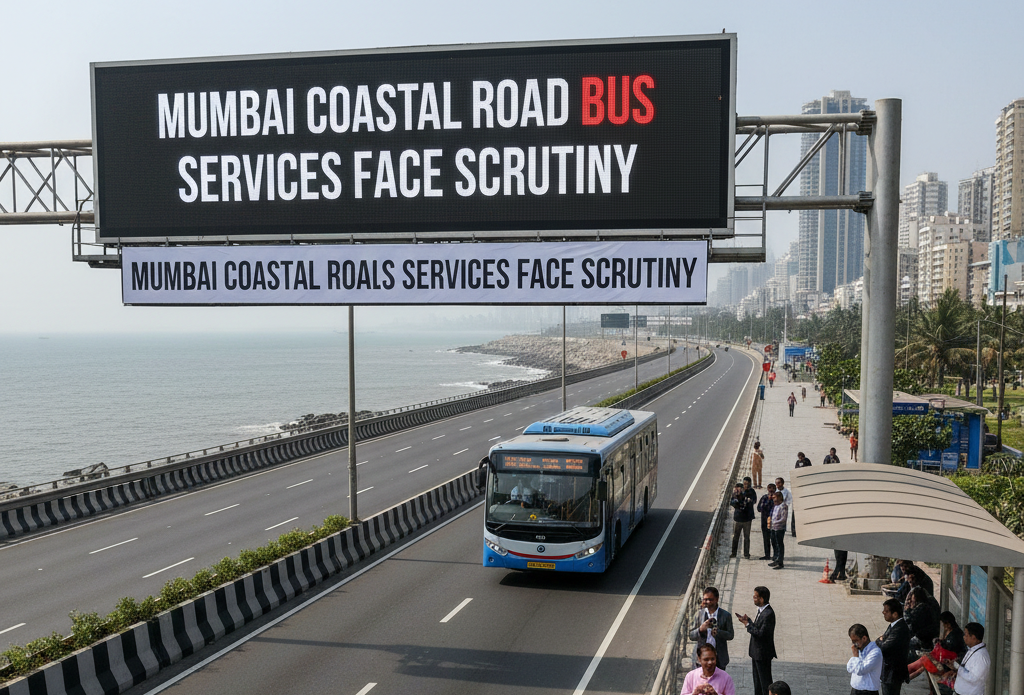
Mumbai’s newest high-speed corridor is drawing growing criticism from public transport users, with daily commuters flagging inadequate bus services on the city’s landmark coastal infrastructure. While the coastal road was positioned as a congestion-relief project with provisions for mass transit, passengers say limited bus frequency has weakened its value as an inclusive mobility solution, raising broader questions about how large road investments serve people without private vehicles.
The concerns centre on the Mumbai Coastal Road, a signal-free stretch designed to offer faster east–west movement and reduce pressure on inner-city roads. Despite the presence of a dedicated bus lane, commuters report that only a handful of bus services operate on the route, resulting in long waiting times and inconsistent connectivity. For many regular users, the promised travel-time savings are offset by uncertainty at bus stops. Public transport planners point out that dedicated lanes are effective only when paired with high-frequency operations. “Infrastructure alone does not shift travel behaviour,” said an urban mobility expert. “Without predictable and frequent services, commuters revert to slower but more reliable alternatives.” This has implications not just for convenience, but also for the city’s climate goals, which rely on shifting trips from private vehicles to shared transport.
The bus services on the corridor are operated by the Brihanmumbai Electric Supply and Transport, which officials say is constrained by fleet availability. Transport administrators have indicated that services on the coastal road are being rolled out in phases, with expansion planned as more buses are inducted. However, commuters argue that the corridor’s early months were precisely when strong public transport presence was needed to shape usage patterns. Ridership advocates estimate that the road could support 50 to 100 bus trips a day, particularly during peak hours, to make meaningful use of the exclusive lane. They say higher service levels would reduce pressure on parallel arterial roads, lower fuel consumption, and improve journey reliability for office-goers and service workers travelling along the western coastline.
The debate has also reopened discussions on network integration. Urban planners suggest that aligning coastal road bus services with trunk corridors such as the Western Express Highway could create a faster, citywide bus spine. Such coordination, they argue, would amplify the economic return on the coastal road while making mobility gains more evenly distributed. From a real estate and urban development perspective, dependable public transport access is closely linked to inclusive growth. Areas connected primarily through car-oriented infrastructure risk excluding lower-income commuters and informal workers, even as land values rise around new projects.
As Mumbai continues to invest heavily in road tunnels, sea links and metro lines, the experience on the coastal road underscores a critical lesson: mobility outcomes depend as much on operations as on construction. Whether the corridor evolves into a people-first transport asset will hinge on how quickly and decisively bus services are scaled up to match the infrastructure already in place.
Mumbai Coastal Road Bus Services Face Scrutiny