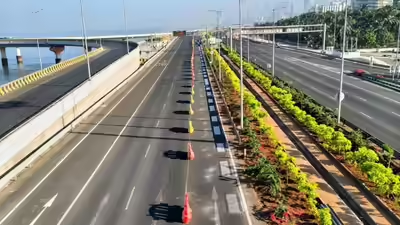
Mumbai Coastal Road Becomes India First Musical Road
Mumbai has inaugurated India’s first “musical road,” an engineered stretch of the Coastal Road that emits a recognisable tune as vehicles travel at specified speeds — an experiment in blending transport infrastructure with sensory engagement that also highlights broader discussions about urban mobility, safety and civic experience. The inaugural segment, designed to play the iconic song Jai Ho when vehicles pass over precision-cut grooves at around 70–80 km/h, is part of efforts to enhance travel experience on one of the city’s most strategic corridors.
Located on the northbound carriageway of the Mumbai Coastal Road between Nariman Point and Worli, the 500-metre “musical road” deploys patterned surface rumble strips calibrated to generate musical notes through tyre-surface friction as cars move at target speeds. Signage has been installed in advance to alert motorists ahead of the musical section, aiding both safety and awareness. The inauguration took place in the presence of state leadership, underscoring the civic emphasis on creative infrastructure.Urban mobility experts suggest the initiative can serve multiple civic functions. While on its surface the musical road provides a unique commuter experience, such engineered auditory cues can also encourage drivers to maintain steady speeds, potentially reducing erratic acceleration and braking on a high-speed urban corridor. In rapidly densifying cities like Mumbai, where traffic congestion and variable vehicle speeds remain persistent challenges, technologies that subtly influence driver behaviour could become part of broader traffic management toolkits.
The concept of musical or melody roads is not entirely new globally, having first emerged from engineering research in Japan and later adopted in places such as Hungary, South Korea and the United Arab Emirates. The grooves’ spacing is mathematically calculated to produce specific sound frequencies when engaged with tyres at given velocities, illustrating how infrastructure design can intersect with acoustics and behavioural science.However, reactions among transport planners and safety advocates remain mixed. While some see value in experiential infrastructure that heightens driver alertness, others warn that novelty alone does not address deeper systemic issues such as peak-hour congestion, last-mile connectivity and equitable access to safe non-motorised transport. Integrating new features like musical roads into broader sustainable mobility frameworks will require careful evaluation of their effectiveness and impact on driver behaviour across different vehicle types.
For residents and regular commuters, the musical road also signals a shift in how urban infrastructure is experienced — from purely functional assets to interactive public realms. As cities pursue climate-resilient, inclusive transport policies, pilots like musical roads could spark innovation in how infrastructure communicates with users, while prompting debate on prioritising investments that balance enjoyment, safety and long-term utility.