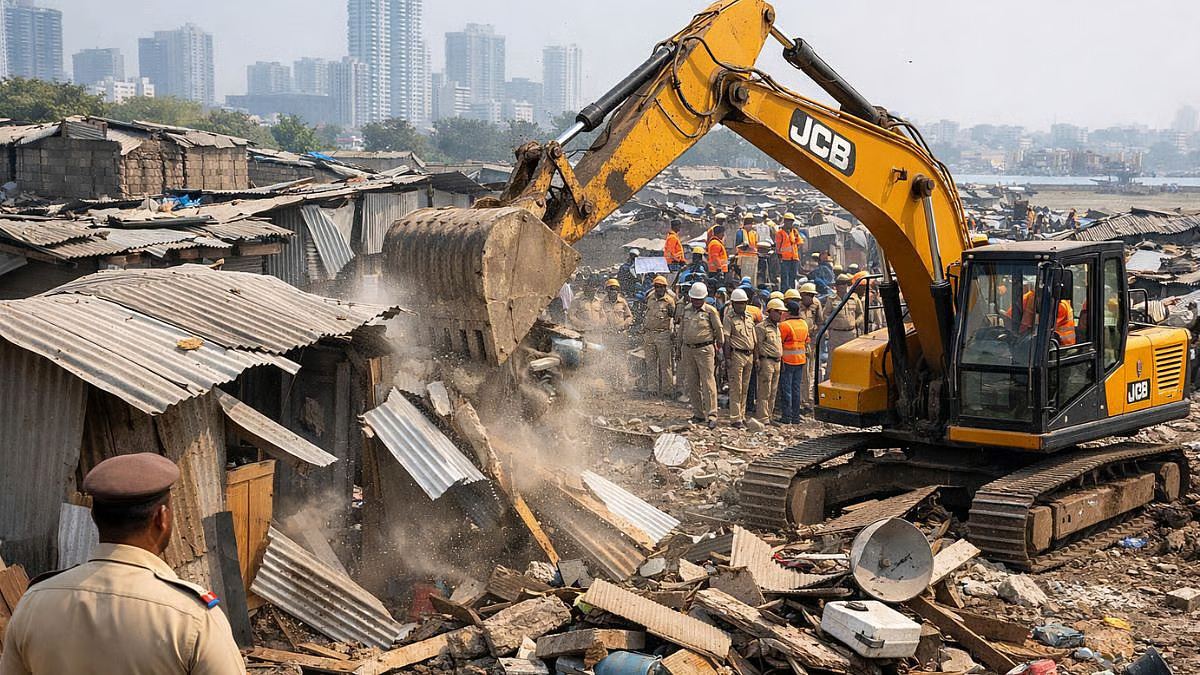
Mumbai’s civic administration has undertaken a large-scale clearance operation in the eastern suburbs, removing more than a thousand informal structures from a government-owned land parcel in Mankhurd. The move is part of a broader effort to reclaim public land for planned urban use, even as it raises immediate concerns around housing vulnerability and displacement in one of the city’s most densely populated zones.
The eviction, carried out jointly by municipal authorities and district administration officials, targeted a long-encroached site along a key transport corridor connecting Ghatkopar and Mulund. Officials indicated that the land had been under unauthorised occupation for several years, complicating infrastructure planning and limiting its potential for public projects. Authorities have linked the clearance to future development plans for the site, with proposals under consideration for institutional or public-use infrastructure. Urban planners note that such land parcels, especially those located along arterial routes, are increasingly being earmarked for projects that support knowledge economies, open spaces, or civic amenities. However, they caution that the transition from informal habitation to formal land use must be managed with adequate rehabilitation strategies.
The operation involved significant logistical deployment, including heavy machinery and coordinated field teams, reflecting the scale and complexity of the exercise. Civic officials described it as part of a wider enforcement push to address unauthorised constructions across Mumbai, particularly in areas where encroachments intersect with planned infrastructure corridors or environmentally sensitive zones. For the city’s urban development agenda, reclaiming land is often seen as critical to unlocking new investments and enabling infrastructure expansion. Yet, housing experts argue that eviction-led approaches without parallel resettlement frameworks can deepen social inequities. Mumbai continues to face a structural shortage of affordable housing, which drives the growth of informal settlements on marginal or government-owned land.
The cleared site’s proximity to transport links makes it strategically significant from a planning perspective. Experts suggest that if redeveloped with a balanced approach—integrating public infrastructure with inclusive housing components—it could serve as a model for equitable land use transformation. This aligns with broader policy conversations around creating mixed-use, transit-oriented developments that reduce commute times while supporting economic activity. At the same time, the incident underscores the persistent tension between land regulation and livelihood realities in megacities. Informal settlements often emerge in response to limited access to formal housing markets, particularly for low-income workers who sustain the city’s services and economy.
As Mumbai continues to pursue infrastructure-led growth, the challenge will be to align enforcement actions with long-term urban inclusion goals. Ensuring that redevelopment pathways incorporate rehabilitation, access to services, and livelihood continuity will be key to building a city that is not only better planned but also more equitable and resilient.
Mumbai Clears Encroachments From Mankhurd Government Land