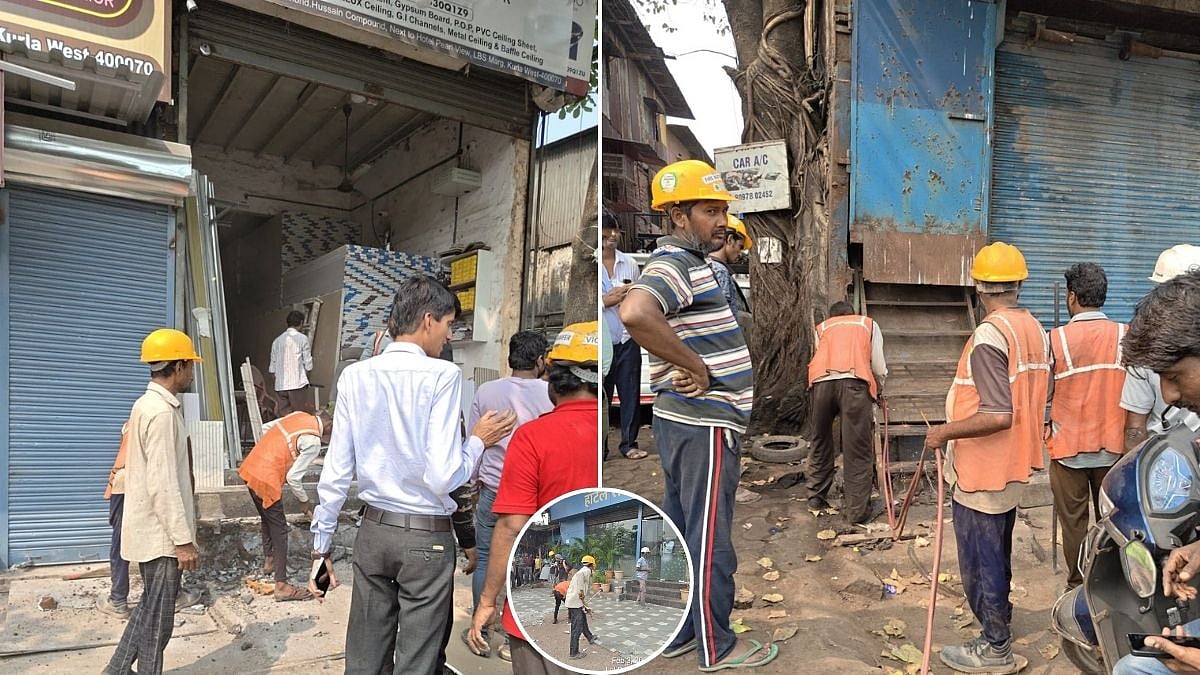
Mumbai’s civic administration has resumed enforcement drives against unauthorised hawkers and illegal extensions on footpaths across several neighbourhoods, signalling a shift in priorities following the completion of local body elections. While demolition and clearance actions have been reported in select areas, urban activists and resident groups argue that the response remains uneven, raising questions about consistency, accountability, and long-term urban management.
Over the past week, municipal teams have carried out targeted operations to remove illegal stalls and extensions that had occupied pedestrian spaces for years. Footpaths in parts of the western suburbs were temporarily cleared, restoring walkability and easing pressure on carriageways. However, civic observers say the gains are fragile, with encroachments often reappearing within days due to weak follow-up and limited deterrence. Urban mobility experts note that footpath encroachment is not merely a law-and-order issue but a systemic urban failure. In a city where walking forms a critical part of daily travel, blocked footpaths force pedestrians onto busy roads, increasing accident risk and disproportionately affecting senior citizens, women, children, and people with disabilities. The issue also has economic implications, slowing last-mile connectivity to public transport and affecting productivity in dense commercial districts.
Activist groups tracking civic enforcement say the intensity of action varies sharply across municipal wards. Some ward offices have launched regular inspections, while others appear inactive, allowing unauthorised structures to persist. This selective enforcement, they argue, undermines public confidence and encourages repeat violations by offenders who treat penalties as a cost of doing business. Adding to the complexity is the blurred line between licensed and unlicensed hawking. Even vendors holding municipal permits are alleged to be exceeding their designated pitches, extending stalls into walking zones and public roads. Urban planners point out that without strict spatial demarcation and digital monitoring of licensed pitches, enforcement becomes subjective and vulnerable to misuse.
Residents’ associations have also raised concerns over what they see as an imbalance in civic penalties. While fines for littering and minor civic offences have increased sharply in recent years, penalties imposed on repeat encroachers remain relatively low. Civic finance experts argue that stronger economic disincentives, including licence suspension and cancellation for habitual violators, are necessary to change behaviour. There are also persistent allegations of informal arrangements between enforcement staff and local hawkers in high-footfall areas, particularly near railway stations and commercial hubs. Such claims, if left unaddressed, risk eroding the credibility of the city’s hawkers’ policy, which was designed to balance livelihoods with pedestrian rights.
Senior civic officials acknowledge that implementation of the hawkers’ policy slowed during the election period and say renewed enforcement is expected now that the elected body is in place. Urban governance specialists stress that durable solutions will require coordinated action across departments, transparent enforcement data, and redesign of footpaths to clearly prioritise pedestrian movement. As Mumbai continues to densify, the management of public space will increasingly define the city’s liveability. Whether the current enforcement drive leads to lasting change will depend on consistency, fairness, and the willingness to align economic activity with people-first urban design.
Mumbai Civic Crackdown Targets Footpath Encroachments