


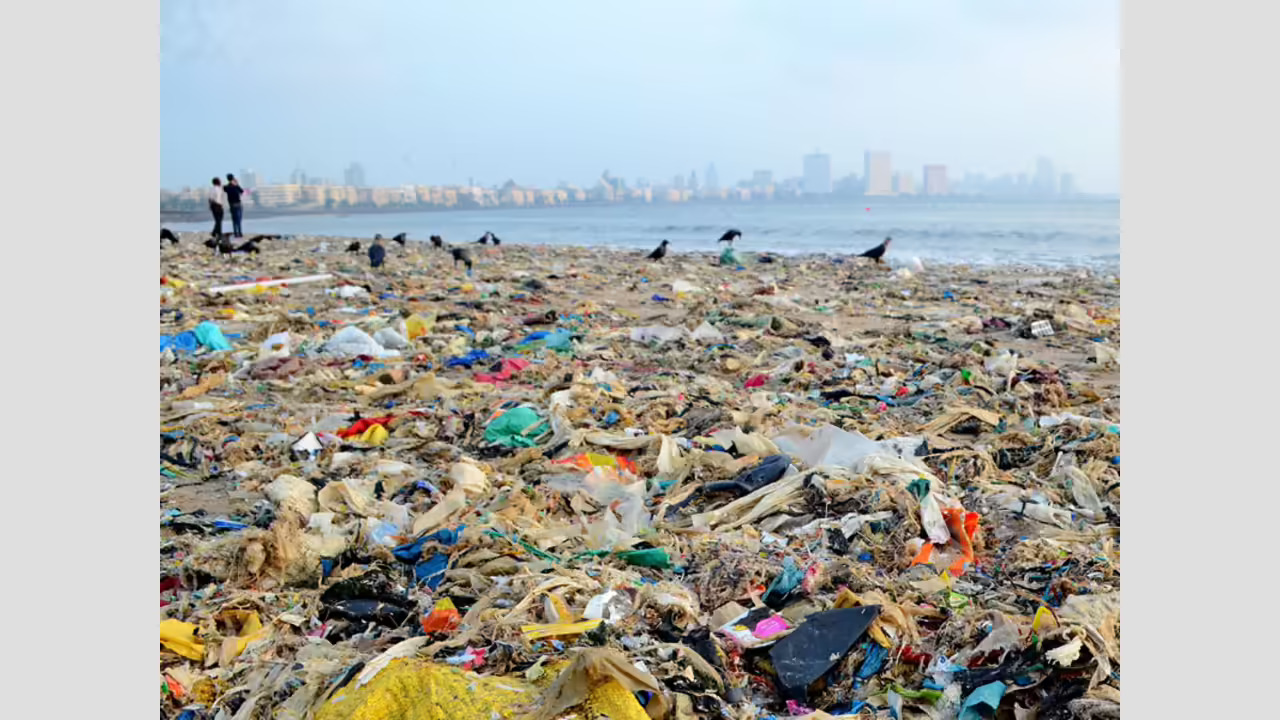
Mumbai has cleared more than 950 metric tons of waste from its beaches in just nine days, underscoring the scale of marine pollution that follows torrential rainfall. The Brihanmumbai Municipal Corporation (BMC) deployed 380 sanitation workers and six specialised machines to clean stretches of Girgaon, Dadar-Mahim, Juhu, Versova, Madh-Marve and Gorai beaches between 15 and 23 August.
Civic officials confirmed that the waste primarily comprised plastic debris, household garbage, and floating material carried through the city’s stormwater drains and rivers. With the Mithi river overflowing and nullahs inundated during the heavy showers, much of this waste was swept into the Arabian Sea, only to return to the coastline days later. The scale of the operation illustrates the recurring challenge Mumbai faces every monsoon. While the corporation has intensified clean-up drives whenever skies clear, officials acknowledge that waste management requires deeper systemic reforms. “Rainfall exposes the fragility of urban waste disposal, where non-segregated garbage enters drains and ends up in the sea,” an official from the solid waste management department said.
Among the beaches, Juhu recorded the highest accumulation, with 375 metric tons cleared, followed by Dadar-Mahim at 300 metric tons and Versova at 200 metric tons. Smaller beaches such as Girgaon, Madh-Marve and Gorai also recorded substantial deposits of 23, 34.5 and 20 metric tons respectively. These figures highlight the uneven distribution of waste accumulation, often influenced by tidal currents and proximity to densely populated neighbourhoods. Officials emphasised that while manpower and machinery help in emergency clearance, reducing marine litter demands behavioural change. The BMC recently concluded a city-wide cleanliness campaign across religious premises and historic maidans, and intends to extend the effort to public engagement on waste segregation, recycling, and reduced plastic usage.
Environmental experts argue that short-term clean-up drives, though essential, cannot alone ensure sustainable beaches. They advocate investments in decentralised waste processing, stormwater filtration systems and tighter monitoring of industrial effluents. “The health of Mumbai’s coastline is directly linked to the city’s resilience,” one environmentalist said. “Clean beaches not only prevent marine biodiversity loss but also improve public health and tourism potential.” The recurring challenge points towards the larger question of accountability—between government bodies, industries and citizens. While the BMC has delivered an impressive logistical exercise, experts insist that sustained waste reduction requires collective participation. With climate change intensifying rainfall patterns, the urgency to build a circular economy for waste in Mumbai has never been greater.
Also Read: Mumbai-Goa Highway Faces Severe Traffic Jams As Ganeshotsav Rush Intensifies Daily
