


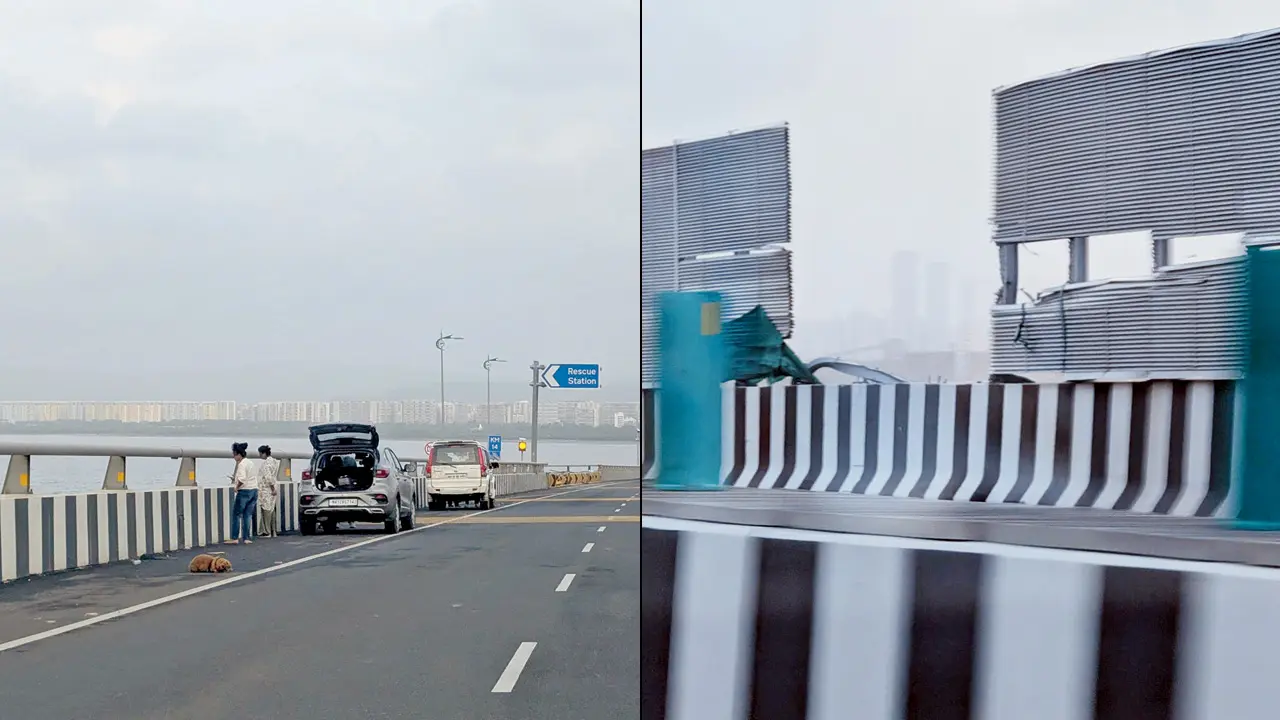
Mumbai’s marquee infrastructure project, the ₹17,843-crore Trans Harbour Link, is facing mounting scrutiny after a missing vision barrier panel and repeated illegal halting by motorists have raised serious safety concerns, with fresh signs of surface wear compounding worries over long-term durability and public security on the city’s longest sea bridge.
Officially known as the Atal Bihari Vajpayee Sewri-Nhava Sheva Atal Setu, the 21.8-km Mumbai Trans Harbour Link (MTHL) was opened to the public earlier this year amid high expectations for reducing congestion between Mumbai and Navi Mumbai. However, months into its launch, the bridge is drawing criticism for lapses in user behaviour enforcement and early signs of structural degradation. A key safety component—a vision barrier panel installed to minimise driver distraction and regulate visibility on high-speed stretches—has reportedly gone missing from one section of the bridge. The absence of this panel has become a hazard, as it encourages motorists to stop midway and photograph scenic views, violating traffic norms and increasing the risk of accidents.
Despite multiple signboards prohibiting stopping or parking along the bridge, motorists continue to pull over, often for selfies or group photos. Such behaviour has been widely observed and documented, including shortly after the bridge’s inauguration in January 2024. These unauthorised stops obstruct traffic and pose collision risks, especially in zones with fast-moving vehicles and limited shoulder space. A senior MMRDA official confirmed that the Mumbai Metropolitan Region Development Authority has received repeated alerts about vehicles halting on the bridge. Traffic police have reportedly issued numerous challans to violators, but enforcement remains difficult due to the limited surveillance coverage across the vast sea link. MMRDA officials, however, have not issued a formal comment on the latest structural concerns.
Transport analysts argue that missing infrastructure components, like barrier panels, must be treated as urgent maintenance priorities. Given the Atal Setu’s status as a flagship engineering project, such oversights raise questions about post-inauguration monitoring protocols and the robustness of ongoing inspections. Meanwhile, independent road safety advocates highlight that infrastructure alone cannot guarantee safe transit unless matched by consistent user behaviour and enforcement. They suggest the integration of advanced surveillance, sensor-based monitoring, and AI-enabled alert systems to detect unlawful halts or surface deterioration in real-time.
In June 2024, images showing cracks on the Ulwe approach road had gone viral, prompting criticism over the quality of construction and raising alarms about premature wear. While MMRDA had responded with patchwork repairs, the lack of transparency in maintenance timelines has continued to fuel public dissatisfaction. Civic groups have called for comprehensive audits of the bridge’s structural components, with an emphasis on long-term resilience and proactive maintenance. These recommendations include public awareness campaigns to discourage unauthorised halting, as well as redesigned rest bays at designated intervals outside the bridge corridor to cater to human needs without disrupting traffic.
Advocates also urge a broader urban mobility strategy that treats driver behaviour as part of the infrastructure system itself. Without robust education and enforcement, even world-class engineering can fall short in delivering safe, sustainable outcomes. As Mumbai positions itself as a global urban hub, its showcase projects such as the MTHL are expected to reflect both architectural excellence and public accountability. The bridge’s core purpose—to provide a seamless transit route between Sewri and Nhava—remains critical to regional decongestion and economic mobility. However, its success hinges not just on concrete and steel, but on coordinated planning, responsive maintenance, and public discipline.
In the absence of immediate rectification, civic risks on the MTHL may escalate. From missing safety panels to rising instances of selfie stops, the situation underlines a vital lesson in city-building: that infrastructure resilience must be supported by operational vigilance and behavioural change. Addressing these issues is no longer optional—it is imperative for the safety and credibility of Mumbai’s transport future.
Also Read : Madhya Pradesh Harpalpur Station Faces Severe Leakage
