


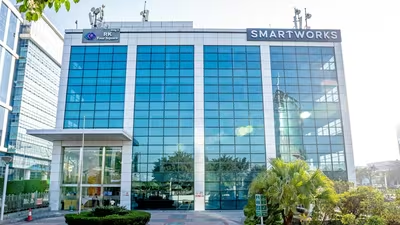
Mumbai’s managed office market has received a fresh boost with a major flexible workspace operator leasing nearly 1.82 lakh square feet in Andheri East, taking its total footprint in the city to around 2 million square feet. The expansion underscores sustained enterprise appetite for plug-and-play workspaces in transit-linked commercial districts.
The newly leased premises are located within a commercial complex near the MIDC business zone and Chhatrapati Shivaji Maharaj International Airport’s Terminal 2. Proximity to the Aqua Metro corridor and the Marol Naka interchange on Metro Line 1 enhances multimodal access an increasingly decisive factor for occupiers balancing commute times and talent retention. Andheri East has emerged as one of Mumbai’s most resilient office micro-markets. Its connectivity to the western suburbs, airport infrastructure and metro network makes it attractive for firms seeking decentralised work hubs outside the traditional Nariman Point and Lower Parel corridors. Real estate consultants note that flexible workspace operators are actively aggregating large floor plates in such locations to cater to enterprise clients requiring scalable, managed campuses. The company, which listed on Indian stock exchanges last year, follows a model of leasing bare-shell commercial buildings and converting them into fully serviced office environments. Amenities typically include food courts, wellness facilities and shared business infrastructure, allowing occupiers to reduce upfront capital expenditure while retaining operational flexibility.
Industry analysts say demand for managed office space has stabilised after pandemic-era disruptions, with larger corporates increasingly opting for flexible formats alongside conventional long-term leases. This hybrid strategy enables companies to manage headcount fluctuations, expand into new cities quickly and align workspace usage with evolving work patterns. In Mumbai, where commercial rents remain among the highest in the country, the managed office model provides cost predictability and operational convenience. At the same time, landlords benefit from steady absorption of large inventory blocks, particularly in Grade A buildings designed to meet modern compliance and sustainability norms. The broader office market in the Mumbai Metropolitan Region has also seen renewed traction in nodes such as Navi Mumbai and Thane, supported by metro extensions and road upgrades. Experts suggest that transit-oriented commercial development can help reduce congestion and lower commute-related emissions an important consideration for a city grappling with air quality and climate resilience challenges.
With its Mumbai portfolio now crossing the 2 million square foot mark, the operator is consolidating its presence in India’s financial capital. As enterprises recalibrate workplace strategies, managed office platforms are expected to remain central to the next phase of commercial real estate growth, particularly in infrastructure-linked micro-markets like Andheri East.
Also Read: Maharashtra real estate backs economy goal
Mumbai Andheri office leasing expands
