


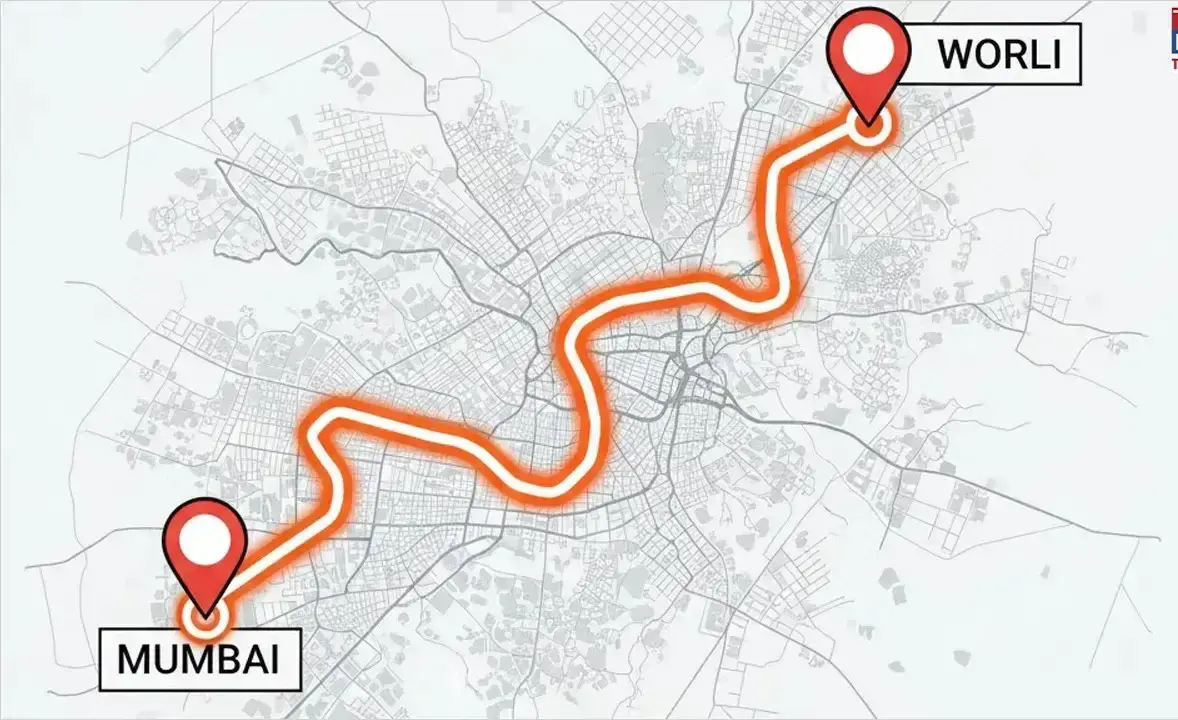
Mumbai is exploring one of its most ambitious urban mobility proposals yet, with the metropolitan planning authority preparing a Detailed Project Report (DPR) for a 70-kilometre underground tunnel road network designed to significantly cut travel time between key business districts, residential hubs, and the international airport. If implemented as envisioned, the corridor could reduce travel between Worli and the airport to roughly ten minutes—an improvement that stands to reshape daily commuting patterns and ease pressure on chronically congested arterial roads.
According to officials, the multi-phase corridor is being conceptualised as an expressway-grade underground system that would allow motorists to bypass surface-level traffic entirely. Phase I is expected to cover a 16-kilometre stretch linking the Worli Sea Link, Bandra-Kurla Complex (BKC), and the airport precinct. This spine would later integrate with additional tunnels proposed under the Coastal Road, the planned bullet train terminal at BKC, and the airport loop, forming a continuous network connecting major transport assets. Planners working on the DPR said the objective is not only to reduce travel time but also to distribute traffic more efficiently across the city’s road system. Mumbai’s north–south corridors—particularly the Western Express Highway (WEH) and SV Road—regularly operate beyond capacity, resulting in slow travel speeds and rising emissions from idling vehicles. The new tunnel network aims to reduce this load by shifting a section of daily traffic underground, potentially improving air quality and reducing noise in dense residential areas.
Environmental feasibility forms a key part of the DPR process. Officials noted that the study will examine geological conditions, construction impacts, and long-term sustainability considerations to ensure the network complies with climate-aligned infrastructure goals. Energy-efficient lighting, ventilation systems, and safety protocols are expected to feature prominently in the design. Experts said that global examples—from Tokyo to Oslo—show that well-designed tunnels can reduce surface congestion while supporting more equitable allocation of urban space for pedestrians, cyclists, and public transport. Urban mobility analysts believe the proposed network could strengthen multimodal integration by linking road tunnels with metro corridors, coastal infrastructure, and railway terminals. “The long-term value lies in creating seamless mobility between different modes rather than adding road capacity in isolation,” an urban transport expert explained. This integration, they noted, will be crucial as Mumbai continues expanding its metro network and realigns transport priorities towards lower-carbon choices.
While the tunnel project remains at the planning stage, stakeholders emphasise that its success will depend on transparent cost evaluations, clear environmental safeguards, and strong coordination across agencies. If executed responsibly, the network could support more efficient travel, cut emissions by reducing congestion, and provide a sustainable addition to the city’s broader mobility transformation. As the DPR progresses, the planning authority is expected to release further details on alignment, timelines, and phasing, paving the way for what could become one of Mumbai’s most significant transport interventions in decades.
Also Read: Mumbai Traffic Crawls On Coastal Road And Eastern Freeway Amid Major Congestion
