


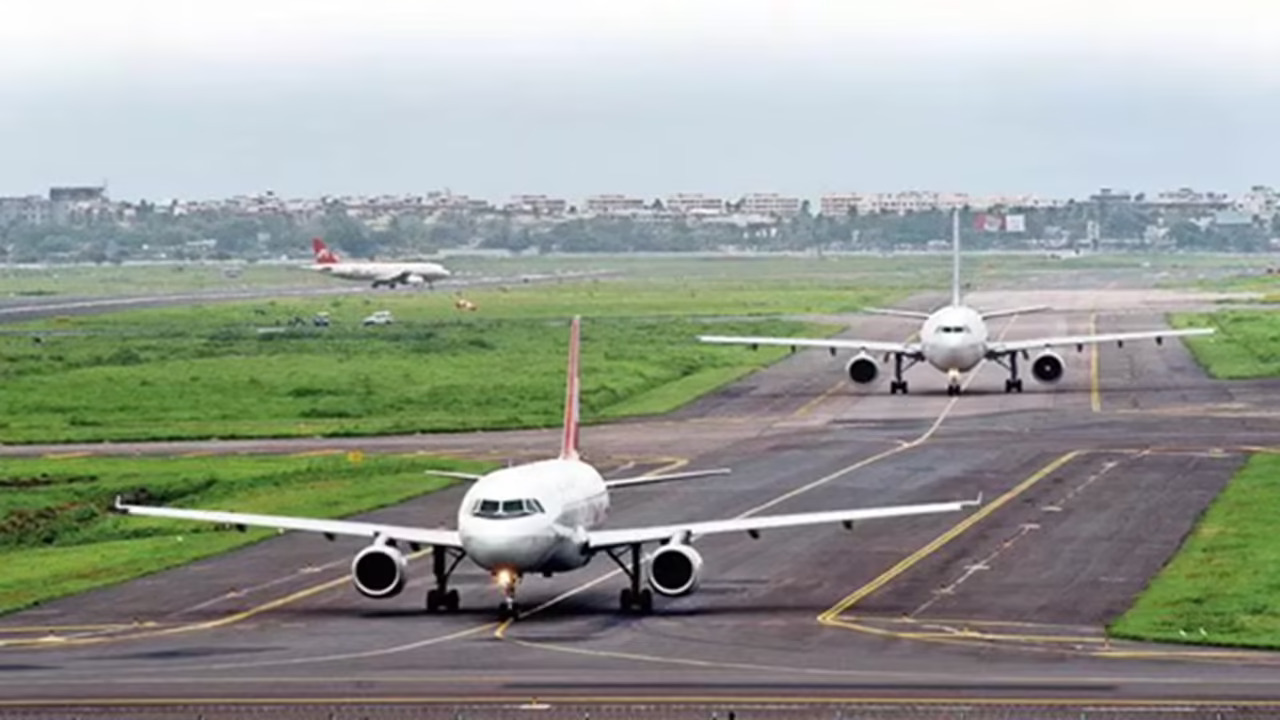
A flyer at Mumbai Airport triggered a major security scare after breaching a restricted area and sprinting across the runway in an attempt to board a flight he had already missed. The unauthorised access, which endangered lives and disrupted airport operations, has raised serious questions over passenger behaviour and security lapses at one of India’s busiest airports.
The incident took place on Thursday morning at Chhatrapati Shivaji Maharaj International Airport, when a 25-year-old man from Kalamboli, Navi Mumbai, reportedly arrived late for a scheduled Air India flight to Patna. After learning that the boarding gate had closed, the flyer forcefully accessed the restricted apron area, an airside zone meant exclusively for aircraft parking, taxiing, and authorised staff operations. Airport security personnel spotted the man running across the tarmac towards an aircraft that had recently arrived from Bhuj. Unaware that his intended flight had already taken off, he made a beeline toward the wrong aircraft, reportedly assuming it was still waiting for passengers. His sudden appearance on the airside triggered immediate concern, with Air India staff raising alarms and alerting the Central Industrial Security Force (CISF).
A CISF team detained the individual before he could reach the aircraft and handed him over to the Sahar police for interrogation. Initial statements from the flyer suggested that a coach ferrying passengers had mistakenly dropped him near the runway. However, officials later dismissed this explanation as false after verifying surveillance footage and ground staff logs, confirming that the man had accessed the area on foot through an emergency exit between gates 42 and 43. In a complaint registered by airline officials, it was stated that the flyer’s actions not only breached security but also posed a serious risk to flight operations. “Had there been a taxiing aircraft or a live runway clearance, this act could have led to a fatal accident,” said an airport operations official involved in the case.
The individual has been booked under multiple provisions of the Indian Penal Code and the Aircraft Act for endangering lives and unauthorised entry into a protected area. Legal experts noted that such breaches are treated with utmost seriousness under Indian aviation law, especially given international norms mandating rigorous safety procedures. “This is not simply a case of trespassing — it’s a breach of critical aviation infrastructure with national safety implications,” said an aviation law expert based in Mumbai. “There is a strong possibility that the flyer could face imprisonment and a ban on future air travel.”
Experts believe the incident reflects deeper systemic and behavioural challenges in India’s public transport culture. The habitual urgency that commuters experience in cities like Mumbai — often seen in last-minute sprints to catch local trains — may inadvertently shape irrational behaviour even in high-security zones such as airports. A behavioural sciences academic noted, “In cities where time is always slipping through the fingers of working-class citizens, there’s a tendency to force access rather than accept denial. This incident is a byproduct of a deeply embedded hustle culture, but one that must be consciously unlearned when entering controlled environments like airports.”
The case has prompted aviation authorities and terminal operators to initiate a security review of emergency access points and passenger guidance systems. While the prompt response of the CISF team prevented a greater crisis, the fact that a flyer could unlock and pass through an emergency gate undetected for several moments is being seen as a serious vulnerability. “There needs to be stricter digital locking mechanisms and real-time alerts for such exits,” said a former head of airport infrastructure at a private aviation consultancy. “Additionally, more comprehensive awareness among passengers regarding safety zones and prohibitions must be integrated into the airport experience, not just hidden in fine print on tickets.”
Meanwhile, airport management confirmed that no flights were delayed due to the incident, but operations were closely monitored for an hour following the breach. Additional patrolling was ordered on the apron to ensure there were no further disruptions or copycat attempts. Civil aviation stakeholders are now calling for enhanced on-ground surveillance, including smarter camera analytics, alarm-based gate controls, and AI-driven behaviour detection at terminals. “As India’s aviation industry scales to accommodate over 500 million flyers annually, security protocols must evolve alongside behavioural insights,” an official from the Bureau of Civil Aviation Security (BCAS) said.
While the incident did not result in any injuries or operational damage, it serves as a critical warning sign for India’s airport authorities, who are already grappling with increased passenger traffic, limited terminal space, and tighter security mandates. The broader question it raises is whether urban infrastructure and societal behaviour are evolving in sync with the complex demands of secure, sustainable, and smart mobility.Transport analysts have urged for the integration of behavioural training into aviation policy, suggesting that India’s flyers, particularly those from semi-urban and first-time flyer backgrounds, be educated on aviation norms through pre-flight video briefings, local language instructions, and simplified signage across terminals.
“There’s an underlying need to balance infrastructure expansion with behavioural maturity,” said a Mumbai-based urban policy researcher. “This isn’t just about safety, but about designing airports — and cities — where the citizen and the system cooperate in harmony.” The detained individual remains in custody as of the latest update, and investigations are ongoing. Authorities have not ruled out stricter penalties to set a precedent and deter similar violations in the future.
As India continues to pursue greener, smarter, and safer urban mobility, such incidents remind us that sustainable development must also be rooted in awareness, accountability, and civic discipline.
Also Read : Mumbai to Ease Rules for Housing Societies
