Mumbai Air Emergency: City Wakes to Toxic Air as Pollution Crisis Deepens
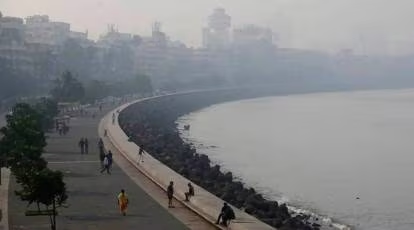
Data from monitoring platforms showed an early-morning citywide AQI of 226—categorised as unhealthy and significantly higher than the moderate readings seen in early November. Environmental researchers noted that the recent spell of heavy rainfall had temporarily purified the air by flushing out suspended pollutants, but the improvement was short-lived.With dry weather returning, the concentration of fine particulate matter has risen quickly, reducing visibility and prompting many residents to report irritation in their eyes and throat. The worst conditions were recorded in the eastern and central pockets. Wadala’s truck terminal logged AQI levels close to 400, placing it in the hazardous range. Locations such as Colaba, Malad, Sion and the Bandra-Kurla Complex also touched severe to unhealthy readings. A senior official at a city pollution control centre described the trend as “expected but worrying”, pointing out that winter-transition weeks typically trap pollutants close to the ground due to low wind speeds and temperature inversion.
Western suburbs fared marginally better but remained far from safe thresholds. Measurements from Kandivali East, Borivali East, Jogeshwari and Powai fell into the poor bracket, illustrating that the haze was widespread rather than localised. Experts attribute this gradient to a mix of factors: construction dust, traffic emissions, stagnant winds, and the city’s dense built fabric, which restricts dispersion. Meteorologists from the India Meteorological Department forecast daytime temperatures near 33°C and early-morning lows around 20°C—conditions that add a nip to the air but also facilitate the formation of smog. While skies are expected to remain clear, the lingering haze indicates that pollutant levels have surpassed the atmosphere’s ability to disperse them.
Health professionals caution that PM2.5 concentrations of this magnitude increase risks for vulnerable groups, including children, the elderly and those with asthma. Environmental planners argue that the recurrence of poor air quality underscores the need for sustained investments in greener mobility, cleaner construction practices and more open public spaces that enhance urban ventilation. As one urban sustainability expert observed, “A city cannot rely on rainfall to reset its air. Structural change is the only long-term solution.”
While pollution levels are likely to fluctuate through the week depending on wind patterns, authorities advise citizens to limit outdoor exertion during early morning and late evening hours. The episode serves as another reminder of Mumbai’s environmental fragility—and the urgent need for coordinated action that balances growth with breathable air.