


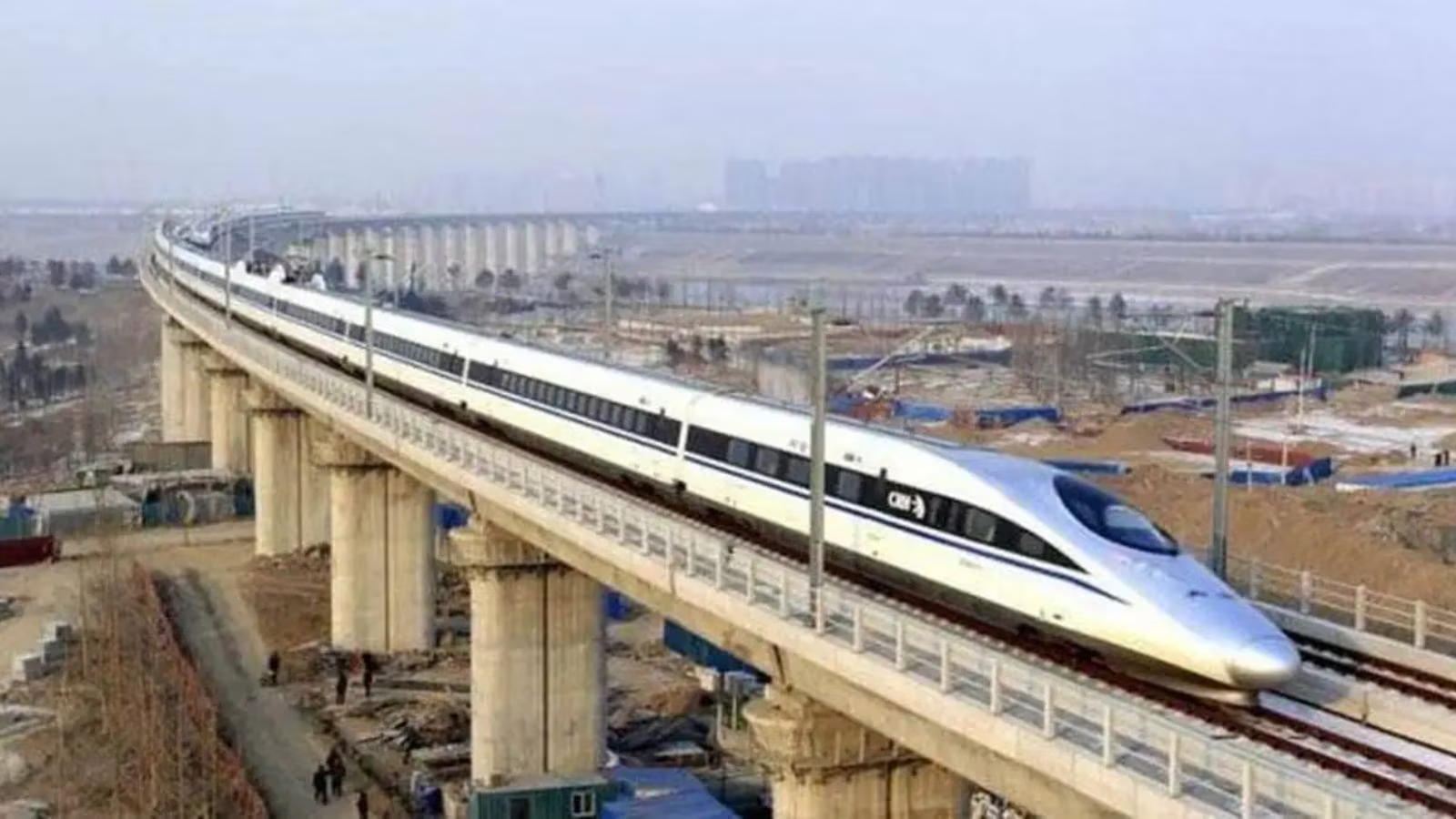
India’s high-speed rail ambitions achieved a significant milestone with the successful completion of a 1.5-kilometre mountain tunnel along the Mumbai-Ahmedabad corridor in Maharashtra’s Palghar district. The tunnel, located between Virar and Boisar stations, represents a critical step in India’s effort to introduce bullet train connectivity between two of its most economically dynamic cities, promising travel times of under two hours once operational.
This tunnel is the second completed underground section in Maharashtra, following a 5-kilometre tunnel between Thane and BKC, and forms part of a broader strategy to overcome challenging topography along the 508-kilometre corridor. The high-speed rail line is being designed for trains operating at speeds of up to 320 km/h, with provisions for future technology upgrades capable of 360 km/h, reflecting a forward-looking approach to infrastructure planning. Railway experts note that the corridor will enhance regional integration across Maharashtra, Gujarat, and the union territory of Dadra and Nagar Haveli, linking key commercial and urban centres including Sabarmati, Ahmedabad, Anand, Vadodara, Bharuch, Surat, Bilimora, Vapi, Boisar, Virar, Thane, and Mumbai. The inclusion of multiple mountain tunnels seven in Maharashtra and one in Gujarat illustrates the project’s commitment to navigating complex terrain while maintaining high operational efficiency. The project’s design also underscores sustainability objectives. By offering a high-capacity, low-emission alternative to road and air travel, the Mumbai-Ahmedabad corridor is expected to reduce congestion on highways, lower carbon emissions, and provide a cleaner transport option for millions of daily commuters and travellers.
Urban planners suggest that such investments in rail infrastructure can have wider socioeconomic benefits, including more balanced regional development and enhanced connectivity for smaller urban centres along the route. Employment generation is another key outcome. During construction, thousands of jobs were created, and operational phases are expected to continue supporting local economies through tourism, business travel, and ancillary services. Experts highlight that improved mobility can catalyse regional economic clusters by easing access to commercial hubs and facilitating faster movement of goods and people. The Mumbai-Ahmedabad High-Speed Rail project also integrates advanced safety and operational systems. The tunnel breakthrough contributes to a cumulative total of eight mountain tunnels planned along the corridor, with the overall underground network spanning over 21 kilometres and surface tunnels adding an additional 6.4 kilometres. These design features aim to ensure seamless travel through varied terrain while accommodating future technological upgrades.
As India moves closer to operationalising its first high-speed rail corridor, the Palghar tunnel milestone signals progress toward transforming intercity travel in the country. Analysts suggest that upon completion, expected in 2027 for the first phase, the corridor will set a benchmark for sustainable, high-speed, and technologically advanced rail transport in India, enhancing both regional connectivity and economic growth.
Also Read: Patna Rail Infrastructure Modernisation Targets Passenger Growth
Mumbai Ahmedabad Bullet Train Tunnel Breakthrough Achieved
