


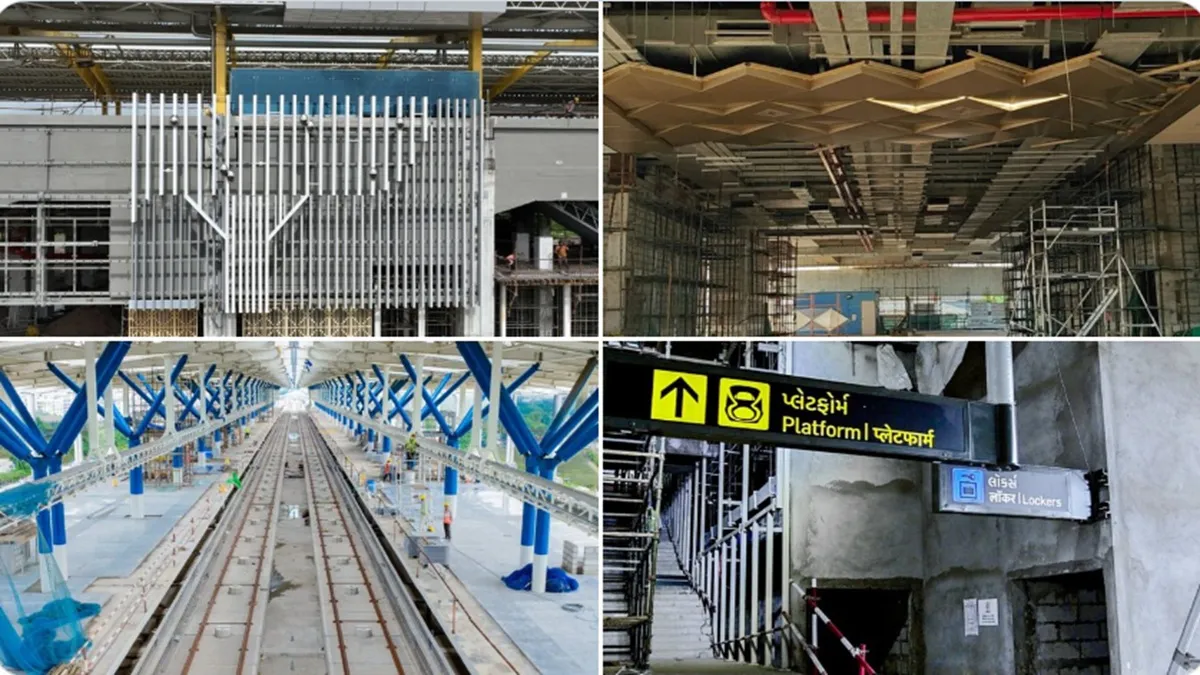
India’s most ambitious infrastructure undertaking, the Mumbai-Ahmedabad High-Speed Rail (MAHSR) corridor, has entered a new phase as visuals of its first bullet train stations surfaced this week. The project is being seen as more than just a transport milestone it is an emblem of modern engineering designed to integrate sustainability, regional aesthetics, and equitable connectivity across states.
The MAHSR project, stretching 508 kilometres, is backed by advanced Japanese technology and significant financial support. With an estimated cost of over ₹1 lakh crore, the project is not merely an answer to India’s mobility demands but a blueprint for green infrastructure. Recent images of under-construction stations reflect sleek architecture infused with regional identity, complemented by solar power installations and rainwater harvesting systems. Experts say these features are a conscious effort to balance economic progress with ecological responsibility.
Also Watch: An Exclusive Interview with Sanjeev Jaiswal (IAS), CEO MHADA
The latest updates highlight remarkable progress in construction. Nearly 393 kilometres of piers, 311 kilometres of girder launching, and 333 kilometres of girder casting have been achieved. Over 127 kilometres of viaducts have already been handed over to contractors for track laying. The Gujarat tunnel has reached completion, while Maharashtra has recorded major progress on the 21-kilometre underground section, including a seven-kilometre stretch beneath the Arabian Sea. Officials suggest that trial runs on the Surat section are expected within the next year, with the Gujarat corridor projected to be operational by 2027 and the full line by 2029.The stations themselves are intended to reflect the culture and spirit of their locations. From Surat’s diamond-inspired design to Ahmedabad’s urban heritage motifs, the architectural approach marries modern speed with a distinct sense of place. Beyond aesthetics, the integration of renewable energy and water conservation is central to the project’s green vision, ensuring that India’s first bullet train corridor also sets a precedent for sustainable transit.
Economists argue that the Mumbai-Ahmedabad corridor is more than a mobility project—it is an economic catalyst. By reducing travel time between two of India’s most significant financial hubs, the line is expected to boost regional investment, expand employment, and transform the industrial corridor into a unified economic ecosystem. This connectivity will serve not just corporate travellers but also small and medium enterprises looking for access to new markets.Sustainability experts caution that while the financial and environmental investments are promising, India’s transport future must ensure inclusivity. For the bullet train to be a symbol of progress, accessibility for diverse income groups, gender-neutral facilities, and safe urban integration must remain at the forefront. The project is already shaping up as a test case for how India can build equitable, climate-conscious infrastructure without compromising on growth.As construction accelerates and visuals inspire public curiosity, the Mumbai-Ahmedabad bullet train is steadily transforming from vision to reality. For India, it signals not just the arrival of high-speed mobility but the possibility of building cities and corridors where speed, sustainability, and society move forward together.
