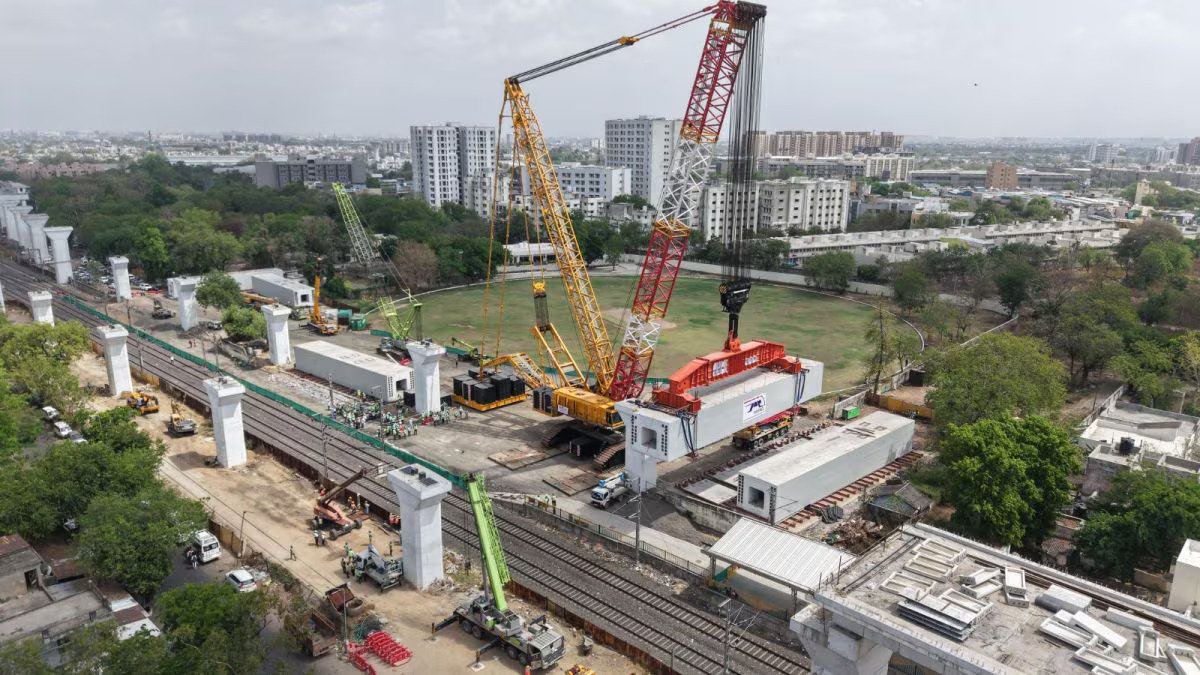
India’s flagship high-speed rail corridor has marked a significant engineering milestone, with project authorities completing the installation of one of the heaviest structural components in a sharply reduced timeframe. The development on the Mumbai Ahmedabad Bullet Train underscores both the scale and technical complexity of the country’s first bullet train project, while signalling growing execution efficiency in large infrastructure works.
The recent operation involved positioning a massive precast structural beam over an active railway section in Gujarat, a task that typically requires extended traffic blocks and prolonged safety windows. However, project engineers managed to complete the lifting and placement process within a few hours, significantly compressing earlier timelines that often stretched across multiple phases of restricted rail operations. This achievement reflects a shift towards precision-led construction practices, where planning, equipment coordination, and risk mitigation are tightly synchronised. The girder, weighing well over a thousand metric tonnes, was installed using high-capacity cranes and specialised lifting systems designed to handle extreme loads while maintaining structural integrity and operational safety.
Officials associated with the project indicate that such accelerated execution is critical for minimising disruption to existing rail services, particularly on busy corridors that cannot afford prolonged shutdowns. By reducing the duration of line blocks, infrastructure agencies can maintain continuity in passenger and freight movement, an important consideration in high-density transport networks. The broader implications extend beyond construction timelines. Experts in urban mobility and infrastructure suggest that such engineering advancements are essential for scaling up high-speed rail projects in India, where land constraints, operational dependencies, and cost considerations often pose challenges. Efficient construction methodologies can help contain project costs while improving delivery schedules, both of which are crucial for investor confidence and long-term viability.
Spanning over 500 kilometres and connecting major economic centres, the high-speed rail corridor is expected to reshape regional connectivity between Mumbai and Ahmedabad. Once operational, it is projected to reduce travel time significantly, offering a low-emission alternative to short-haul aviation and road transport. This aligns with broader climate goals by promoting energy-efficient mass transit solutions. At a technical level, the use of precast components and modular construction is increasingly being adopted to enhance quality control and speed. These methods also reduce on-site environmental impact by limiting prolonged construction activity in densely populated or ecologically sensitive areas.
While the project continues to face challenges typical of mega infrastructure developments, including land acquisition and coordination across jurisdictions, milestones such as this indicate steady progress. They also demonstrate how engineering innovation is being leveraged to overcome logistical constraints in one of India’s most ambitious transport initiatives. As construction advances, the focus will remain on maintaining safety standards while sustaining execution momentum. The ability to deliver complex tasks within compressed timelines could set new benchmarks for future infrastructure projects across the country.
Mumbai Ahmedabad Bullet Train Records Fastest Girder Installation