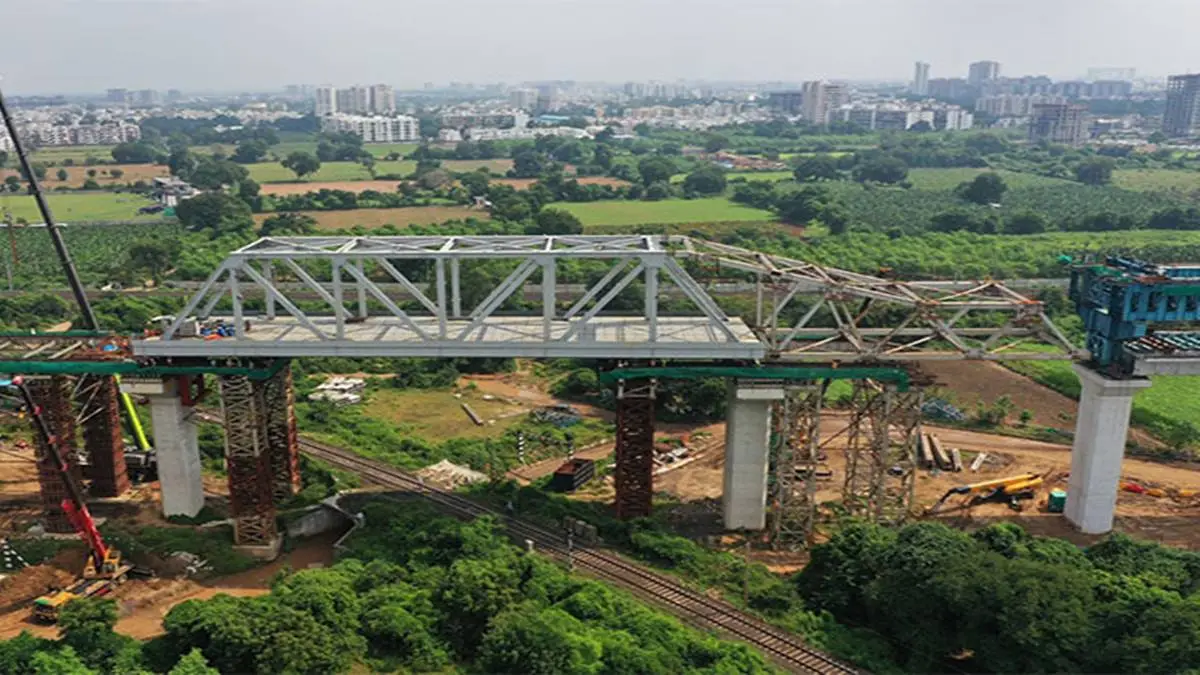
The National High-Speed Rail Corporation Limited (NHSRCL) successfully launched a 70-metre long steel bridge near Vadodara, Gujarat, marking a key milestone in the ambitious high-speed rail corridor.
The installation of this bridge, which is part of the broader infrastructure needed to support the high-speed rail line, highlights the steady progress of the project, despite challenges posed by logistics and operational complexities. This bridge, weighing 674 metric tonnes and measuring 13 metres in height and 14 metres in width, was fabricated at a workshop in Durgapur, West Bengal, and then transported to its site using specialised trailers. The installation process, which took place on a Tuesday, involved the use of cutting-edge technology and careful coordination to ensure minimal disruption to nearby freight operations. The operation was completed within a span of just 12 hours, with intermittent traffic blocks on the tracks of the Dedicated Freight Corridor Corporation of India Limited (DFCCIL), which were strategically implemented to maintain safety and precision during the launch.
The successful launch of this steel bridge is the seventh completed in Gujarat, part of a larger plan to construct 28 such steel bridges along the entire Mumbai-Ahmedabad corridor. These bridges will support the high-speed rail project that aims to revolutionise travel between Mumbai and Ahmedabad, significantly reducing travel time between the two major cities. According to an official from the NHSRCL, the bridge installation process required meticulous planning and the use of sophisticated engineering techniques. The steel bridge was assembled on temporary trestles at a height of 18 metres above the ground before being launched into position using an automatic mechanism. This mechanism consisted of two semi-automatic jacks, each capable of lifting up to 250 tonnes, and mac-alloy bars for enhanced stability and safety. The process was carried out with an emphasis on precision and ensuring the structural integrity of the bridge over the long term.
The bridge’s construction involved the use of approximately 28,800 high-strength bolts, specifically designed for the demanding requirements of high-speed rail operations. To protect against corrosion and ensure durability, a C5 system protective painting process was applied to the steel structure, while elastomeric bearings were used to facilitate load distribution and enhance the longevity of the bridge. Experts have indicated that these materials and designs have been specifically selected to ensure a lifespan of over 100 years, reinforcing the commitment to building sustainable and future-proof infrastructure. This bridge installation marks an important moment in the project, as it brings the Mumbai-Ahmedabad bullet train one step closer to realisation. The entire high-speed rail corridor will rely on a combination of advanced technologies, high-strength materials, and expert engineering to ensure that it can support the speeds and operational demands of the bullet train system.
The project itself is a flagship initiative under the Indian government’s vision for improving infrastructure and modernising the country’s transport networks. The Mumbai-Ahmedabad high-speed rail corridor is set to be one of the fastest rail routes in India, with trains expected to reach speeds of up to 320 kilometres per hour. Once operational, the bullet train will cut travel time between Mumbai and Ahmedabad from over seven hours to under three, offering a seamless and efficient mode of transportation. With 28 steel bridges planned across Gujarat, this project is set to leave a lasting legacy on the state’s infrastructure. Each bridge plays a crucial role in ensuring that the high-speed rail system can function smoothly, while also serving as a symbol of India’s ambitious push to modernise its transport infrastructure. The successful installation of these bridges also reflects the project’s focus on employing state-of-the-art engineering techniques and adhering to the highest standards of safety and sustainability.
Beyond the immediate construction milestones, the Mumbai-Ahmedabad bullet train project has the potential to reshape India’s transport ecosystem. The project is expected to reduce carbon emissions, promote economic growth, and improve connectivity across the country. Furthermore, it will provide a blueprint for future high-speed rail projects in India, aligning with the country’s broader goals of enhancing sustainable, low-carbon transportation systems. The installation of the steel bridge is a notable achievement in the ongoing development of the Mumbai-Ahmedabad bullet train corridor, and it demonstrates the capability of Indian engineers and planners to execute large-scale infrastructure projects with precision and efficiency. As work continues, officials remain confident that the project will meet its projected timeline for completion, with the high-speed rail network expected to be operational in the coming years.
The success of this steel bridge installation exemplifies the hard work and collaboration among engineers, government officials, and contractors, all working towards a common goal: to create an advanced, sustainable, and efficient transport system for India’s future.
Mumbai Ahmedabad Bullet Train Project Advances with New Steel Bridge