


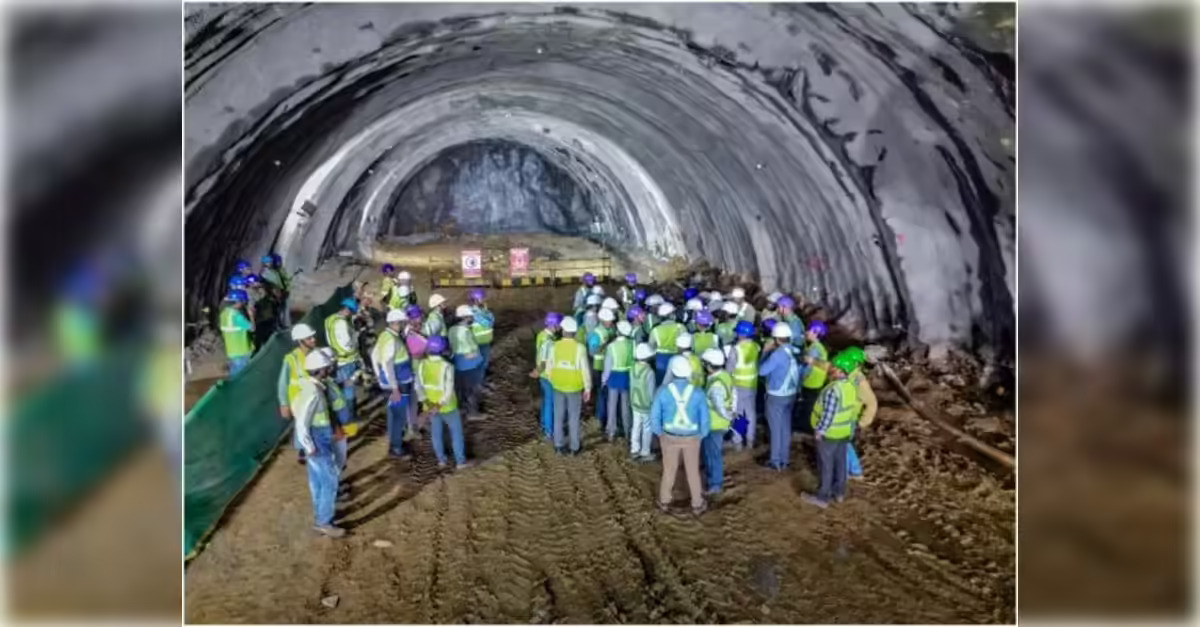
The Mumbai-Ahmedabad high-speed rail (MAHSR) corridor marked a significant engineering milestone on 20 September with the successful completion of a 4.88 km undersea tunnel connecting Ghansoli and Shilphata in Maharashtra. This tunnel is part of the planned 21 km stretch between Bandra-Kurla Complex (BKC) in Mumbai and Shilphata, representing a critical segment of India’s first undersea rail passage.
Railway officials explained that excavation proceeded simultaneously from both Ghansoli and Shilphata ends, navigating complex underwater conditions, variable soil layers, and confined spaces. The breakthrough was achieved when the two tunnel sections seamlessly joined, signifying a key accomplishment for the Mumbai-Ahmedabad bullet train corridor. Experts noted that such precision work under challenging creek conditions demonstrates the growing technical capabilities of Indian infrastructure projects. Officials highlighted that this undersea tunnel is integral to reducing travel time between Mumbai and Ahmedabad to just 2 hours and 7 minutes. Beyond faster travel, the project is expected to strengthen connectivity between major economic hubs, stimulate regional commerce, and facilitate knowledge transfer between business and technology centres along the corridor.
The project is also closely aligned with India’s sustainability and green transport objectives. By providing an energy-efficient high-speed alternative to conventional road and rail travel, the bullet train is expected to reduce carbon emissions and congestion across the Mumbai-Ahmedabad corridor. Analysts point out that large-scale infrastructure projects like MAHSR serve as a model for eco-friendly, gender-neutral, and equitable urban mobility solutions. In addition to engineering updates, railway officials met with a Japanese delegation to review the progress and explore the deployment of Japan’s advanced E10 Shinkansen technology on the corridor. Experts emphasised that the Shinkansen system, designed exclusively for the high-speed bullet train line, will operate separately from existing Vande Bharat trains, ensuring operational safety and efficiency.
The first operational segment, between Surat and Bilimora, is scheduled to commence in 2027, further underlining the project’s phased approach to transforming long-distance rail travel in western India. Officials also confirmed that ongoing construction and tunnel completion will adhere to international safety standards, climate resilience guidelines, and sustainable engineering practices. The undersea tunnel breakthrough not only signifies an infrastructural achievement but also positions India among nations capable of executing technically sophisticated high-speed rail projects. Experts suggest that the successful integration of advanced tunnelling technology, project management, and international collaboration underscores the country’s readiness to implement large-scale, sustainable transport solutions.
Also Read : Chennai Launches First App Integrating Metro Bus And Auto Travel
