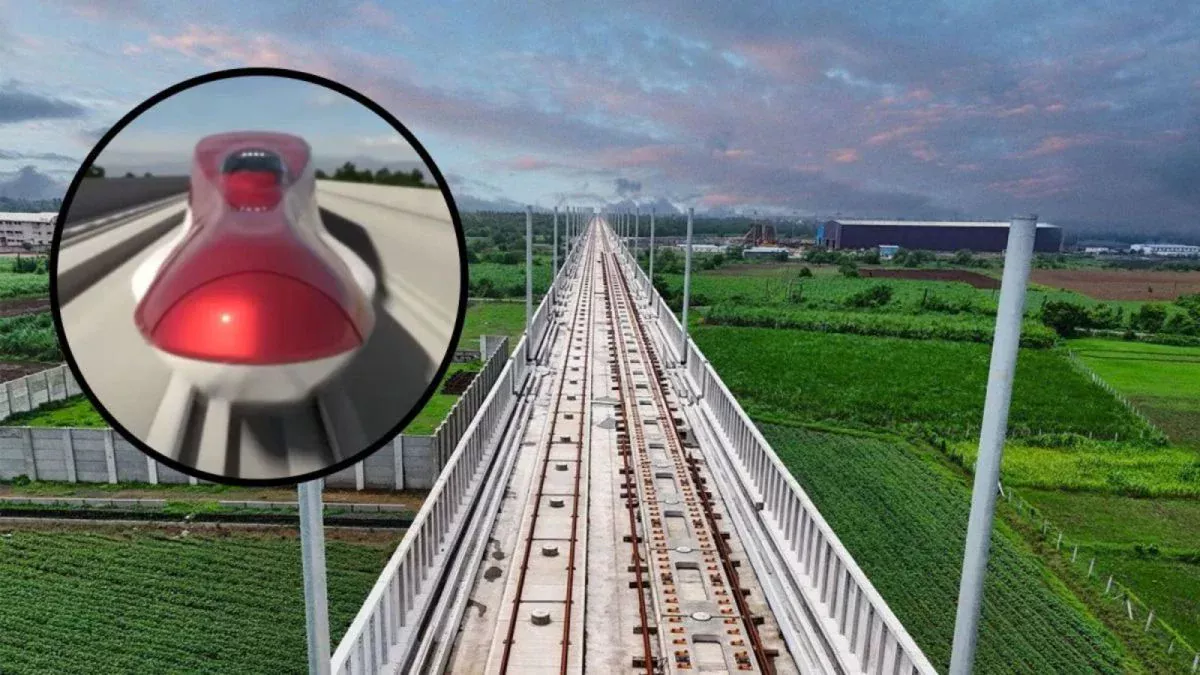
Construction of India’s first high-speed rail line connecting Mumbai and Ahmedabad has moved beyond the halfway stage, marking a significant milestone in the country’s most ambitious rail infrastructure project. Official monitoring data shows that work on the 508-kilometre Mumbai Ahmedabad bullet train corridor has reached more than 57 percent physical completion, indicating accelerating progress after years of planning, land acquisition and early construction hurdles.
The high-speed rail project, which runs across Maharashtra and Gujarat, is being tracked under the central government’s infrastructure monitoring system that evaluates large public investments. Financial data indicates that expenditure on the corridor has already crossed ₹86,000 crore, reflecting the scale of engineering, land development and civil construction underway across multiple sections of the route. The Mumbai Ahmedabad bullet train corridor is designed to transform intercity mobility between two of India’s most important economic regions. Once operational, the line will dramatically reduce travel time between the financial capital and Gujarat’s largest city, creating a new model for high-capacity, low-emission transport in the country. High-speed trains on the corridor are expected to operate at speeds approaching 320 kilometres per hour.
Transport planners say the project represents more than a technological upgrade to India’s railway system. High-speed rail corridors have the potential to reshape regional economies by enabling faster movement of people, strengthening business connectivity and encouraging balanced urban growth between major metropolitan centres and smaller cities along the route.
The project’s construction strategy involves opening the corridor in phases. Initial operational sections are expected to emerge in Gujarat before the full Mumbai connection becomes functional in the final stage of development. Authorities have indicated that a shorter stretch between two cities in south Gujarat could host the first trial passenger service once track and station infrastructure are ready.
Engineers working on the project say construction activity is currently focused on large civil works including viaducts, tunnels, station buildings and track foundations. One of the most technically challenging components is the undersea tunnel planned near Mumbai, which will allow the high-speed rail line to enter the city’s dense urban landscape while minimising disruption to existing infrastructure. Urban development specialists view the Mumbai Ahmedabad bullet train corridor as a test case for how India integrates advanced rail technology into its broader mobility strategy. High-speed rail can potentially shift passengers away from short-haul flights and long highway journeys, contributing to lower transport emissions while supporting more sustainable regional travel patterns.
Real estate analysts also note that cities located along the corridor could witness new economic activity around future stations. Transit-oriented development where housing, offices and services cluster around major transport nodes has been widely used in other countries with high-speed rail systems to promote compact and efficient urban growth.
However, the project continues to face financial scrutiny as cost estimates evolve during construction. Infrastructure economists point out that projects of this scale often undergo revisions due to complex engineering requirements, land acquisition costs and technology integration. Even with these challenges, the progress recorded so far suggests that India’s first high-speed rail corridor is steadily moving toward operational reality. As construction advances over the coming years, the Mumbai Ahmedabad bullet train is expected to play a defining role in shaping the next phase of intercity transport infrastructure in western India.
Mumbai Ahmedabad Bullet Train Progress Passes Halfway Stage