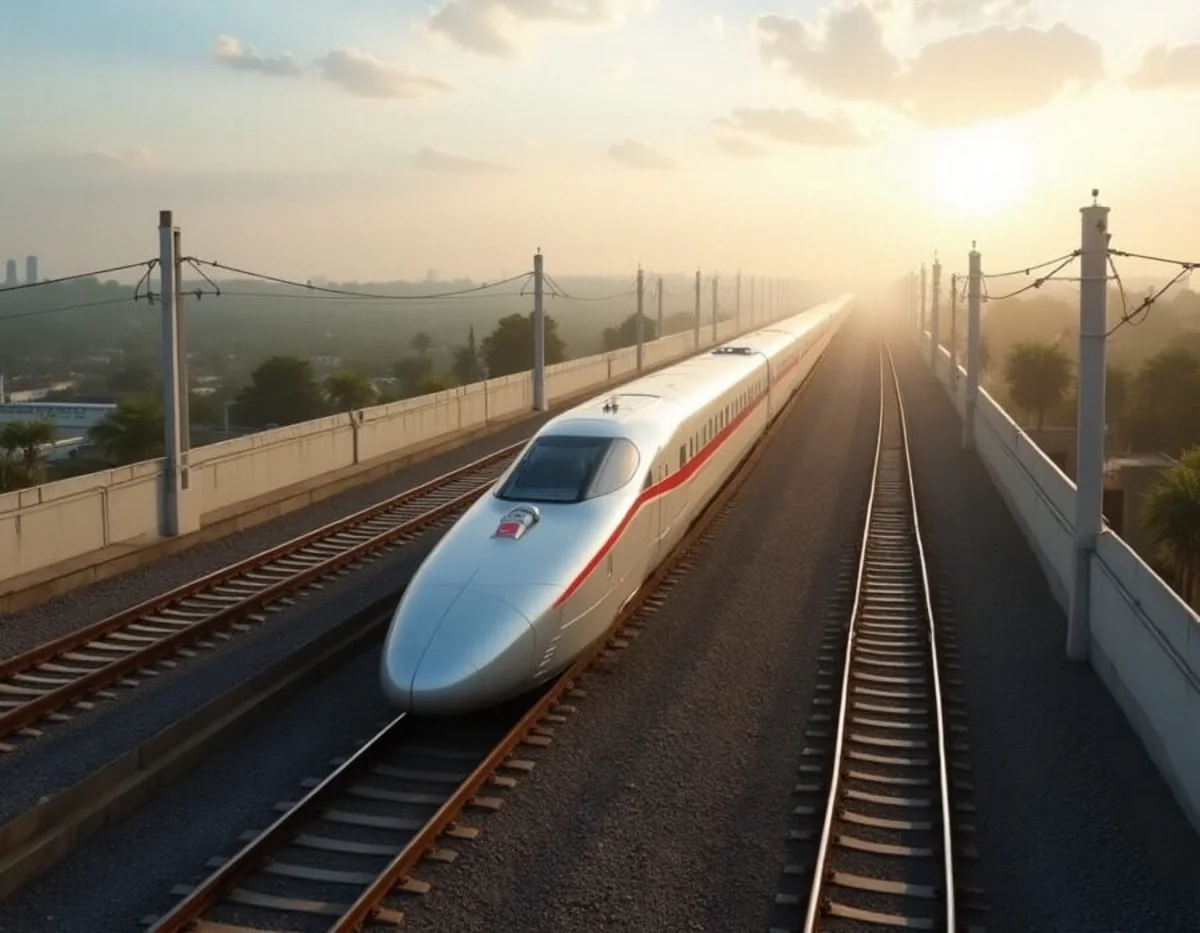
India’s first high-speed rail corridor between Mumbai and Ahmedabad is emerging as more than a transport project; it is becoming a testbed for domestic engineering capability, advanced rail technology and long-term infrastructure planning. Railway officials have confirmed that the 508-km Mumbai Ahmedabad Bullet Train corridor is progressing across Gujarat and Maharashtra, with construction activity accelerating after land acquisition hurdles were resolved.
The Mumbai Ahmedabad Bullet Train project, developed with technical and financial collaboration from Japan, is fully land-secured and backed by statutory clearances. Civil works are advancing at varying speeds across states. In Gujarat, foundations and piers have been completed across large stretches, with significant progress in girder casting, launching and track bed construction. In Maharashtra, structural works are advancing, including the complex underground section at Bandra Kurla Complex and the under-sea tunnel segment, where tunnelling activity has begun and partial stretches are already complete.
Out of the 12 planned stations, foundational work has been completed at most locations in Gujarat, while key stations in Maharashtra remain under construction. Seventeen river bridges are finished, and major crossings over large rivers are in advanced stages. Depots at Thane, Surat and Sabarmati are also under development to support operations and maintenance. Beyond physical construction, the Mumbai Ahmedabad Bullet Train initiative is catalysing technology transfer and skill creation. Long-span steel truss girders are now being fabricated domestically. Heavy machinery for launching full-span viaduct sections has been indigenised. Slab track materials and specialised track equipment are increasingly sourced from Indian manufacturers. Railway engineers, supported by academic institutions, are developing dynamic analysis tools and advanced simulation models to design traction power systems and overhead equipment.
Approximately a thousand engineers and skilled workers have undergone training in Japanese high-speed rail methodologies, and a dedicated track training facility has been established in Surat. Sector analysts say this capacity building could reduce reliance on imported expertise as India considers additional high-speed corridors. Safety design remains central to the corridor’s engineering philosophy. Structures are being built to withstand seismic activity, with dampers and stoppers integrated into viaducts. An earthquake early warning system is planned, while operational areas will incorporate high-level surveillance and access control. Stations are designed with anti-vibration measures and energy-efficient features aligned with green building benchmarks, reinforcing the role of rail in low-carbon mobility transitions.
Financially, expenditure on the Mumbai Ahmedabad Bullet Train has crossed ₹86,000 crore. Officials indicate that long-term viability assessments consider projected passenger demand, regional economic integration and travel time savings. Ticket pricing is expected to remain competitive with air and premium rail services. Parallel investments in Dedicated Freight Corridors have already demonstrated how segregated rail infrastructure can free up capacity on conventional lines. Urban economists suggest that if high-speed rail corridors are integrated with city master plans and multimodal networks, they can reshape regional growth patterns while reducing aviation-linked emissions.
As India evaluates future high-speed alignments, the Mumbai Ahmedabad Bullet Train corridor may serve as the operational blueprint testing not just engineering ambition, but the country’s readiness to embed speed, safety and sustainability into its transport future.
Mumbai Ahmedabad Bullet Train Builds Capability