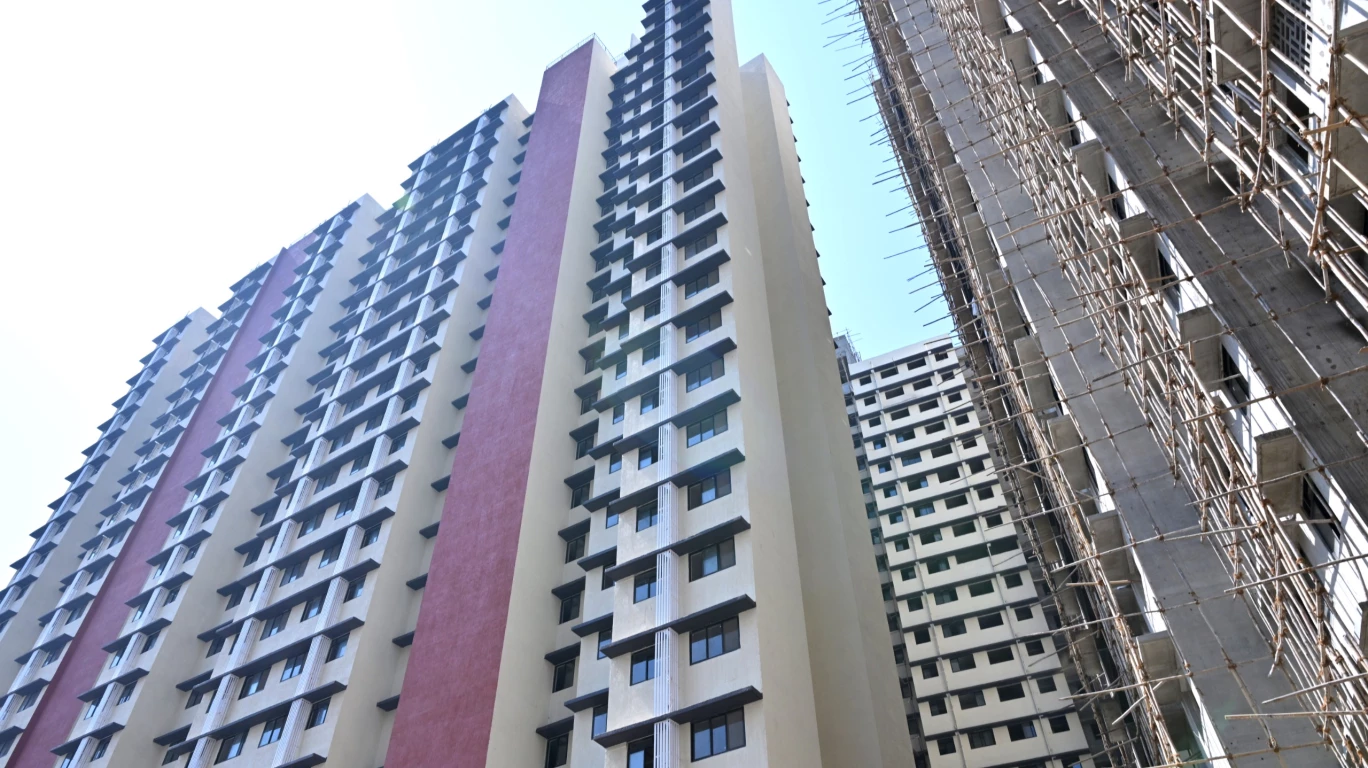
Authorities in Mumbai have accelerated construction of a large rehabilitation housing complex in Kanjurmarg West intended for families affected by the Goregaon–Mulund Link Road (GMLR) project, a critical east–west connectivity corridor under development in the city. The housing initiative is designed to ensure that residents displaced by the infrastructure project are relocated to permanent homes before major tunnelling work begins on the road corridor.
Civic officials overseeing the project say the residential development will include more than 900 apartments spread across seven high-rise buildings on a site of approximately 10,000 square metres. Each structure is being developed with a ground floor and more than twenty upper levels, forming part of a planned rehabilitation precinct that will accommodate households relocated from areas impacted by the GMLR alignment. The apartments being constructed under the GMLR rehabilitation housing programme are designed as compact urban homes, each measuring roughly 300 square feet. The layouts include a living space, bedroom, kitchen and private sanitation facilities, reflecting a standard rehabilitation housing model commonly used for infrastructure-linked resettlement projects in Mumbai.
Urban planners say such rehabilitation housing is increasingly central to large-scale infrastructure development in dense cities. Projects like the Goregaon–Mulund Link Road require land in built-up neighbourhoods, making planned resettlement essential to balance urban expansion with social equity. Ensuring affected families are moved to safe, serviced housing helps reduce disruptions while enabling critical transport projects to progress. Municipal engineers monitoring the project indicate that two of the seven residential towers have reached advanced stages of construction. Once final approvals and completion clearances are secured, the first group of displaced residents is expected to move into the new buildings. The remaining towers are projected to be completed in the coming weeks as finishing works and safety inspections continue.
The housing complex is being planned as a self-contained community rather than a simple relocation site. Officials say the design includes facilities such as internal roads, open spaces, local retail areas, healthcare services and community infrastructure. Environmental utilities like a sewage treatment plant are also being integrated to support sustainable waste management within the residential cluster. Infrastructure experts note that the GMLR rehabilitation housing programme highlights how urban transport expansion increasingly intersects with housing policy. The Goregaon–Mulund Link Road, once completed, will provide a major east–west road connection across Mumbai’s central suburbs, reducing travel time between western and eastern corridors and easing pressure on existing arterial routes.
Before the next construction phase of the link road begins, including underground tunnel excavation planned later this year, households currently residing along sections of the proposed alignment will be shifted to the Kanjurmarg complex. This relocation will allow engineers to proceed with heavy infrastructure works while minimising displacement risks. Urban development analysts say timely completion of rehabilitation housing is crucial to maintaining public trust in infrastructure projects. As Mumbai continues to expand its road and transit networks, integrated resettlement planning—paired with access to civic amenities—will remain a key factor in ensuring that infrastructure growth supports inclusive and liveable city development.
Mumbai Advances Rehabilitation Housing For GMLR Project Families