


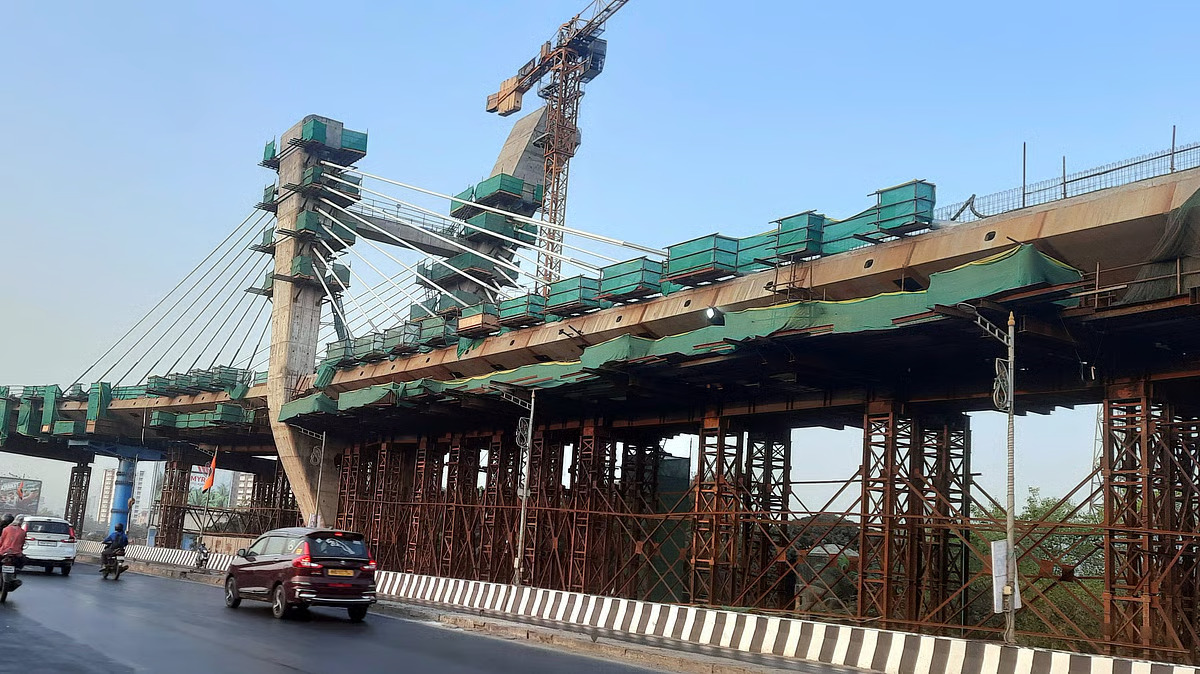
Mumbai is set to witness a major boost to urban connectivity as the Santacruz–Chembur Link Road (SCLR) extension and the final arm of the Kalanagar Flyover are scheduled to open on 14 August. The Mumbai Metropolitan Region Development Authority (MMRDA) has confirmed that preparations for the inauguration are in their final stages, with the event likely to be presided over by senior state leadership.
The opening of these long-awaited links is expected to significantly ease traffic between the Western and Eastern Express Highways, especially benefitting motorists travelling between Kurla, the airport, the Bandra–Worli Sea Link, and the western suburbs. Transport planners suggest the move could reduce travel times and lower vehicular emissions — aligning with the city’s vision for cleaner, more efficient mobility. The SCLR extension features a 215-metre cable-stayed bridge on the Western Express Highway, the first of its kind in Asia. Designed to handle two-lane traffic with widths ranging from 10.5 to 17.2 metres, the bridge promises a seamless connection that bypasses the heavily congested Vakola junction. Until now, commuters from Chembur or the Bandra Kurla Complex heading northwards faced time-consuming detours, exiting at Hans Bhugra Marg and navigating signal-heavy stretches.
This final 1.9 km alignment completes the 5.4 km SCLR extension, of which 3.4 km was operational earlier. By diverting northbound traffic directly onto the Western Express Highway, the project aims to relieve bottlenecks, cut idle times, and improve fuel efficiency — delivering both commuter convenience and environmental benefits. Alongside the SCLR milestone, the MMRDA will also commission the last of three planned arms of the Kalanagar Flyover. This new arm will link the Sion–Dharavi Link Road directly to the Bandra–Worli Sea Link, bypassing the infamously congested Kalanagar Junction. Experts note that this design could not only ease pressure on one of Mumbai’s most challenging traffic nodes but also improve public transport reliability by creating more predictable travel conditions.
Urban development specialists believe these linkages will have a far-reaching economic impact. Faster access to business hubs such as Bandra Kurla Complex and improved airport connectivity can enhance productivity while encouraging redevelopment in adjoining areas. They also caution that infrastructure gains must be matched with sustainable traffic management and active promotion of public transport to avoid new choke points in other parts of the network. The MMRDA has highlighted that both projects were executed with structural efficiency and durability in mind, ensuring longevity while minimising the environmental footprint of construction. City planners hope that these additions will serve as a model for integrating traffic decongestion measures with sustainability goals.
For commuters, the change will be most visible in reduced congestion, shorter travel times, and smoother journeys — a long-awaited transformation of two of Mumbai’s busiest urban corridors.
Also Read : DGCA issues notice to IndiGo over unapproved pilot simulators
