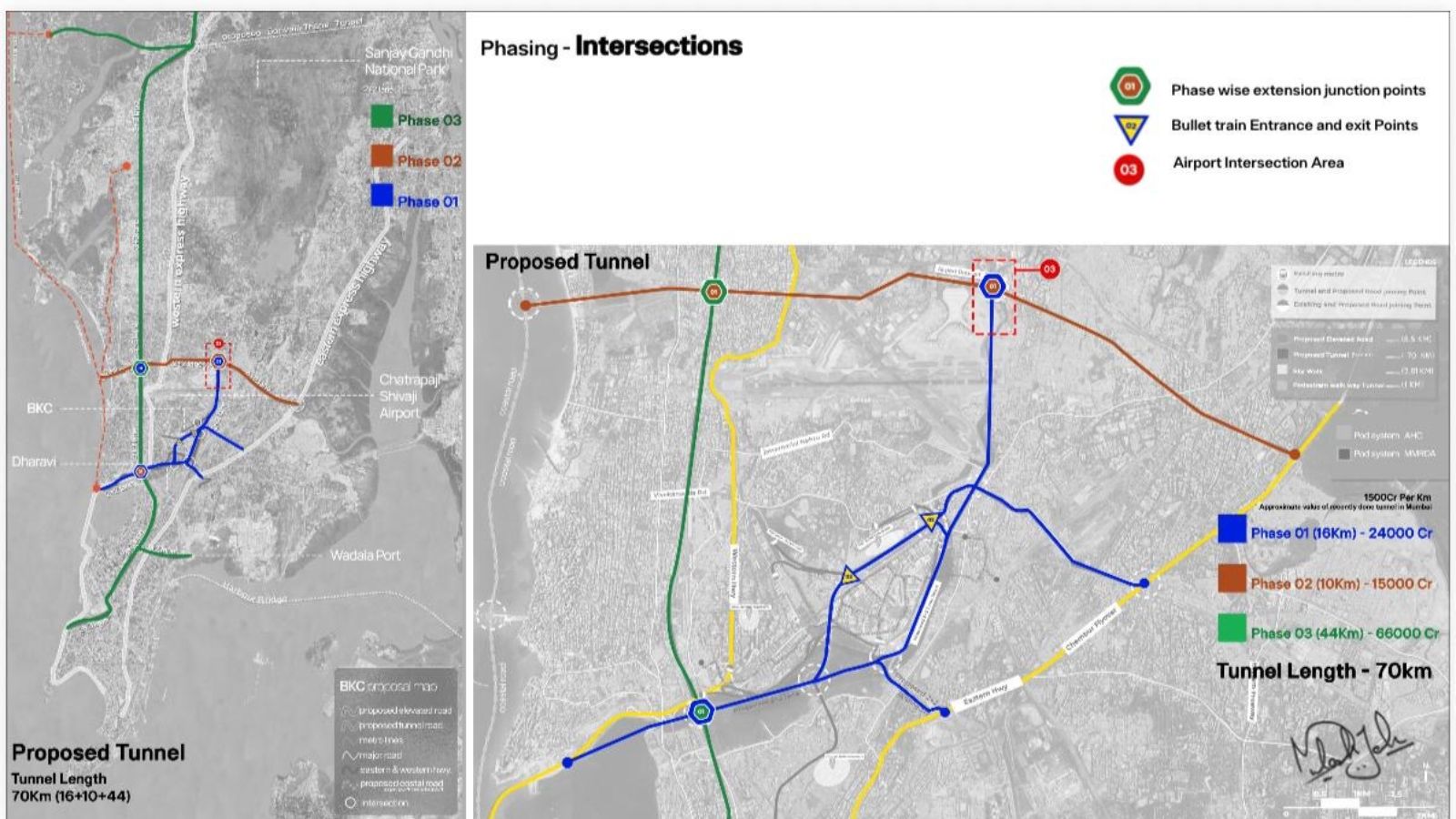
Mumbai Metropolitan Region Development Authority (MMRDA) is developing a 70-kilometre underground tunnel network—touted as the city’s third mode of mobility after roads and railways. Estimated to cost ₹1.05 lakh crore, the project aims to create seamless, multi-level transport corridors linking key business and residential hubs.
According to officials, the project is designed to complement existing transport infrastructure, reducing the pressure on arterial roads such as the Western Express Highway and S.V. Road. The first phase, a 16-kilometre tunnel linking Worli and Terminal 2 of the Chhatrapati Shivaji Maharaj International Airport, will serve as a proof of concept for the broader network. The MMRDA has appointed consultants to prepare a techno-economic feasibility study and a detailed project report (DPR), which will guide future implementation based on demand forecasts and environmental assessments. Once approved, construction is expected to proceed in multiple phases.
Urban transport experts describe the initiative as a landmark step in Mumbai’s journey toward sustainable, multi-modal mobility. “A tunnel network will help shift vehicular traffic underground, reduce surface congestion, and unlock valuable urban land for public use and green spaces,” said an urban planner familiar with the project. The proposed tunnels will integrate with the city’s expanding metro system, the coastal road, the Bandra Kurla Complex (BKC), the bullet train terminal, and the international airport. The longest of these tunnels—spanning roughly 44 kilometres—will connect south Mumbai with Borivali and is expected to cost around ₹66,000 crore. This corridor will feature multiple entry and exit points, improving last-mile access and potentially linking with the upcoming Thane–Borivali twin tunnel.
Officials emphasise that the initiative goes beyond congestion relief. It represents a new model of sustainable mobility planning that balances infrastructure growth with environmental considerations. “By moving a portion of the city’s transport network underground, we can reclaim surface land for pedestrians, cyclists, and green corridors,” an MMRDA official noted. The project is also expected to contribute to lower vehicular emissions by shortening travel time and minimising idling on traffic-heavy routes. As Mumbai continues to urbanise rapidly, planners view the tunnel network as an essential step toward building an efficient, low-carbon transport system that aligns with India’s broader net-zero goals.
If executed effectively, the initiative could transform Mumbai’s daily commute and redefine how India’s densest metropolitan region manages its transport future—moving towards a more resilient, inclusive, and sustainable city.
MMRDA Plans 70 Km Underground Tunnel Network To Ease Mumbai Traffic Congestion