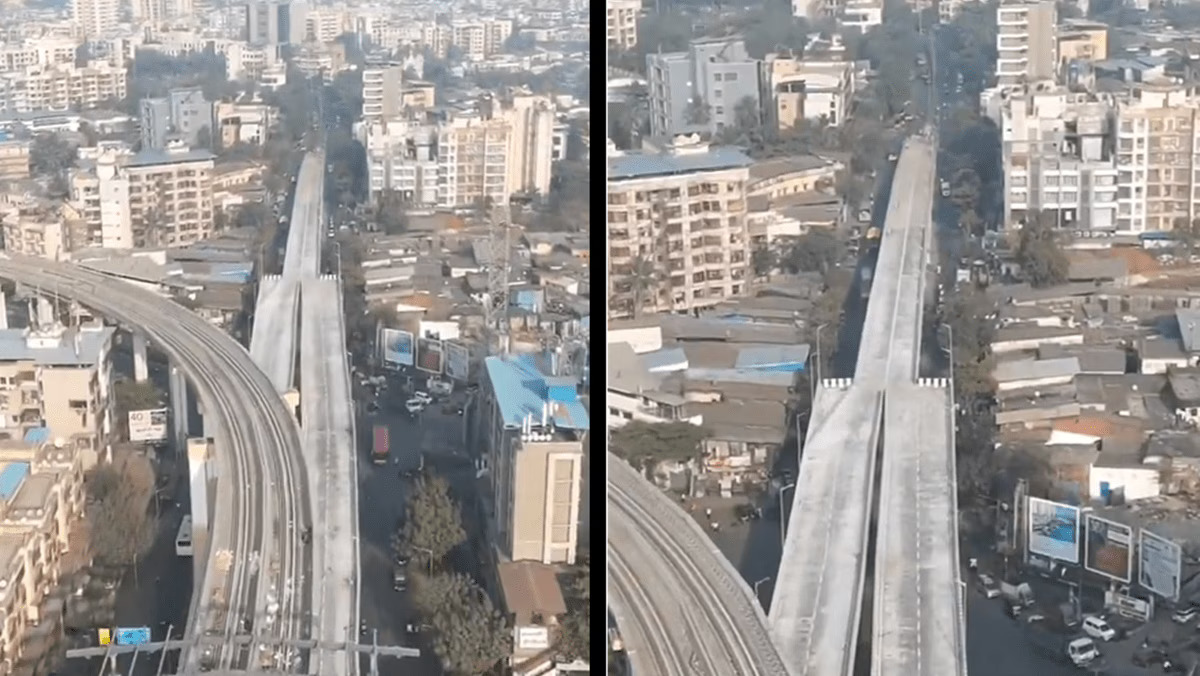
A critical road link in the fast-growing Mira–Bhayandar urban belt is set for redesign after safety concerns triggered widespread public scrutiny. The Mumbai Metropolitan Region Development Authority has finalised a six-point traffic and safety intervention for the Mira Bhayandar flyover, responding to feedback from commuters, transport planners, and road safety professionals.
The flyover, which recently opened to ease congestion at one of the region’s busiest junctions, became the focus of debate after users flagged abrupt lane transitions near its ramp section. For a corridor designed to streamline east–west movement and reduce pressure on surface roads, the early criticism underscored the risks of operational gaps in rapidly delivered infrastructure. According to officials involved in the review, the revised plan prioritises predictable lane behaviour and safer merging distances. One of the most significant changes involves shifting the lane convergence point further away from the ramp, allowing vehicles additional space to align before entering the narrower section. Urban mobility experts note that such buffer distances are essential in high-speed elevated corridors, particularly in dense suburban zones where driving patterns vary widely.
To further manage traffic flow, the authority will introduce a gradual lane tapering system, reducing four lanes to two well in advance of the ramp. This approach, supported by crash barriers and visual cues, is expected to lower sudden braking and side-swiping risks—common causes of accidents on newly commissioned flyovers. Temporary barriers at the exact merge point will also be adjusted to create clearer sightlines for drivers. The ramp connecting the flyover to Railway Phatak Road will receive additional lane delineation using separators to prevent opposing traffic from drifting into each other’s paths. Height restriction structures will be installed at the ramp entry to ensure only suitable vehicles access the elevated structure, addressing structural and safety limitations.
Signage, reflective markers, and warning boards will be added across the corridor to improve night-time visibility and driver awareness. Transport planners say such low-cost interventions often deliver outsized safety benefits, especially during the initial months of operation when commuter behaviour is still adjusting. The flyover plays a strategic role in bypassing the heavily congested Golden Nest junction, where multiple arterial roads intersect. While it remains four lanes along most of its length, long-term plans envisage extending the narrowed section across the railway corridor towards Bhayandar West—a proposal currently under evaluation.
The episode has also reignited discussion around integrating road projects with adjacent mass transit infrastructure, particularly with nearby stations on Mumbai Metro Line 9 nearing readiness. Urban experts argue that synchronising road design with public transport access is key to achieving safer, lower-carbon mobility outcomes. As the region continues to urbanise at pace, the flyover’s recalibration highlights a broader shift in infrastructure governance—where public feedback, safety audits, and adaptive design are becoming as important as speed of delivery. The effectiveness of these measures will be closely watched by commuters in the weeks ahead.
MMRDA Overhauls Mira Bhayandar Flyover Traffic Design