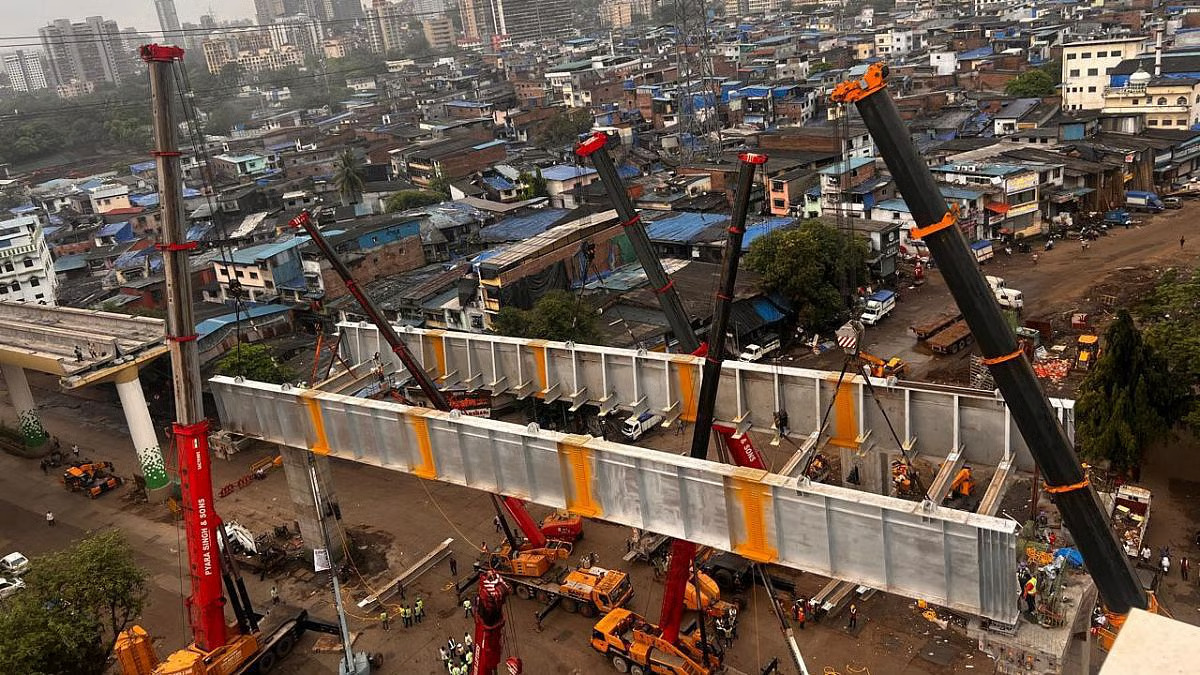
The Mumbai Metropolitan Region Development Authority (MMRDA) has completed a critical engineering milestone on the under-construction Metro Line 4, successfully installing a 56-metre steel span weighing 450 tonnes over the busy Bhandup–Sonapur Junction. The overnight operation, completed without traffic disruption, marks 84.5% completion of the ambitious Green Line project linking Wadala to Kasarvadavali.
The 32.32-kilometre fully elevated corridor, also known as the Green Line, is designed to transform east-west connectivity across Mumbai’s congested suburbs. Stretching from Wadala in south Mumbai to Kasarvadavali in Thane, it will include 30 stations, while a 2.7-kilometre extension (Line 4A) will continue further north to Gaimukh. Together, these links are expected to offer seamless travel, reduce road congestion, and promote low-carbon mobility in one of India’s busiest metropolitan regions. According to officials, the successful placement of the steel span demonstrates Mumbai’s growing engineering expertise and capacity to execute complex urban infrastructure safely within live traffic environments. More than 100 skilled professionals, aided by nine high-capacity cranes and two multi-axle pullers, worked overnight to complete the operation amid unseasonal rain. The coordination among the traffic police, municipal corporation, and electricity utility helped ensure a smooth execution without disruption to daily commuters.
The metro project is being implemented in three phases. The first stretch, from Gaimukh to Cadbury Junction, is targeted for completion by April 2026, with four stations likely to become operational by December 2025. The second phase, from Cadbury Junction to Gandhi Nagar, is scheduled to follow by October 2026, while the final leg linking Gandhi Nagar to Wadala is expected to open by late 2027. Once operational, Metro Line 4 will run six-coach trains initially, with the stations designed to accommodate up to eight coaches in future. This scalability is intended to cater to rising passenger demand as Mumbai’s population continues to expand. Officials noted that the ₹15,498-crore project will integrate with other metro lines, forming part of the city’s larger vision for sustainable public transport.
Urban mobility experts highlight that the project aligns with Mumbai’s long-term sustainability goals. By shifting commuters from private vehicles to mass transit, the Green Line will contribute to reducing vehicular emissions, improving air quality, and advancing equitable access to transport across socio-economic groups. As Mumbai moves closer to a fully interconnected metro network, the success at Bhandup stands as a reminder that large-scale infrastructure can be both technically sound and environmentally responsible—key to building a resilient, people-centred metropolis.
MMRDA Installs 56-Metre Steel Span Achieving 84.5 Percent Progress