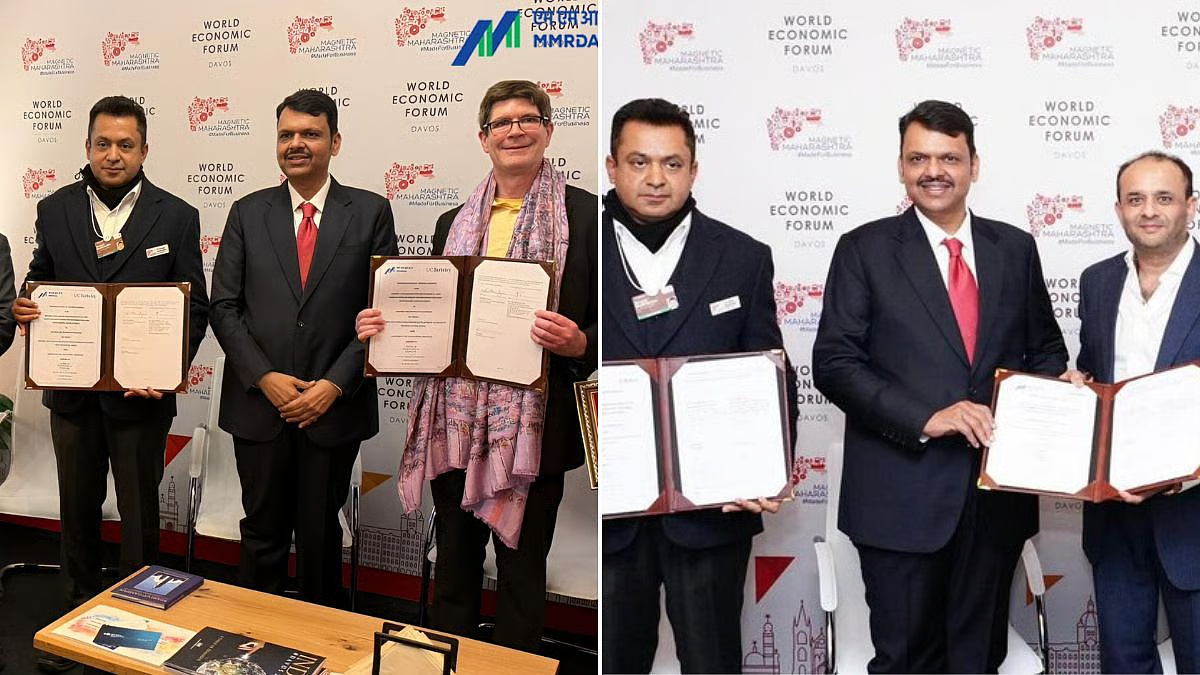
Mumbai’s metropolitan planning authority has secured one of its largest-ever overseas investment commitments, signalling a decisive shift in how India’s financial capital plans to grow over the next decade. At the World Economic Forum’s 2026 annual summit in Davos, the Mumbai Metropolitan Region Development Authority (MMRDA) formalised ten investment and collaboration agreements valued at nearly USD 96 billion, aimed at reshaping the region’s economic and urban trajectory.
The scale of the MMRDA Davos MoUs goes beyond headline investment numbers. Urban planners and market analysts view the agreements as an attempt to rebalance Mumbai’s growth model—from land-intensive real estate expansion to a diversified ecosystem built around logistics, digital infrastructure, financial technology, education, and low-carbon industrial clusters. If implemented as outlined, the projects are expected to generate close to one million direct and indirect jobs over the coming decade, largely outside the city’s already saturated core. Several of the MoUs focus on large-format logistics and industrial hubs across peripheral districts of the Mumbai Metropolitan Region. These developments are intended to ease pressure on Mumbai’s constrained land supply while improving supply-chain efficiency for western India. Industry experts note that such decentralised growth could help reduce daily commuter stress and emissions by bringing employment closer to emerging residential zones.
Another significant component of the MMRDA Davos MoUs targets financial technology and digital urban systems. Proposed fintech districts and innovation clusters are expected to combine office space with data infrastructure, urban services, and housing. According to urban economists, this reflects a broader shift in Indian cities towards “mixed-use innovation zones” that integrate work, mobility, and civic services rather than separating them into distant silos. The agreements also place unusual emphasis on sports infrastructure, specialised education, and skill development. Plans for a large-scale sports city and a sports-focused innovation university indicate a move to diversify Mumbai’s service economy beyond finance and entertainment, while creating new professional pathways linked to health sciences, sports medicine, and urban wellness.
Equally notable are the non-financial partnerships embedded within the Davos announcements. Collaborations with global universities and development agencies aim to introduce digital twins, climate-resilient planning tools, and data-led transport management systems. Urban policy specialists say such frameworks are critical if large investments are to translate into more liveable, equitable cities rather than fragmented construction-led growth. For residents, the long-term implications will depend on execution. Improved transit-oriented development, cleaner industrial corridors, and digital governance systems could ease long-standing challenges around congestion, housing affordability, and environmental stress. However, planners caution that inclusive outcomes will require careful land-use planning, affordable housing integration, and transparent monitoring of environmental impacts.
As Mumbai competes with global cities for capital and talent, the MMRDA Davos MoUs mark a clear statement of intent. The coming years will determine whether this ambition reshapes everyday urban life—or remains concentrated within investment announcements alone.
MMRDA Davos MoUs Signal Structural Shift In Mumbai Metropolitan Economy