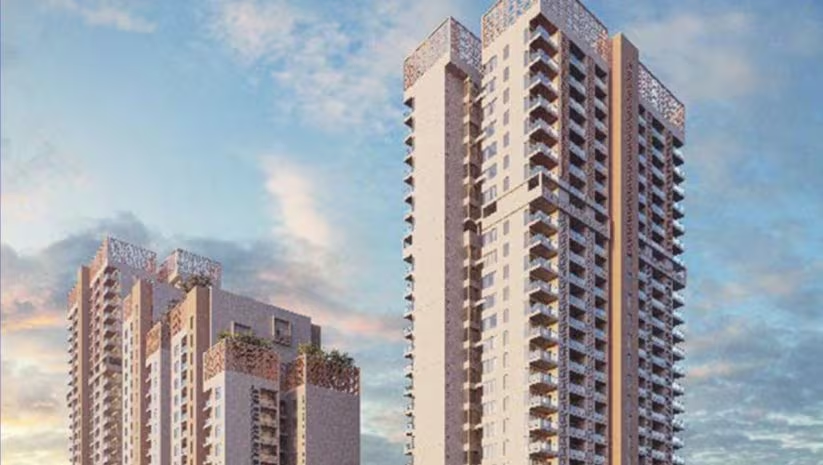
A significant shift is underway in the Mumbai Metropolitan Region’s residential landscape as Embassy Developments Ltd (EDL) formally enters the city’s housing market with plans for multiple luxury residential projects worth several thousand crore rupees. This marks a strategic expansion for a developer better known for its commercial footprint and underscores robust demand in MMR’s high‑end housing segment — with long‑term implications for urban form, investment flows and sustainable real estate supply in India’s financial capital.
The Bengaluru‑based real estate firm has committed to deploying an estimated ₹7,000 crore across six housing projects, combining new launches with the completion of legacy developments. The flagship initiatives include three marquee residential schemes in Worli, Juhu and Alibaug, areas prized for connectivity, lifestyle infrastructure and prime urban appeal. Collectively, these projects are expected to generate more than ₹12,000 crore in revenue, reflecting confidence in sustained buyer interest for premium built environments. Urban planners and property market analysts interpret Embassy’s Mumbai entrance as a barometer of investor sentiment toward the city’s luxury housing segment. Despite broader macroeconomic headwinds and rising construction costs, affluent demand remains resilient in micro‑markets that offer high accessibility to employment hubs, quality urban amenities and lifestyle value. Worli and Juhu, in particular, have long been focal points for aspirational housing and cosmopolitan living, while Alibaug is increasingly valued for second‑home lifestyles grounded in coastal proximity and improving transport links.
Importantly, the expansion arrives amid wider efforts by Maharashtra and metropolitan authorities to integrate housing growth with sustainable mobility, infrastructure and environmental resilience. For example, Mumbai’s transport network enhancements — including ongoing metro expansions — are reshaping commuter patterns, making peripheral and coastal districts more attractive for homebuyers seeking balance between work and wellbeing. Developers are responding by situating projects near transit corridors and mixed‑use ecosystems that reduce daily travel footprints. Economic experts observe that high‑value residential launches can also exert upward pressure on land values and construction input prices, which may present affordability challenges for mid‑income households. To mitigate this, some developers are increasingly incorporating design efficiencies, modular construction methods and green building practices that trim lifecycle costs while enhancing environmental performance. These measures serve both sustainability objectives and competitive positioning in a market where regulatory scrutiny of energy and water efficiency is tightening.
The Embassy entry arrives as the sector grapples with the dual task of meeting diverse housing needs while preserving urban liveability. Strategies that layer affordable and mid‑segment offerings alongside premium developments may broaden opportunities for inclusive growth, particularly as MMR’s population expands and migration patterns evolve. Urban designers argue that embedding equitable access to quality housing within large‑scale project portfolios — alongside public‑private partnerships — will strengthen resilience against economic cycles and infrastructural bottlenecks.
For buyers and investors, Embassy’s Mumbai initiative signals renewed confidence in the city’s housing dynamics and a deepening of product choices in the luxury category. As launches proceed from late 2026 onwards, close attention will be paid to sales velocity, pricing strategies and how these projects integrate climate‑sensitive design — a growing priority for both homeowners and regulators.