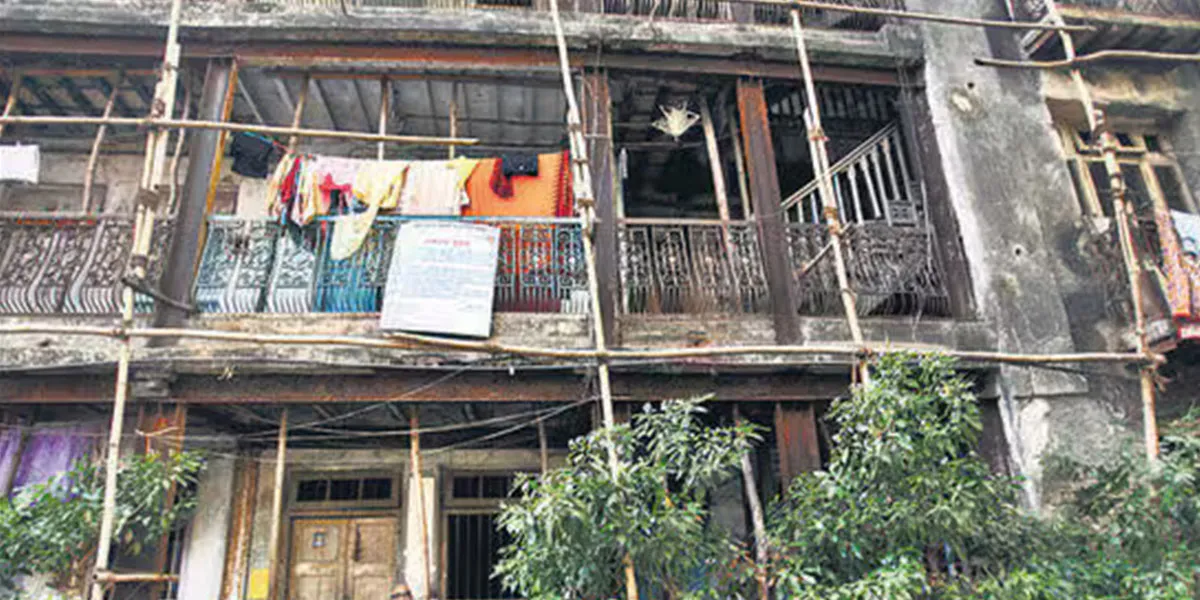
Mumbai’s long-pending housing redevelopment challenge in its historic southern neighbourhoods may finally see movement, as the state housing authority has agreed to directly undertake cluster redevelopment of ageing residential buildings if housing societies unite under a collective proposal. The move could provide overdue relief to tens of thousands of families living in structurally unsafe homes across South Mumbai.
Officials familiar with the matter said the Maharashtra Housing and Area Development Authority (Mhada) has communicated its willingness to redevelop clusters of old buildings that have failed to attract private developers for years. The key condition is that housing societies must come together, pass a joint resolution, and formally request Mhada to step in. The approach seeks to overcome long-standing barriers created by fragmented land ownership and commercially unviable plot sizes. Nearly 27,000 families currently occupy around 388 deteriorating buildings spread across areas such as Colaba, Girgaon, Byculla, Sewri, Prabhadevi, Mahim and the island city core. Most of these structures were originally rebuilt by Mhada several decades ago and now require a second cycle of redevelopment. Each building typically sits on small land parcels, often between 400 and 600 square metres, making independent redevelopment financially unattractive for private builders.
Urban housing experts note that repeated attempts by individual societies to appoint developers have failed due to limited development potential and disagreements among residents. “Cluster redevelopment is often the only viable solution in dense, land-scarce areas like South Mumbai, but coordination between multiple societies has always been the biggest hurdle,” said an urban redevelopment consultant. Resident representatives have welcomed Mhada’s decision, saying it could benefit a significant share of the affected buildings. Since the land ownership rests with the housing authority, its direct involvement removes legal uncertainty and aligns redevelopment with public housing objectives rather than purely commercial considerations. Resident groups have also renewed calls for the city to implement a mini-cluster redevelopment framework that lowers the minimum land size requirement, enabling smaller clusters to qualify for redevelopment benefits.
However, concerns remain about Mhada’s execution capacity. Housing activists pointed out that despite legal amendments empowering the authority to take over stalled redevelopment projects, progress on that front has been limited. Several cessed buildings identified for acquisition over the past few years continue to remain in limbo, leaving tenants displaced or living in unsafe conditions. “There is a clear policy intent to rescue residents trapped in stalled projects, but implementation has been painfully slow,” said a civic accountability advocate, adding that timely intervention is critical to prevent further loss of housing stock and community networks.
From a broader urban perspective, experts argue that state-led cluster redevelopment offers an opportunity to rebuild ageing neighbourhoods using safer construction, improved infrastructure, and more energy-efficient designs. If executed transparently and inclusively, such projects could contribute to safer, more resilient, and socially balanced housing in one of India’s densest urban districts.
Mhada Agrees To Undertake Cluster Redevelopment Of Ageing Housing In South Mumbai