


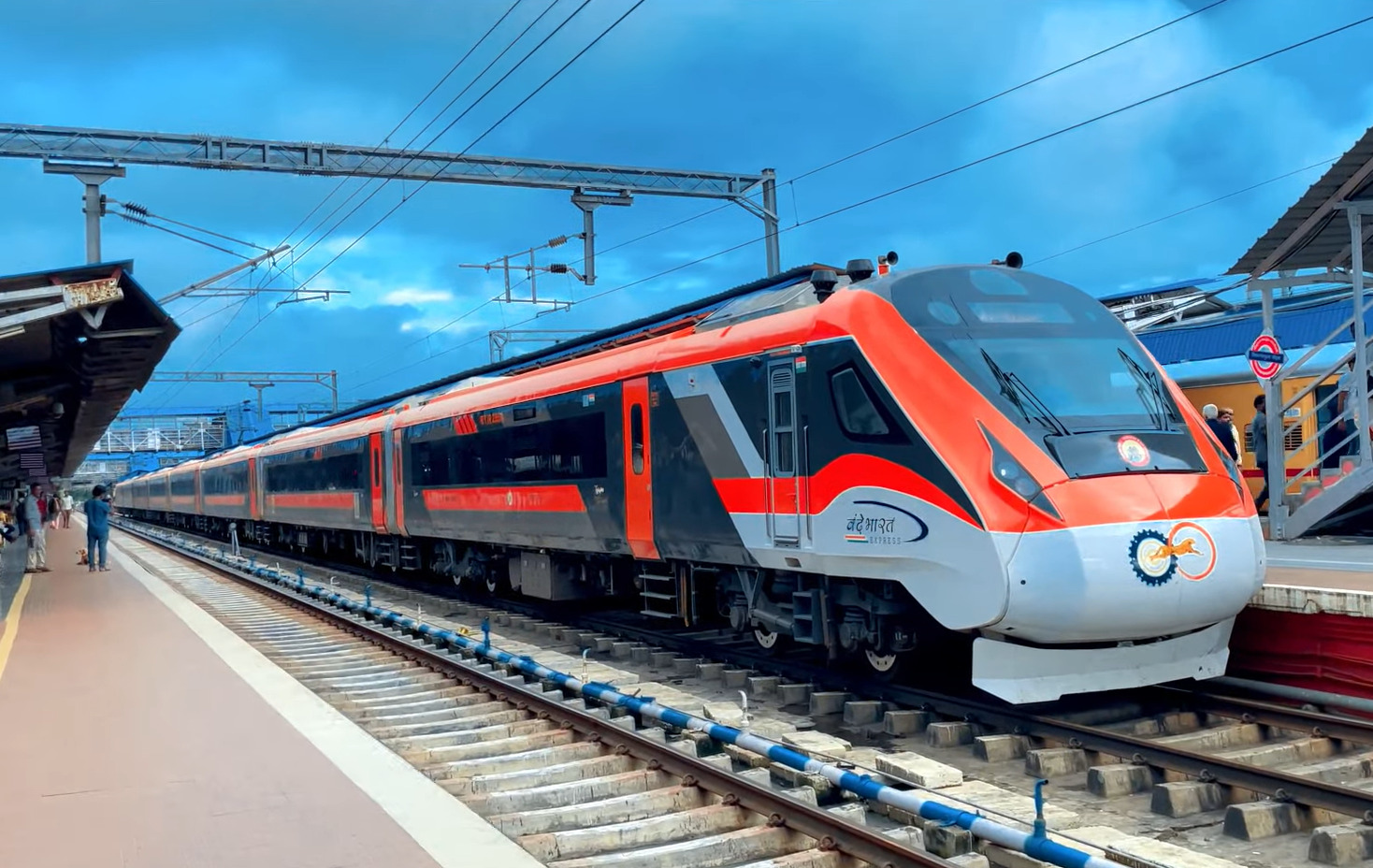
The much-awaited Bengaluru–Mangaluru Vande Bharat Express is one step closer to reality as the electrification work on the crucial Sakleshpur–Subrahmanya Road ghat section nears completion.
With the South Western Railway (SWR) aiming to finish the electrification by October, the train’s anticipated launch is becoming more tangible. However, railway officials stress that the final decision on its launch rests with the government and the Railway Board. The electrification of this section, which covers a challenging 36 km from Donigal to Shiribagilu, is one of the last hurdles in the transformation of the Bengaluru-Mangaluru rail corridor. The steep and rugged terrain of the Western Ghats presents unique challenges, primarily due to the lack of direct road access. As a result, all necessary materials for the electrification works must be transported by train, adding complexity to the process.
As part of the ongoing works, certain train services have been temporarily suspended. From May 31 to November 2, one pair of trains per day—totalling three pairs each week—will be cancelled. Despite this, railway officials assure the public that this will have minimal impact on passenger travel, as three pairs of trains will continue operating between Bengaluru and Mangaluru, maintaining regular connectivity. The Bengaluru–Mangaluru rail route is vital for both passenger and freight traffic, and the electrification of this section is set to enhance its efficiency. Divisional Railway Manager (DRM) of SWR’s Mysuru division stated that the entire stretch between Bengaluru and Mangaluru is electrified, except for the difficult ghat stretch, which is now nearing completion. He noted that the electrification work was critical not only for the proposed Vande Bharat Express but also for improving the overall rail infrastructure in the region.
Currently, five pairs of passenger trains operate through the ghat section, including four pairs linking Bengaluru and Mangaluru and one connecting Mangaluru to Vijayapura. The cancellation of six daily trains is a necessary step to facilitate the movement of material trains, which are crucial for the ongoing electrification work. Given the approaching monsoon season, it was deemed vital to avoid disrupting freight movement, ensuring that critical goods can continue to be transported without delay. The ghat section’s steep gradients require special operational rules, including longer intervals between trains. In most rail routes, the track is divided into smaller segments called block sections. However, due to the difficult terrain, two blocks are combined into one in this section, making it a single-line route. This means that trains cannot pass through the ghat section simultaneously and must clear the entire stretch before another train can enter. To mitigate delays, a four-hour block is scheduled daily for the movement of material trains. Each material train takes about 1.5 hours to travel one way and another 1.5 hours for the return journey, with one hour allocated for unloading.
The electrification work is being carried out by Rail India Technical and Economic Service (RITES), and the SWR officials are confident that the project will be completed within the targeted timeframe. This progress is crucial for the realisation of the Vande Bharat Express, which will offer faster, more efficient travel between Bengaluru and Mangaluru. With the completion of electrification, the introduction of the Vande Bharat Express is expected to bring several benefits, including reduced travel times, enhanced passenger comfort, and a more sustainable transport option for the region. This aligns with the broader objective of modernising India’s rail infrastructure, making it more energy-efficient, and contributing to the country’s commitment to reducing carbon emissions.
As the electrification work progresses, the completion of this critical section will mark a significant milestone in India’s railway modernisation programme, setting the stage for the introduction of more advanced, eco-friendly, and efficient trains like the Vande Bharat Express.
Also Read :Mumbai Ahmedabad high speed rail builds 300 km viaduct
