


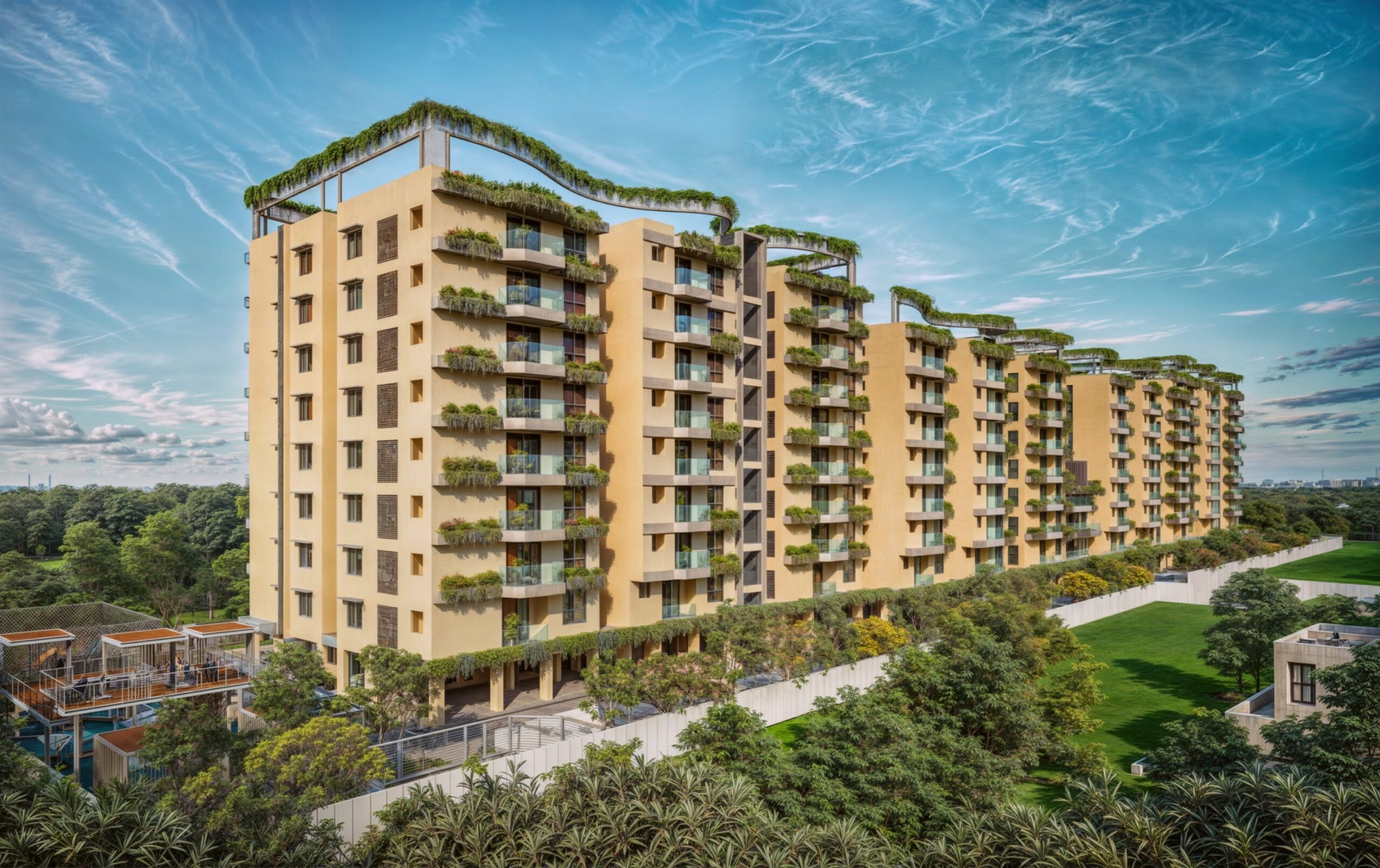
As India’s technology capital grapples with water stress, rising energy demand and rapid urban expansion, a cluster of new projects by a city-based developer has secured top certifications from the Indian Green Building Council (IGBC), signalling a deeper shift in how commercial and residential assets are being designed.
Mana Projects has received IGBC Platinum and Gold ratings across its commercial and residential portfolio in Bengaluru, adding to a growing pipeline of certified developments in the city. The recognitions cover a commercial project along the Sarjapur Road growth corridor and two residential communities that integrate water recycling, energy efficiency and lower embodied carbon materials. The commercial development, located in one of Bengaluru’s fastest-expanding office micro-markets, incorporates full on-site wastewater treatment and reuse systems. According to project disclosures, treated water recycling supports significant reductions in freshwater demand. Energy performance measures including façade optimisation, lighting efficiency and passive design strategies are aimed at lowering electricity consumption in a market where commercial power demand continues to climb. Urban planners note that Sarjapur Road has evolved into a high-density employment zone driven by IT and start-up ecosystems. Green-certified office supply in such corridors is increasingly sought by global occupiers with environmental, social and governance (ESG) mandates. Platinum-rated projects often command stronger tenant interest and long-term occupancy stability.
On the residential side, the developer’s Gold-rated and registered green projects integrate rainwater harvesting, decentralised sewage treatment and organic waste processing. Such measures are becoming critical in Bengaluru, where groundwater depletion and waste management challenges have intensified. Native landscaping and biodiversity-sensitive planting are also being deployed to reduce irrigation needs and mitigate local heat stress. Materials selection forms another component of the sustainability strategy. The use of low volatile organic compound (VOC) finishes improves indoor air quality, while incorporating industrial by-products such as ground granulated blast-furnace slag (GGBS) in concrete reduces embodied carbon. Accessibility features and pedestrian-oriented internal layouts reflect a gradual shift toward more inclusive, people-first housing design. Industry experts observe that while IGBC certifications represent a small share of the overall market, demand for green-rated real estate in Bengaluru is expanding. Institutional investors and corporate occupiers increasingly evaluate environmental performance alongside financial metrics. For residential buyers, operational savings through lower water and energy use are emerging as tangible value drivers. However, sustainability specialists caution that certification alone is not sufficient. Long-term performance depends on maintenance, occupant behaviour and integration with city infrastructure systems. As Bengaluru pushes toward climate resilience and lower-carbon growth, scaling such practices across mainstream development remains the larger challenge.
The recent IGBC certifications reflect a broader transition in the city’s real estate ecosystem one where environmental compliance is moving from a niche differentiator to an operational baseline in a rapidly urbanising metropolis.
Also Read: Karnataka eases KIADB norms for high rise projects
Mana Projects Bengaluru advances green building standards
