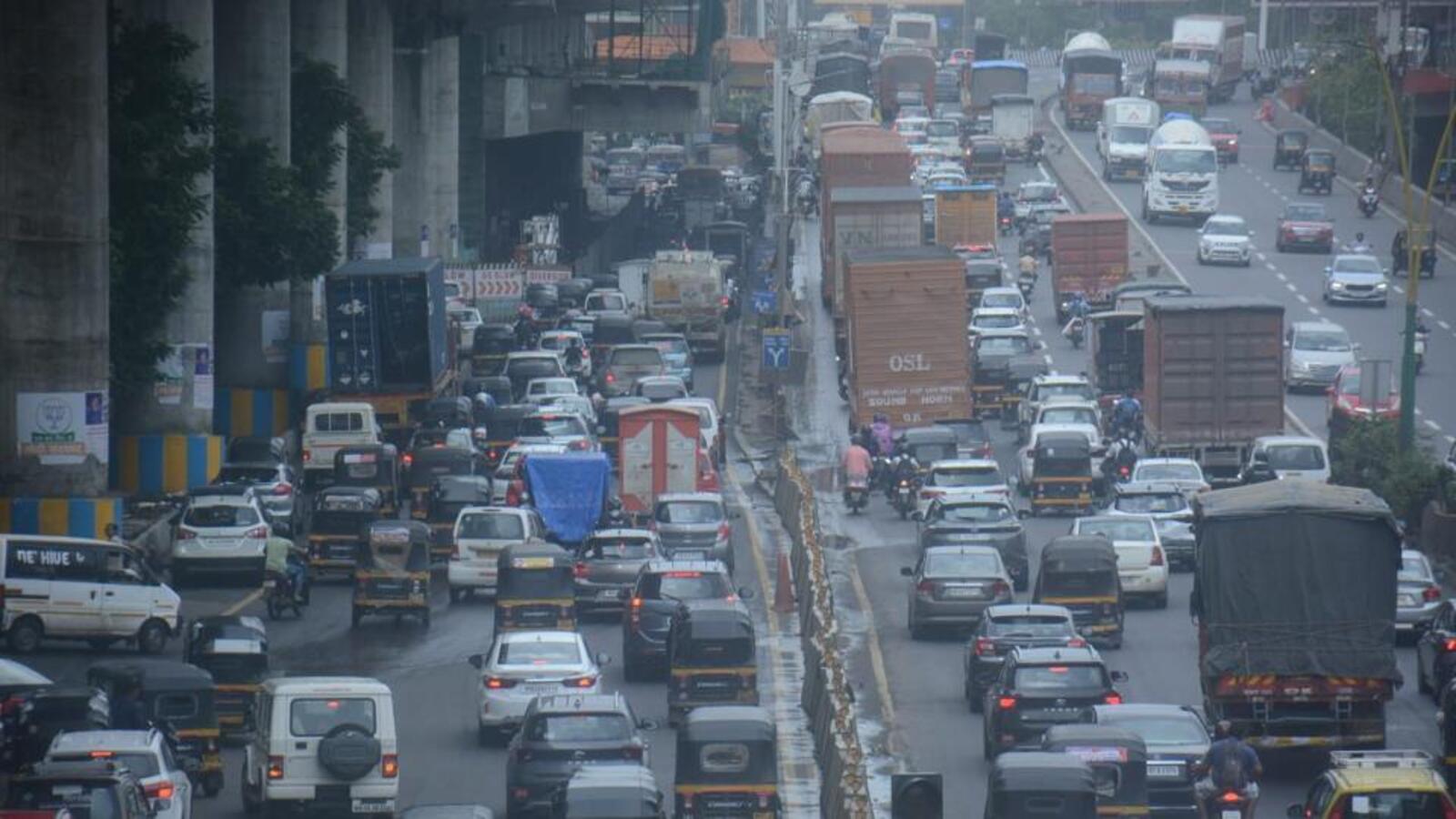
A sudden road subsidence at Majiwada Junction in Thane has triggered severe traffic disruption across key arterial routes, exposing vulnerabilities in urban infrastructure at one of the region’s busiest transit nodes. The incident, reported late in the night and escalating through peak hours the following day, brought vehicular movement to a near standstill across multiple connecting corridors.
The Majiwada road cave in occurred along a critical stretch linking residential and commercial zones to Thane’s central areas, forcing civic authorities to immediately barricade the affected section. As a result, traffic flow from major entry points such as Ghodbunder Road and adjoining neighbourhoods was significantly constrained, impacting daily commuters and logistics movement. Preliminary assessments suggest that underlying utility networks may have contributed to the collapse. The affected stretch is known to house multiple underground pipelines and service lines, and officials are examining whether structural stress or leakage weakened the road base. Infrastructure experts point out that ageing utility systems, when combined with heavy traffic loads, can accelerate subsurface erosion, eventually leading to such failures.
Compounding the situation is the presence of ongoing infrastructure work in the vicinity. Construction activity linked to an elevated corridor project had already reduced available carriageway space, leaving little buffer to absorb disruptions. Urban planners note that simultaneous infrastructure interventions, if not carefully coordinated, can heighten systemic risk and reduce network resilience. This is not an isolated occurrence. The Majiwada road cave in marks the second such incident reported in the area within a short span, raising concerns about the durability of road engineering and the effectiveness of maintenance protocols. Repeated failures in high-traffic zones can have cascading economic impacts, from lost productivity to increased fuel consumption and logistical delays.
From a broader urban development perspective, the incident highlights the need for integrated infrastructure management. Experts emphasise that road construction, utility maintenance, and urban transport planning must be aligned through shared data systems and regular audits. Without such coordination, cities risk reactive responses to infrastructure failures rather than preventive action. There is also a growing call for adopting advanced monitoring technologies, such as ground-penetrating radar and predictive maintenance systems, to identify vulnerabilities before they escalate into visible damage. Such approaches are increasingly being explored in global cities facing similar challenges of ageing infrastructure and rapid urbanisation.
For commuters, the immediate impact has been longer travel times and route diversions, with traffic authorities advising the use of alternate corridors. However, the disruption has also renewed public scrutiny over infrastructure accountability and long-term planning in fast-growing urban clusters like Thane. As repair work progresses, the focus will be on restoring normal traffic conditions while addressing underlying causes. The Majiwada road cave in serves as a reminder that resilient urban infrastructure requires not just expansion, but sustained investment in maintenance, coordination, and climate-adaptive design to withstand increasing pressures.
Majiwada Junction Sinkhole Triggers Heavy Traffic Congestion In Thane