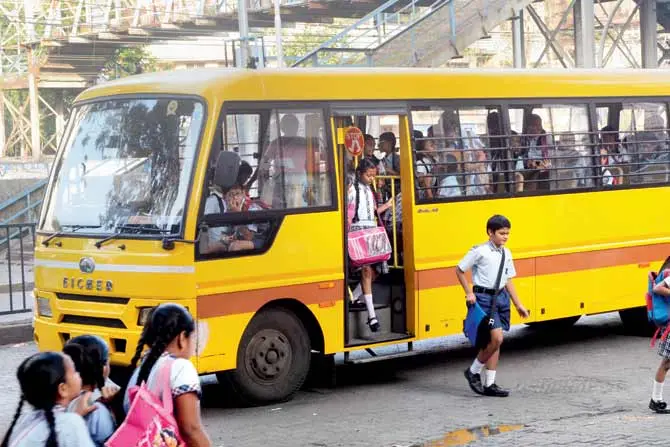
Maharashtra Orders Statewide School Transport Safety Drive
The Maharashtra government has announced a statewide inspection campaign to verify whether vehicles transporting schoolchildren comply with mandatory safety regulations, signalling a renewed push to strengthen child mobility standards in one of India’s most urbanised states. The initiative will involve coordinated checks by transport authorities, police, and education officials across districts to ensure that school buses and vans meet prescribed operational safeguards.
Officials indicated that the inspection programme will focus on enforcing existing school transport safety norms rather than introducing new rules. Authorities say the goal is to ensure consistent implementation across cities, suburban municipalities and smaller towns where monitoring of school transport services often varies. The move follows renewed scrutiny after an incident in the Mumbai metropolitan region in which two students were injured after falling from a privately arranged school van, highlighting persistent gaps in oversight of vehicles used for student travel.Under the current regulatory framework, schools are expected to maintain dedicated transport committees responsible for monitoring vehicles used to ferry students. District-level bus safety committees are also tasked with supervising compliance through coordination between the education department, police and regional transport offices. However, urban mobility experts note that the growing dependence on privately operated vans and contracted vehicles has made enforcement more complex, particularly in dense suburban corridors and rapidly expanding satellite towns.
The school transport safety guidelines require several protective measures. These include driver background verification, installation of GPS-based tracking systems and CCTV cameras, and the presence of trained female attendants on school buses. Operators must also ensure that drivers and transport staff undergo police verification and periodic monitoring to rule out substance abuse or other safety risks.Urban planners say the inspection drive reflects a broader challenge facing fast-growing metropolitan regions: ensuring that transport systems serving children keep pace with expanding city boundaries and rising school enrolments. In the Mumbai metropolitan region alone, thousands of students travel daily through a mix of school-operated buses, private vans and parent-organised vehicles—many of which operate beyond direct institutional supervision.
Experts argue that enforcement drives should be complemented by digital monitoring tools, better licensing systems and stronger accountability frameworks for operators. Real-time vehicle tracking, standardised driver training programmes and stricter penalties for violations could help close regulatory gaps in a sector that remains fragmented and largely decentralised.From a city governance perspective, safe school mobility has become an important component of inclusive urban infrastructure. Reliable and secure student transport allows families—especially working parents—to access education networks without additional commuting burdens, while also supporting safer road environments around schools.
Authorities say the inspection campaign will be rolled out across districts with joint teams conducting checks on vehicle permits, equipment compliance and staff verification. Officials expect the exercise to identify operational lapses and push operators toward full adherence to safety norms before the next academic cycle intensifies daily travel demand.