Maharashtra Orders Flood Line Survey To Ease Redevelopment
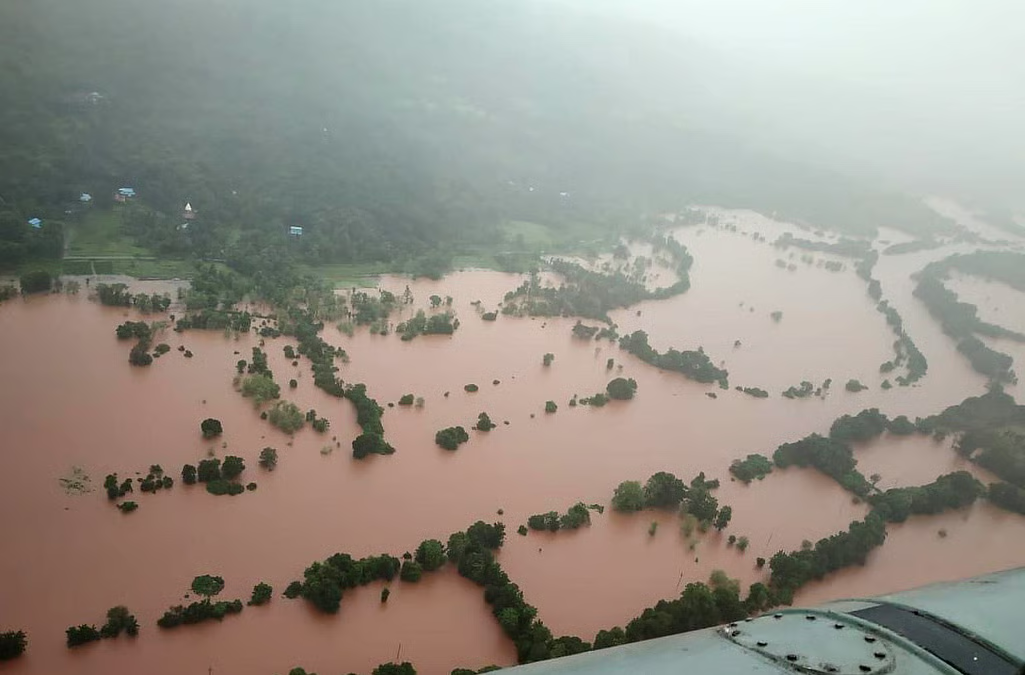
The Maharashtra government has launched a new flood line resurvey initiative that could unblock stalled redevelopment projects affecting authorised buildings located along rivers in several cities, including Pune and Pimpri-Chinchwad. The decision to re-evaluate blue and red flood line demarcations — statutory planning limits used to define flood-risk areas — signals a recalibration of urban policy where climate risk management and redevelopment imperatives intersect. The move also reflects intensifying pressure on local authorities to translate regulatory frameworks into actionable plans that balance safety with urban renewal.
A 12-member expert committee, chaired by the Additional Chief Secretary of the Water Resources Department and constituted by the state government, has been charged with conducting comprehensive reviews and recommending corrective measures. The panel’s mandate includes re-surveying flood-prone stretches, reassessing existing flood line boundaries, and advising regulatory changes that can facilitate the redevelopment of authorised buildings currently hamstrung by outdated demarcations.In Maharashtra’s urban centres, many redevelopment applications for sanctioned structures have stalled because restrictions linked to flood line designations — including blue (recurrence of flood flow) and red (danger/maximum flood) zones — effectively constrain permissible construction or alteration. Stakeholders, ranging from housing societies and developers to residents and civic agencies, have argued that some flood line boundaries were drawn decades ago and do not fully account for current rainfall intensity, modern drainage infrastructure or urban expansion patterns.
Urban planners and flood management experts explain that redraws of regulatory flood lines, informed by updated hydrological data, could serve two critical ends: enhancing public safety in genuine high-risk areas, and unlocking redevelopment potential where risk can be mitigated through design and regulatory provisions. This might include recommending the use of Transfer of Development Rights (TDR) or revising permissible plinth and floor levels — planning tools that allow additional development potential to be transferred from risk-exposed lands to safer urban pockets, while respecting safety norms.The initiative also responds to broader legal and civic pressures. Litigation over flood line demarcations — such as petitions before the Bombay High Court — underscored perceived ambiguities and their impact on long-pending redevelopment cases. If the committee’s recommendations lead to clearer, calibrated flood lines, authorities expect it to reduce legal uncertainty and offer paths forward for residential and mixed-use projects that contribute to urban densification without compromising safety.
For community advocates, the updated surveys may offer much-needed clarity on where redevelopment is viable and where structural adaptation will remain necessary. With monsoon variability and extreme rainfall events becoming more frequent under climate change, accurate flood-risk data integrated into urban planning is increasingly vital. A re-survey effort anchored in contemporary environmental modelling can support resilient redevelopment — enabling authorities to protect lives and assets while revitalising ageing city districts.The expert panel has been tasked with submitting draft recommendations within two months, setting the clock on an expedited policy exercise that could reshape redevelopment timelines for thousands of buildings across Maharashtra’s fast-growing urban regions.