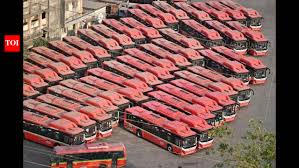
In a bid to stabilise its finances and expand mobility across the state, the Maharashtra State Road Transport Corporation (MSRTC) has unveiled plans to induct 8,300 buses into its fleet during 2026, marking a significant strategic push to reverse persistent revenue shortfalls and scale up services across both urban and rural corridors. The decision — ratified with in-principle approval from the Maharashtra government — comes as the corporation confronts an annual revenue-expenditure gap that has strained operations post-pandemic.
Officials say the move forms the first phase of a longer-term expansion strategy that could see 20,000–25,000 buses added in coming years, with an immediate focus on strengthening service frequency, coverage and passenger experience. Currently, MSRTC’s operational fleet stands at around 12,600 vehicles, down sharply from pre-COVID counts of nearly 18,000–19,000.State Transport Minister and MSRTC Chairman highlighted that increasing capacity is central to improving the corporation’s financial health, which is currently running a daily deficit estimated at ₹1–1.5 crore. By expanding the fleet, the corporation aims to raise daily ridership from roughly 50 lakh commuters to an aspirational 70–75 lakh, thereby enhancing farebox revenue and closing operational losses.The planned additions include 3,000 high-capacity 55-seater buses, scheduled to be rolled out from March onwards and prioritised on busy intercity routes; 5,000 standard buses pending final tender awards; 100 midi-buses to improve connectivity in remote and tribal areas; and 200 premium coaches designed to compete with private operators on select corridors.
Urban transport analysts say that chronic underinvestment in state transport fleets has been an endemic issue not just in Maharashtra but across India, where public operators have seen ageing inventories, rising maintenance costs and service gaps exacerbated by pandemic-era disruptions. Strengthening MSRTC’s fleet could ease pressure on regional mobility networks, complementing rail and metro expansions in metropolitan zones while offering affordable alternatives for intercity travel. They also note that enhanced public transport capacity aligns with climate-resilient mobility goals by shifting travel demand away from private vehicles, thereby reducing emissions and congestion in dense urban corridors.However, challenges remain. Financing the acquisition and operating costs of thousands of new buses will require tight fiscal management, and analysts caution that operational efficiencies must improve in parallel to fleet growth. Strategic fare concessions, such as half-fare discounts for women and free travel for senior citizens — policies introduced in recent years — have boosted ridership but also weighed on revenues, requiring careful subsidy calibration.
The MSRTC’s expansion plan will be watched closely by municipal and state planners, as it intersects with broader mobility ambitions across Maharashtra, including ongoing expressway upgrades, metro expansions and integrated transport projects. Success in balancing supply, operational efficiency and fiscal sustainability could position the corporation as a backbone of inclusive regional mobility in India’s second-largest state.