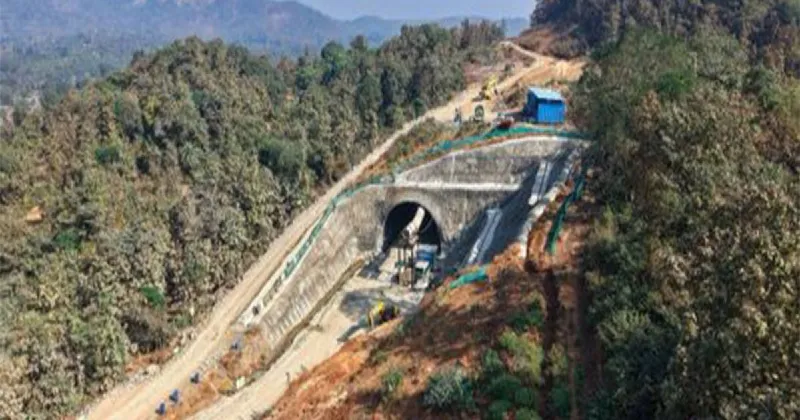
Maharashtra has marked a significant engineering milestone in India’s flagship high-speed rail initiative as the second mountain tunnel for the Mumbai-Ahmedabad High-Speed Rail (MAHSR) corridor was successfully pierced in Palghar district, officials announced. The breakthrough underscores accelerating work on the 508-kilometre project connecting two major economic regions, with implications for future mobility, urban connectivity and regional development.
Railways authorities confirmed that the Mountain Tunnel-6 (MT-6) section — spanning about 454 metres in length and 14.4 metres in width — now provides a continuous passage through the Western Ghats terrain, accommodating both up and down bullet train tracks. The engineering feat was achieved using the New Austrian Tunnelling Method (NATM), a technique suited to complex geological conditions where traditional tunnel-boring machines are less effective.This latest milestone follows the MT-5 breakthrough at the same Palghar site earlier this year — with both accomplishments realised within a month, reflecting an intensifying pace of civil works in the Maharashtrian segment. A total of seven mountain tunnels are being excavated in the district, each at varying stages of completion, as part of the broader high-speed corridor construction programme.
For planners and transport economists, such structural progress is more than symbolic. The MAHSR project — India’s first true bullet train link — aims to dramatically reduce travel times between Mumbai and Ahmedabad while catalysing economic activity along its route. When operational, the corridor is expected to support trains at speeds up to 320 km/h, enabling a paradigm shift in regional mobility and creating ancillary development opportunities in a climate-conscious manner.However, the construction challenges are significant. The Western Ghats terrain demands sophisticated engineering solutions to manage rock stability, groundwater and seismic considerations, alongside rigorous safety protocols for tunnel workers. NATM allows real-time adjustments within the tunnel environment, enabling structural supports to be adapted during excavation — a crucial feature given the variable geology encountered in this mountainous region.
Beyond tunnels, work on the MAHSR corridor extends across multiple fronts. Civil infrastructure such as viaducts, river bridges and major crossings over highways and railways are at various stages of completion, with substantial progress reported on nearly 334 kilometres of viaducts and 17 river bridges. Meanwhile, station construction and alignment works continue concurrently in both Maharashtra and Gujarat.Urban and regional planners observe that such connectivity enhancements can have far-reaching effects on land use, economic clusters and city hierarchies. By linking Mumbai — one of India’s most densely populated metropolitan regions — with Ahmedabad’s emerging high-growth corridors, the MAHSR project could redistribute economic activity, relieve pressure on congested road networks and support integrated regional planning.
Still, experts stress that operational benefits will hinge on integrated planning beyond construction: seamless feeder transport systems, equitable land-use frameworks around stations, and climate-resilient infrastructure design. With key milestones now being met in Palghar, the immediate focus turns to sustaining momentum and ensuring the corridor’s timely commissioning — a complex endeavour that requires synchronising multiple civil, electrical and systems disciplines over the next few years.