


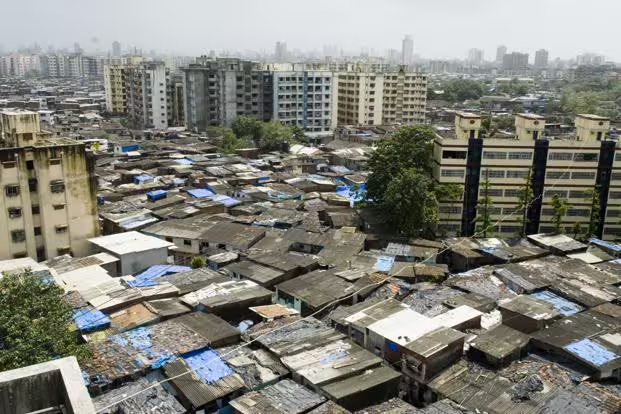
Mumbai’s push to accelerate large-scale slum redevelopment gained fresh momentum on Thursday, with the state government approving a new framework that allows cluster redevelopment projects to proceed without requiring consent from slum residents. The move is intended to fast-track delayed housing upgrades across the city while opening up more land for structured, long-term urban renewal.
The revised policy, issued through a government resolution, increases flexibility for planning authorities by enabling clusters to be carved out on contiguous land parcels of at least 50 acres, provided that a majority of the area comprises slum settlements. Officials say this threshold is designed to allow entire neighbourhoods—rather than fragmented plots—to be considered for integrated redevelopment, making project execution faster and reducing repetitive displacement. Under the new rules, existing schemes approved under the city’s Development Control and Promotion Regulations (DCPR) can be absorbed into the larger cluster model. This includes not just informal housing but also industrial units, small commercial establishments and warehouse structures that fall within the designated boundary.
Planners note that the inclusion of mixed-use parcels could help create more balanced neighbourhoods with improved public facilities, wider roads and better emergency access. Notably, the government has expanded the list of eligible land parcels by permitting the use of centrally owned land, subject to approvals from the relevant departments. Land leased by state agencies and semi-government bodies can also be brought into the redevelopment fold, provided that rehabilitation follows DCPR norms and the parent authority is compensated.
A senior housing official described this as “a significant shift that increases land availability in a land-starved city.” The most consequential change concerns coastal regulation zones.
For the first time, slum pockets situated in CRZ–I and CRZ–II can be integrated into cluster-scale redevelopment, with either in-situ or nearby rehabilitation permitted within a five-kilometre radius. Urban planners say this may finally allow safer housing for thousands of families living in hazard-prone zones, while enabling ecological restoration of stretches that have long been under stress. The Slum Rehabilitation Authority has been appointed as the nodal agency for implementation and will recommend cluster proposals to the state’s high-power committee. Developers with control of more than 40% of a cluster may be given preference, though the government insists that selection will follow a transparent bidding process.
Importantly, developers must deposit rental compensation for displaced households at every phase, a measure intended to safeguard residents from prolonged construction delays. While the reforms are aimed at unlocking stalled projects, housing experts caution that the city’s transition must remain people-centred.
Also Read: Mumbai Traffic Crawls On Coastal Road And Eastern Freeway Amid Major CongestionMaharashtra Government Unveils Cluster Redevelopment Policy to Speed Up Slum Clearance in Mumbai
