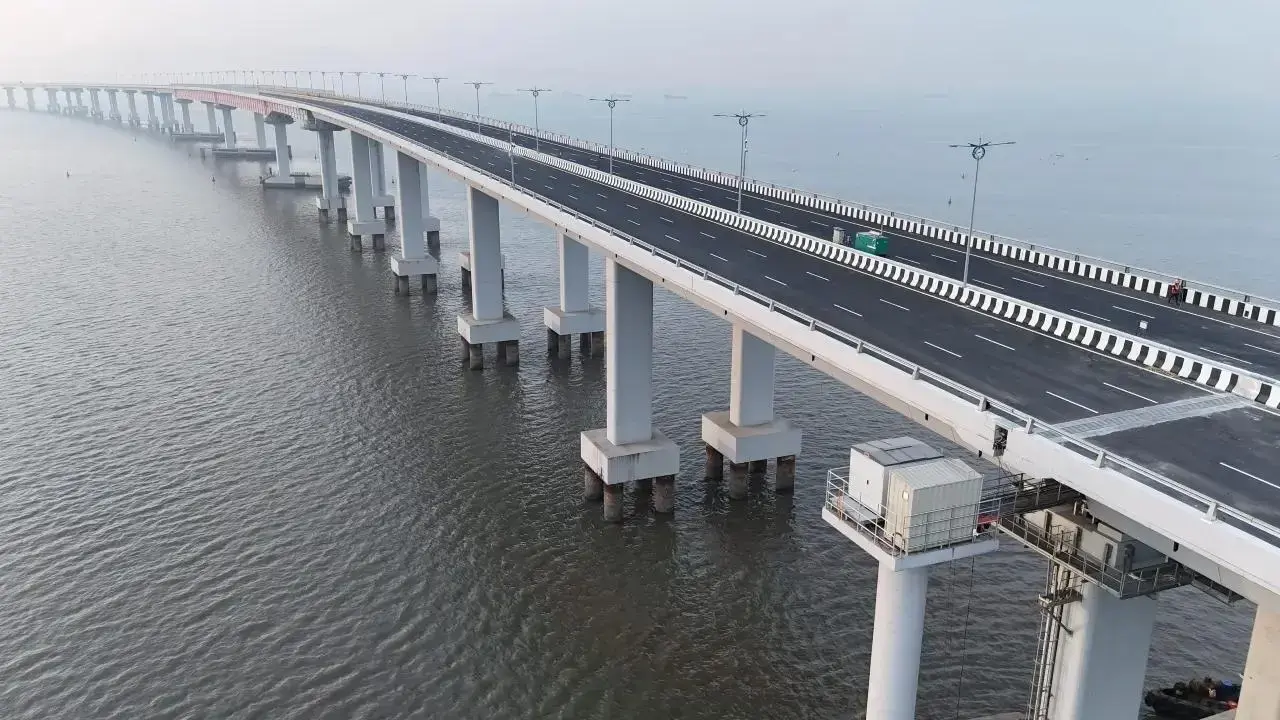
The Maharashtra government has decided to continue toll relief on Mumbai’s critical sea link connecting the island city with Navi Mumbai, extending the existing concession framework through the end of 2026. The decision reinforces the bridge’s role as a strategic connector for the metropolitan region at a time when airport-led growth, housing expansion, and cross-harbour commuting are accelerating.
Under the latest approval, users of the 21-kilometre trans-harbour corridor will retain a 50 per cent reduction on applicable toll charges for another year. In addition, electric motor cars and electric buses will remain fully exempt from toll payments, aligning road pricing with the state’s broader mobility transition goals. The continuation applies for travel between January and December 2026. Urban mobility experts view the Atal Setu toll concession as a calibrated intervention aimed at encouraging modal shift and easing cost pressures for daily commuters and logistics operators. Since opening to traffic, the bridge has significantly shortened travel times between Mumbai’s eastern waterfront and Navi Mumbai’s emerging economic districts, including the airport influence zone. By keeping toll rates moderated, authorities aim to maintain steady traffic volumes while supporting decentralised employment growth beyond the island city.
The bridge, delivered by the regional development authority as one of India’s largest urban sea crossings, is now a vital approach corridor to the newly operational international airport. Industry analysts note that uninterrupted and affordable access is essential for aviation-linked services, hospitality supply chains, and real estate absorption across Navi Mumbai, Ulwe, Panvel, and surrounding nodes. The exemption for electric vehicles is being interpreted as more than a fiscal incentive. Transport planners point out that toll-free access for electric buses improves the viability of zero-emission public transport routes across the harbour, particularly for airport workers and service-sector commuters. Over time, this could help reduce dependence on private fossil-fuel vehicles while lowering per-capita transport emissions in the Mumbai Metropolitan Region.
From a public finance perspective, the continuation of the Atal Setu toll concession reflects a balancing act between infrastructure cost recovery and economic productivity. While toll revenue contributes to long-term maintenance, senior officials indicate that wider economic gains from faster freight movement, labour mobility, and land value unlocking are factored into pricing decisions for strategic assets. Real estate developers and logistics firms have also welcomed predictability in toll policy, noting that stable commuting costs influence both residential location choices and warehouse distribution models. However, urban economists caution that toll concessions should remain time-bound and data-driven, supported by traffic studies and environmental impact assessments.
As Mumbai and Navi Mumbai evolve into a dual-core metropolitan economy, infrastructure pricing will increasingly shape travel behaviour and development patterns. The coming year is expected to test whether targeted toll relief can deliver both equitable access and sustainable transport outcomes at scale.
Maharashtra Extends Atal Setu Toll Concession