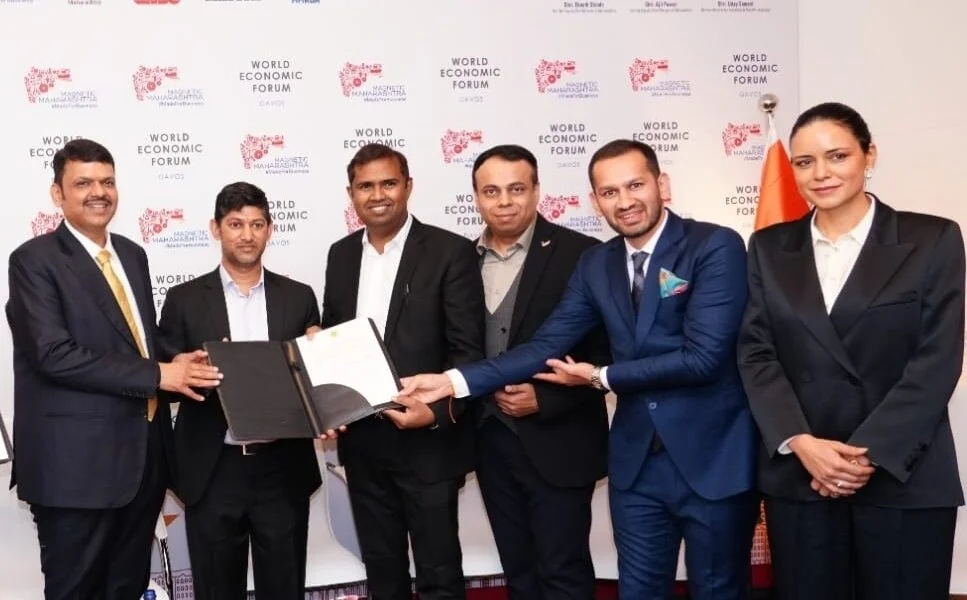
The Government of Maharashtra and a private infrastructure group have agreed to develop a large-scale Sustainable Aviation Fuel (SAF) manufacturing project at Chalisgaon in Jalgaon district, signalling a major step in India’s clean energy industry and rural value creation. The project, backed by a Memorandum of Understanding (MoU) signed at the World Economic Forum in Davos, represents a strategic expansion of industrial capacity within the state and aligns with national goals on energy security and emissions reduction.
Estimated at roughly ₹15,000 crore, the planned SAF facility will convert agricultural residues — including sugarcane bagasse, cotton stalks, soybean husk and pigeon pea waste — into aviation-grade sustainable fuel using internationally certified conversion technologies. Policymakers and sector analysts say this type of fuel, which has a lower carbon profile than conventional jet fuel, is critical to decarbonising air travel and reducing reliance on imported fossil fuels.The phased approach to commissioning seeks to manage investment risk while scaling production capacity through 2029. Urban economists note that such long-duration industrial projects help diversify local economies beyond traditional sectors by anchoring high-value manufacturing in semi-urban and rural districts.
Government officials regard the Maharashtra deal as part of broader efforts to attract clean energy investment and enhance the state’s industrial ecosystem. By partnering with a firm branching out from real estate into energy manufacturing, the state signals confidence in public-private collaboration on sustainability-linked infrastructure. Observers point out that this strategy parallels shifts in global energy markets, where alternative fuels are gaining prominence as nations seek to meet climate targets.Beyond the direct industrial footprint, the project is expected to generate significant economic spillovers. Early estimates indicate thousands of jobs across construction, operations, logistics and supply chains, while long-term feedstock agreements could create stable revenue streams for local farmers who supply agricultural residues previously at risk of open-field burning. Reducing crop burning not only curbs seasonal air quality issues but also enhances rural incomes, aligning with inclusive development goals.
Urban planners and environmental analysts emphasise that integrating SAF production within an existing industrial state like Maharashtra could help reduce transport emissions and reposition the region as a node in India’s emerging low-carbon fuel infrastructure. A sustainable fuel ecosystem also requires scaled renewable-energy inputs, resilient water-use frameworks and alignment with global environmental, social and governance (ESG) standards, which the project’s structuring aims to address.
While full commercial operations are several years away, stakeholders see this agreement as a platform for enhancing domestic SAF supply, supporting the aviation sector’s transition and strengthening Maharashtra’s industrial diversification. For policymakers and industry leaders alike, the focus now shifts to implementation, infrastructure readiness, and ensuring that environmental and socioeconomic benefits materialise alongside production targets.