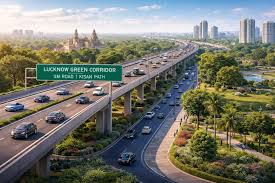
Lucknow Urban Roadmap Drives UP City Transformation
A comprehensive urban transformation roadmap is being rolled out across Uttar Pradesh, aiming to reconfigure cities around ease of living, mobility, and economic productivity. Anchored in the state’s long-term “Viksit UP 2047” vision, the plan seeks to shift urban development from incremental expansion to integrated, systems-led growth.
At the centre of the strategy is the reimagining of Lucknow as a State Capital Region, supported by a network of regional economic hubs aligned with local strengths. These nodes are expected to distribute growth more evenly across districts, reducing pressure on major cities while unlocking employment and investment opportunities in emerging urban centres. A key pillar of the Uttar Pradesh modern cities plan is mobility transformation. Authorities are targeting a significant increase in public transport usage—up to 25%—through a mix of metro rail, rapid rail systems, electric buses, and smart traffic management. The shift is intended to reduce congestion, lower emissions, and improve affordability of urban travel, particularly in rapidly expanding cities.
The roadmap also introduces a “15-minute city” approach under a Liveable Cities Mission, where essential services such as healthcare, education, and markets are accessible within short distances from residential areas. Urban planners note that this model could reduce commute times, improve productivity, and enhance quality of life—an increasingly critical metric in India’s urban policy framework. Governance reforms form another core component. The plan calls for 100% digital delivery of civic services, backed by GIS-based property mapping and Integrated Command and Control Centres for real-time monitoring. These systems aim to improve transparency, streamline taxation, and enable data-driven decision-making across urban local bodies.
Environmental resilience is also embedded in the strategy. Initiatives such as the “Sponge City” model focus on rainwater harvesting, revival of water bodies, and protection of natural drainage systems—measures designed to mitigate urban flooding and improve groundwater recharge. In parallel, waste-to-energy projects are being proposed to reduce landfill dependency and move towards circular waste management systems. Housing and inclusivity remain central to the plan, with expanded provisions for economically weaker and low-income groups alongside mixed land-use development. Experts highlight that such integration is essential to prevent spatial inequality as cities grow and densify. From an urban policy perspective, the Uttar Pradesh modern cities initiative reflects a broader shift in India’s approach to city-building—where infrastructure, governance, environment, and economic strategy are increasingly treated as interconnected systems rather than standalone sectors.
However, execution will be critical. As past experience shows, large-scale urban visions often face challenges in coordination, financing, and on-ground implementation. The success of this roadmap will depend on institutional capacity, inter-agency alignment, and sustained monitoring. As Uttar Pradesh advances this agenda, the focus is not just on building bigger cities, but on shaping urban environments that are efficient, inclusive, and resilient. The coming decade will determine whether these ambitions translate into measurable improvements in how residents live, move, and work across the state’s urban landscape.