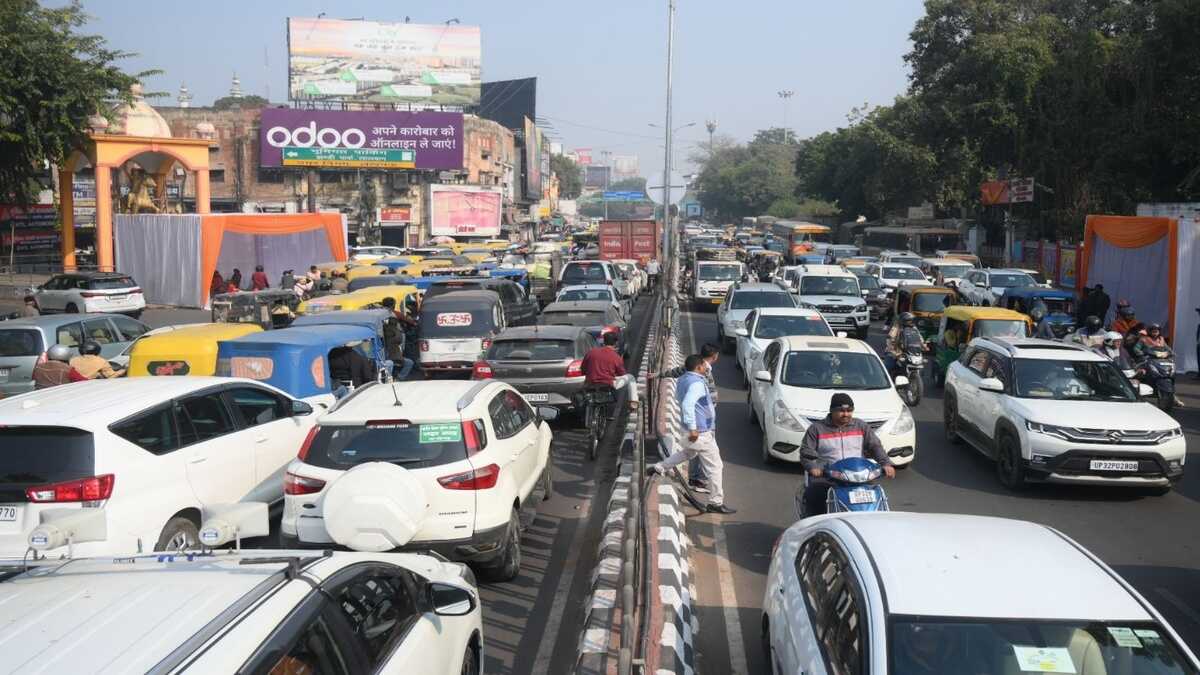
Lucknow’s worsening traffic congestion has prompted the state government to initiate a coordinated governance response, with plans underway to establish a multi-agency mechanism focused on long-term traffic management and road safety improvements. The move reflects growing concern that rising vehicle ownership, combined with daily commuter inflows from surrounding districts, is outpacing the city’s existing road capacity and traffic systems.
Senior state officials overseeing Lucknow have directed district and civic authorities to move beyond ad-hoc measures and develop a comprehensive, location-specific traffic strategy grounded in on-ground assessments. The proposed approach aims to align enforcement, planning and municipal functions under a single framework, recognising that congestion is no longer just a policing issue but a broader urban infrastructure challenge. At the core of the initiative is a dedicated committee bringing together the traffic police, the urban development authority and the municipal corporation. Urban planners say such inter-agency coordination is critical in cities like Lucknow, where road design, land use patterns, parking behaviour and enforcement often function in silos. Without unified planning, temporary diversions or signal adjustments tend to shift congestion rather than resolve it.
Officials involved in the discussions indicate that the panel will map high-density corridors, junction bottlenecks and pedestrian conflict zones, and recommend targeted interventions. These may include revised traffic circulation plans, selective one-way systems, redesigned intersections, time-bound vehicle restrictions and improved roadside management. Importantly, the emphasis is on solutions that can be sustained, rather than short-term fixes deployed during peak congestion hours. Immediate steps are also being taken to reduce pressure in sensitive zones, particularly around high-security and institutional areas, where unmanaged heavy vehicle movement has been identified as a recurring cause of delays. Continuous monitoring has been mandated to ensure that any restrictions introduced translate into measurable improvements in travel time and road safety.
Transport economists point out that congestion carries hidden economic costs for cities, including lost productivity, higher fuel consumption and increased emissions. For Lucknow, which is positioning itself as a regional service and administrative hub, unreliable mobility can undermine both investment attractiveness and quality of life. A structured traffic management plan is therefore seen as integral to the city’s broader growth strategy. The initiative also aligns with evolving urban mobility thinking that prioritises smoother traffic flow, safer streets and reduced dependence on private vehicles. Experts note that effective congestion management must eventually be complemented by better public transport integration, pedestrian-friendly design and demand management measures.
The committee is expected to submit a detailed roadmap in the coming weeks. For residents, the success of the initiative will depend less on announcements and more on whether coordinated planning can finally deliver consistent, predictable movement across one of north India’s fastest-growing state capitals.