


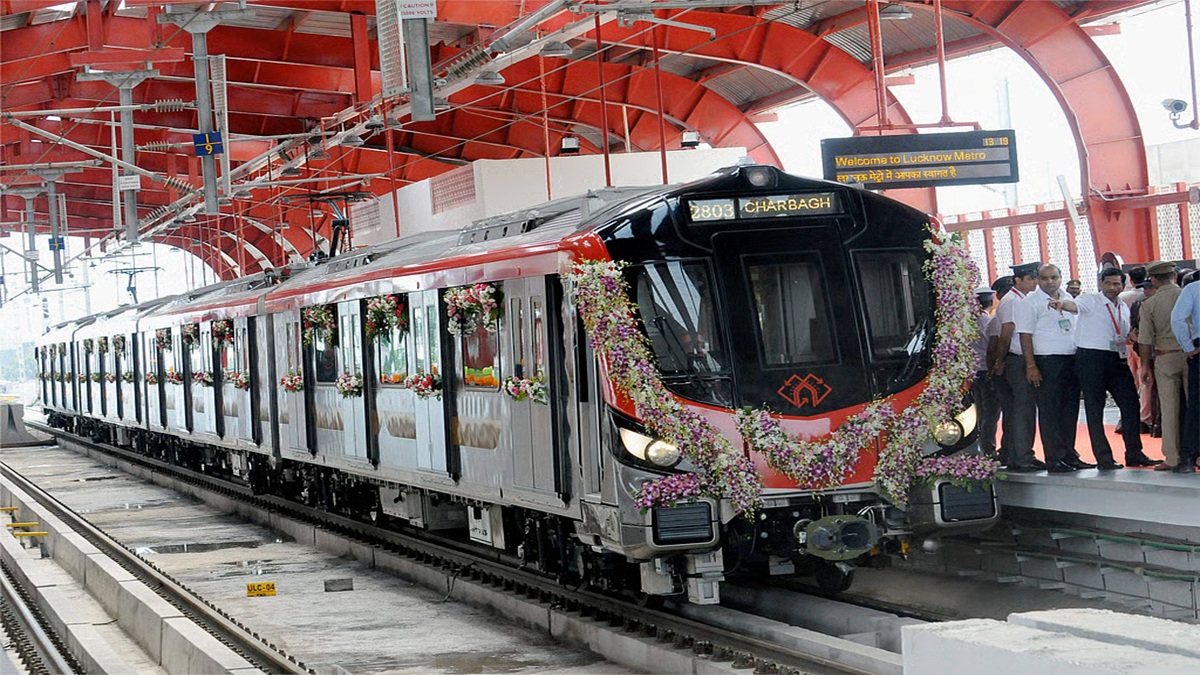
Lucknow’s long-pending east–west metro extension has received a fresh financial injection of ₹550 crore, clearing a key hurdle for the next stage of rapid transit expansion in Uttar Pradesh’s capital. The funding support, comprising a state grant and institutional borrowing, is expected to help advance early works on the Lucknow Metro Phase 1B corridor connecting Charbagh to Vasant Kunj.
Officials in the state’s urban development department confirmed that ₹150 crore has been allocated from the capital budget, while ₹400 crore will be mobilised through loans to support construction and associated infrastructure. The 11.16-kilometre corridor, estimated to cost ₹5,801 crore, forms a crucial link between the historic core of the city and its expanding western neighbourhoods.Urban mobility experts say the renewed financing momentum for Lucknow Metro Phase 1B comes at a critical time, as traffic congestion intensifies along arterial roads passing through Aminabad, Chowk and Thakurganj. The corridor is planned with 12 stations—seven underground through dense inner-city zones and five elevated in peripheral stretches—reflecting the engineering complexity of building mass transit in built-up heritage precincts.
Project authorities have already finalised tenders for civil works, and preliminary site preparations are expected to begin within months. A 40-acre depot is planned at Vasant Kunj to house rolling stock and maintenance facilities. Technical surveys, including soil and geotechnical assessments, have been completed, although station locations may undergo minor adjustments to align with traffic flow and safety requirements.Funding for Lucknow Metro Phase 1B follows a blended model. Apart from state support and borrowings, the Union government is expected to release its share in tranches. Bank financing is projected to account for nearly half the total project cost. Transport economists note that such multi-source financing structures are now standard for urban rail projects, but long-term viability will depend on ridership growth and integrated land use planning.
The corridor is designed to ease pressure on central Lucknow by offering uninterrupted travel across some of the city’s most crowded commercial and residential districts. Planners argue that reliable metro access can reduce private vehicle dependence, lower particulate emissions and encourage transit-oriented development around station areas.Real estate analysts expect property values along the alignment to strengthen once construction progresses, particularly in neighbourhoods previously underserved by mass transit. However, they caution that equitable housing policies and pedestrian-friendly design must accompany metro-led growth to prevent speculative displacement.
Authorities are also exploring external financing avenues to widen the capital base for Lucknow Metro Phase 1B, signalling confidence in the project’s long-term demand. As groundwork advances, attention will shift to construction timelines and cost management—factors that will determine whether the expansion can meaningfully reshape mobility patterns in one of north India’s fastest-growing urban centres.
Also Read:Maharashtra Govt Signs MoUs For Health Water And Livelihood
Lucknow Metro Phase 1B funding unlocked
