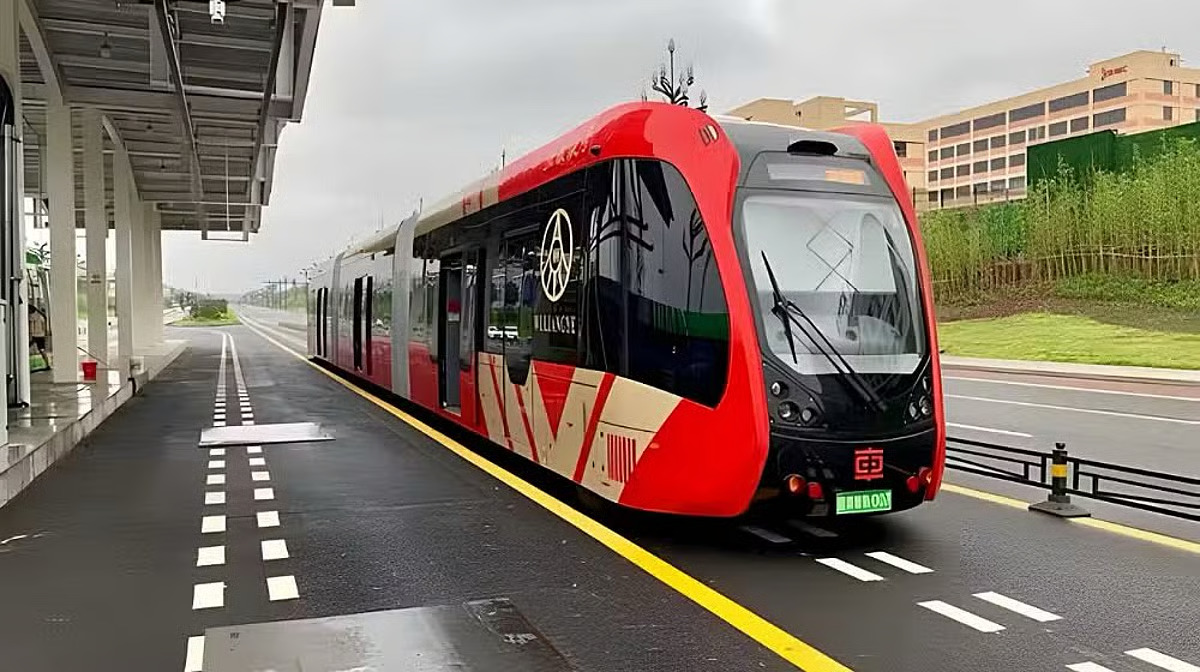
Lahore Trials South Asia’s First Smart Trackless Metro System
In a move poised to reshape public transportation in the region, Lahore has launched South Asia’s first trackless metro trial, introducing a cutting-edge transit model designed to offer greener, smarter, and more inclusive mobility. The pilot system mimics traditional metro operations but without rails, running autonomously on roads using GPS, sensors, and digital mapping. Fully electric and battery-powered, the metro trial marks the beginning of a broader initiative aimed at building sustainable, affordable, and equitable public transit networks in densely populated cities that struggle with conventional infrastructure costs and space limitations.
The trial near Lahore Airport signals a bold step in urban innovation for the region. Unlike conventional metro systems that demand extensive civil works, this model operates without steel tracks or elevated corridors. Instead, it relies on virtual track technology, allowing greater route flexibility and faster deployment. Transport officials overseeing the trial stated that this could drastically reduce project time and cost, while simultaneously offering the public a cleaner alternative to high-emission private transport. With its electric coaches capable of transporting up to 300 passengers, the trackless metro system promises high-frequency, low-emission urban connectivity. This initiative is part of Punjab’s ambitious transport master plan, which aims to revolutionise mobility in 30 cities through an Automated Rapid Transit (ART) model. The model envisions multiple-coach, solar-powered electric vehicles delivering fast and frequent services across urban corridors, bypassing the need for rails or flyovers.
Experts suggest that such systems could help close the mobility gap for millions in underserved areas by bringing down the operational and infrastructural costs typically associated with metro systems. The goal, officials said, is not just to build infrastructure but to build equity in access to mobility. Initial rollouts are planned in Lahore, Faisalabad, and Gujranwala, followed by further expansion across 10 cities each year for the next four years. The decision to prioritise mid-sized urban centres acknowledges the growing need for inclusive and scalable transit solutions in fast-growing towns often overlooked by large-scale metro projects. Officials noted that each trackless vehicle could replace around 100 cars on the road, significantly cutting noise, air pollution, and traffic congestion, while improving quality of life for urban dwellers. Moreover, with solar-powered systems, the model supports regional net-zero ambitions.
Public response to the Lahore pilot will shape the technology’s future in the region. If trials prove successful, formal operations could commence by 2026, potentially extending to major cities like Karachi and Islamabad. Urban mobility analysts believe the model offers a viable blueprint for other South Asian cities facing infrastructure strain. By combining the agility of buses with the precision of rail systems, trackless metros may become the preferred alternative for cities seeking low-carbon, space-efficient, and socially inclusive transport networks.