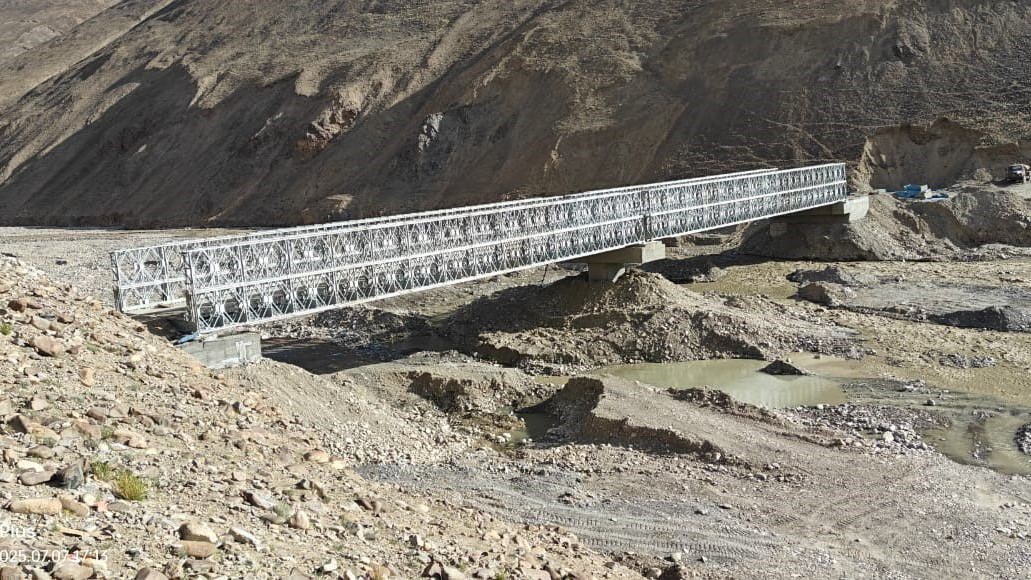
Ladakh Bridge Boosts Connectivity Across Remote Military Corridor
In a major stride towards strengthening India’s border infrastructure, a newly launched modular bridge in Ladakh is helping connect one of the country’s most remote and strategic routes. Developed and installed in just 20 days by a defence public sector unit, the double-lane steel bridge now spans the Phobrang–Marsimik La–Hot Spring road, enhancing seamless movement for both civilians and military units in the ecologically fragile region. With wide carriageways and advanced modular design, the bridge not only ensures troop and equipment mobility but also symbolises India’s push towards resilient, self-reliant infrastructure in high-altitude areas.
The bridge’s launch in record time is being seen as a significant achievement in the ongoing modernisation of remote Himalayan roadways. Officials involved in the effort cited the terrain’s extreme altitude, harsh weather, and logistical barriers as major challenges overcome through precise planning and innovation. The 280-foot bridge was designed to permit two-way traffic, thereby reducing bottlenecks and ensuring rapid deployment in strategic zones near the international border. The structure, entirely fabricated within India, adheres to national road safety and engineering standards, aligning with eco-sensitive design norms. By creating roadways that are robust yet minimally invasive to the terrain, such efforts contribute to the region’s long-term resilience against both climatic and security threats. Authorities assert that the project is part of a larger initiative to fortify border areas with climate-resilient and rapidly deployable infrastructure. The steel used in the bridge is engineered to endure snow loads, temperature extremes, and seismic activity, while allowing for quick dismantling and relocation if needed.
This flexibility is critical in high-conflict zones, but also opens new possibilities for sustainable development in isolated regions. The defence PSU behind the construction has already delivered over 50 similar modular bridges across the country, all tailored for challenging terrain while maintaining sustainability goals and carbon-conscious designs. Each installation reflects India’s pivot towards greener, more agile engineering in response to strategic and environmental demands. Local communities are also expected to benefit from improved access, as these high-altitude roads serve as lifelines for remote settlements. Officials noted that better connectivity can facilitate emergency medical aid, resource delivery, and even controlled tourism in alignment with environmental thresholds. However, experts stress that such developmental gains must be balanced with ecological safeguards, especially in regions facing glacier retreat and biodiversity loss.
As India continues to reimagine infrastructure in line with its net-zero and self-reliance goals, projects like the Ladakh bridge reflect a shift towards modular, environmentally adaptive engineering. While the strategic implications are clear, the broader potential lies in building a development model that serves national security and climate equity in equal measure. For remote communities and defence agencies alike, such bridges are more than steel and bolts—they are links to opportunity, stability, and resilience.