

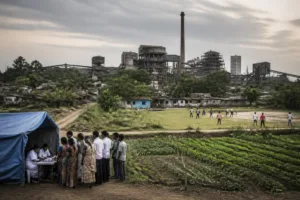
The latest health screening in Kymore, Katni district, has produced one suspected tuberculosis case and 100 sputum samples under testing, but its larger significance lies in what the exercise cannot establish. In a town with a long industrial history of asbestos exposure, screening 274 residents over two days is not enough to measure the full disease burden or determine whether people at risk are receiving sustained medical surveillance.
The camp was held on October 9 and 10 for residents living in and around the defunct Kymore plant. Health department officials said 112 people attended on the first day and 162 on the second. Of those screened, about 100 provided sputum samples for CBNAAT testing, a molecular diagnostic method that can detect tuberculosis bacteria and identify resistance to rifampicin, a key anti-TB drug. One participant showed suspected symptoms, but the case has not been confirmed.
That distinction matters. The camp has generated a diagnostic process, not a prevalence estimate. A positive or suspected result can identify an individual who requires follow-up, but the number of people screened cannot by itself show how widespread infection is across Kymore. Experts cited by The Times of India said the exercise was too limited to establish the extent of infection and that a wider, systematic survey would be needed.
The immediate public-health question is therefore narrower than the broader urban question. The samples may clarify whether the suspected case involves tuberculosis and whether any drug resistance is present. They do not, on their own, answer how many residents have been exposed to asbestos, how many have developed asbestos-related disease, or whether former workers and affected households remain under observation.
Kymore’s industrial history makes those unanswered questions more consequential. The town was home to India’s first asbestos factory, established in 1933. The plant is now defunct, but the concerns linked to its legacy extend beyond the factory premises. A 2016 assessment by Canadian environmental consultancy ECOH Management documented asbestos contamination in Kymore and neighbouring Kalhara, including material found in residential yards, agricultural fields and playing areas.
That finding changes the way a health camp should be understood. If contamination is confined to a controlled industrial site, worker-focused medical surveillance may be the central administrative task. If asbestos-containing material is present in places where people live, farm and play, the affected population becomes harder to define. Exposure may involve former workers, family members, neighbouring households and residents who have no formal connection with the factory.
The available evidence does not establish how many people in Kymore have been exposed or how many have developed asbestos-related illnesses. It does, however, point to a record-keeping problem. A Times of India investigation published on September 25 reported the absence of a consolidated government database documenting residents exposed to asbestos, people diagnosed with related diseases, or those who may have died from their effects.
That missing database is not a minor administrative inconvenience. It affects the ability of public agencies to identify the population requiring screening, track diagnoses over time, connect people to treatment and evaluate whether compensation has been followed by continuing care. Without a common record, different departments may hold fragments of the same history without any institution having a complete picture of the town’s health burden.
The uncertainty also extends to people who have already entered a formal claims process. The T&N Trust, established in the United Kingdom to handle asbestos-related claims linked to Turner & Newall, has settled claims by Indian citizens, including more than 1,000 people from Kymore. The available attendance records do not establish whether beneficiaries who received compensation through the trust attended the recent camps.
This gap illustrates the difference between compensation and surveillance. A settlement may recognise an individual claim, but it does not necessarily create a continuing public-health system for a locality. The supplied report does not establish whether compensation recipients are receiving regular medical checks. It identifies that question as unresolved, making it impossible to determine from the current records whether one of the town’s most clearly documented groups is being systematically followed up.
The limits of event-based screening
The two-day camp represents an event-based response: residents are invited to attend, symptoms are assessed and samples are collected. Such camps can be useful for reaching people quickly, particularly where access to routine care is limited. They can also generate referrals and bring previously undiagnosed cases into the health system.
But an event-based camp has structural limits when the underlying risk is historical and geographically dispersed. Attendance depends on awareness, mobility, trust, timing and the perceived relevance of the exercise. People who are elderly, unwell, economically constrained or no longer connected to the former factory workforce may be less likely to attend. The report does not provide a demographic breakdown of the 274 participants, so it cannot show whether the camp reached the groups most at risk.
The number of people screened also needs to be read against the size and distribution of the affected area. Kymore and neighbouring Kalhara contain residential, agricultural and recreational spaces where the 2016 assessment reportedly found asbestos contamination. The camp figures therefore provide a count of participation, not a map of exposure or a representative sample of the population.
The use of CBNAAT is significant for the samples that have been collected. The test can detect tuberculosis bacteria and identify rifampicin resistance, allowing health officials to move beyond symptom-based assessment for those tested. Yet the technology does not resolve the broader problem of asbestos-related disease surveillance. The current exercise is focused on tuberculosis testing, while the unresolved questions include the extent of asbestos exposure and whether residents have developed related illnesses.
The distinction between tuberculosis and asbestos-related disease is essential. The report records a suspected tuberculosis case and testing of sputum samples; it does not establish that asbestos exposure caused tuberculosis or that the suspected case is related to the former plant. Nor does the camp’s outcome confirm or rule out asbestos-related illness among residents who attended. The evidence supports concern about an incomplete health response, not a conclusion about causation.
A governance problem as much as a medical one
Kymore’s case demonstrates how industrial legacies can fall between administrative responsibilities. Health officials may organise screening, while environmental authorities hold contamination assessments, local administrations maintain population records, and compensation trusts or other institutions retain claimant information. If these records are not linked, public agencies cannot easily identify who needs what kind of intervention.
The reported absence of a consolidated government database is particularly important because asbestos-related illness can involve long intervals between exposure and diagnosis. The supplied material does not provide a timeline for individual cases or describe a current surveillance programme. It does show that the town’s exposure history stretches back decades, beginning with the factory’s establishment in 1933, while the environmental assessment cited in the report was conducted in 2016.
This creates a continuity problem. A single camp in 2026 can record attendance and collect samples, but it cannot substitute for an institutional record that follows residents over time. Without consistent case definitions, exposure histories, test results and follow-up status, each new camp risks becoming a fresh starting point rather than one stage in a cumulative health-monitoring system.
The same problem affects public accountability. If authorities cannot state how many people have been screened, diagnosed, treated, compensated or placed under surveillance, it becomes difficult to assess whether official action is reaching the population identified as vulnerable. The available information does not show that such a system exists in consolidated form.
The T&N Trust claims add another layer. More than 1,000 Indian citizens from Kymore reportedly received settlements, but the current attendance records do not show whether claimants participated in the camp. That does not prove that they were excluded from care. It does show that the available camp data cannot answer whether a recognised group of affected residents has been integrated into present-day monitoring.
What the current evidence confirms
The evidence supports four clear conclusions. First, 274 people attended a two-day screening camp in Kymore, with 100 sputum samples undergoing CBNAAT testing. Second, one suspected tuberculosis case was identified, but it remains unconfirmed. Third, experts consider the exercise insufficient to establish the extent of infection in the town. Fourth, longstanding asbestos exposure concerns exist alongside an absence of a consolidated government database covering exposure, related disease and deaths.
The evidence does not establish the prevalence of tuberculosis in Kymore, the number of residents with asbestos-related disease, the precise boundaries of contamination, or whether compensation recipients are receiving continued medical surveillance. It also does not show that the suspected tuberculosis case is linked to asbestos exposure or to the former plant.
Those limits are not reasons to dismiss the camp. They are the reason to interpret it as an initial screening exercise rather than a definitive assessment. The pending CBNAAT results may clarify the immediate status of the samples collected. The larger public-health issue will remain whether authorities can build a systematic record of exposure and disease across Kymore and neighbouring areas.
Kymore’s asbestos legacy therefore presents a test of whether urban and industrial health governance can outlast the factories that created the risk. The next meaningful developments are the confirmation of the suspected case, the results of the 100 samples, and evidence of whether authorities undertake the wider survey and consolidated record-keeping that experts say are needed.