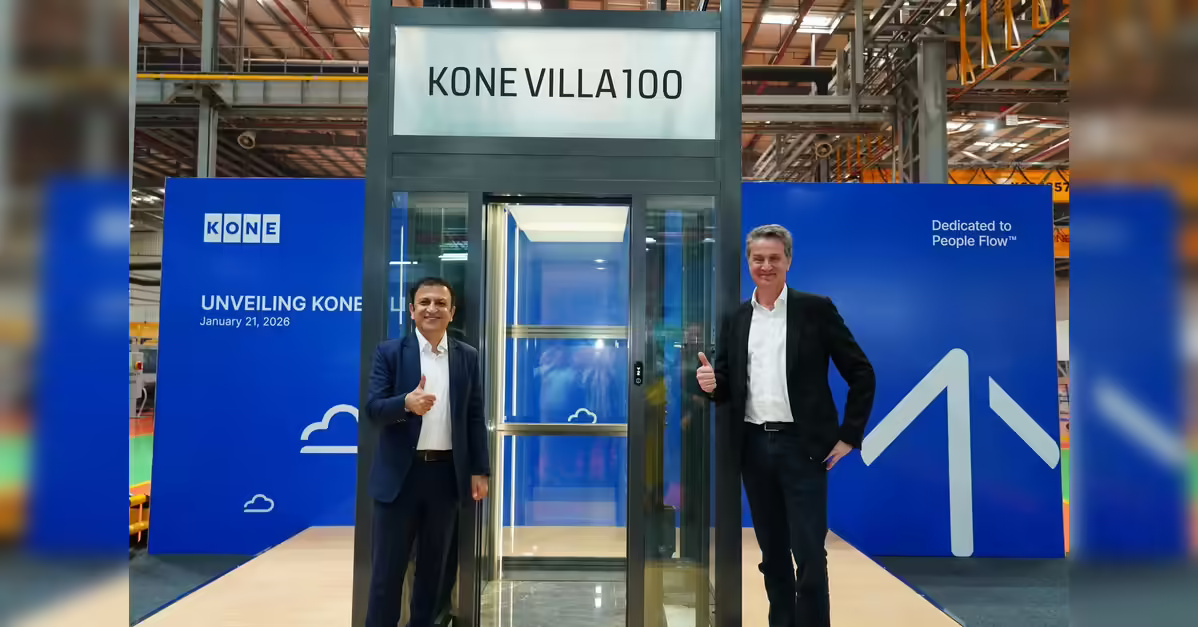
A new residential mobility solution has been introduced from KONE India’s manufacturing facility in Sriperumbudur, Tamil Nadu, signalling the company’s deeper alignment with India’s evolving housing market. The launch of the KONE Villa 100 home elevator marks a strategic move to address the growing demand for compact, energy-efficient mobility solutions within independent homes, villas, and low-rise residential developments across urban and semi-urban India.
The unveiling took place at KONE’s Sriperumbudur supply unit, underscoring the facility’s expanding role beyond domestic assembly into full-scale manufacturing and regional product development. Industry observers view this as part of a broader trend where global building technology firms are increasingly using India as a base for engineering, production, and innovation, driven by rising housing demand, cost efficiencies, and strengthening industrial ecosystems. Unlike commercial elevators designed for high footfall and large building cores, home elevators face unique architectural and operational constraints. Space limitations, residential power configurations, and noise sensitivity significantly influence adoption. According to company officials familiar with the product roadmap, the KONE Villa 100 has been engineered to operate on a standard single-phase household power supply, removing the need for costly electrical upgrades that often deter homeowners.
From a technology standpoint, the elevator uses gearless traction machinery with variable frequency control, enabling smoother starts and stops while reducing vibration and operational noise. Urban housing experts note that such features are particularly relevant in dense residential settings, where elevators often operate adjacent to living spaces and bedrooms. Quiet operation and reliability are therefore central to user acceptance. Energy efficiency has also been prioritised in the design. The system automatically powers down lighting and ventilation when idle, resuming operation only when summoned. While modest in isolation, such measures resonate strongly in Indian households where energy costs, backup power dependence, and sustainability considerations increasingly influence purchasing decisions. Built environment analysts argue that incremental efficiency gains across residential technologies can collectively contribute to lower household energy loads and reduced carbon footprints.
Safety remains a core requirement in residential mobility, especially for multi-generational households. The Villa 100 includes automatic rescue features to ensure the elevator reaches the nearest landing during power interruptions, along with controlled braking and emergency lighting. These features align with prevailing residential safety standards without positioning the system as a heavy-duty alternative to commercial lifts. The company has not disclosed pricing or production targets, though officials indicated that manufacturing will be localised at the Sriperumbudur plant and focused initially on the Indian market. Real estate developers and architects see the timing as significant, with demand rising for age-friendly housing, accessibility upgrades, and lifestyle-driven home improvements in premium and mid-segment residential projects.
Beyond the product itself, the launch reflects a wider shift in how global infrastructure and mobility firms view India. Increasingly, the country is not just a consumption market but a design and manufacturing hub shaped by local housing patterns and urban realities. As Indian cities expand outward with low-rise developments and private housing, residential mobility solutions like the Villa 100 may play a growing role in making homes more inclusive, adaptable, and future-ready.
KONE Introduces Compact Home Lift For Indian Housing Market