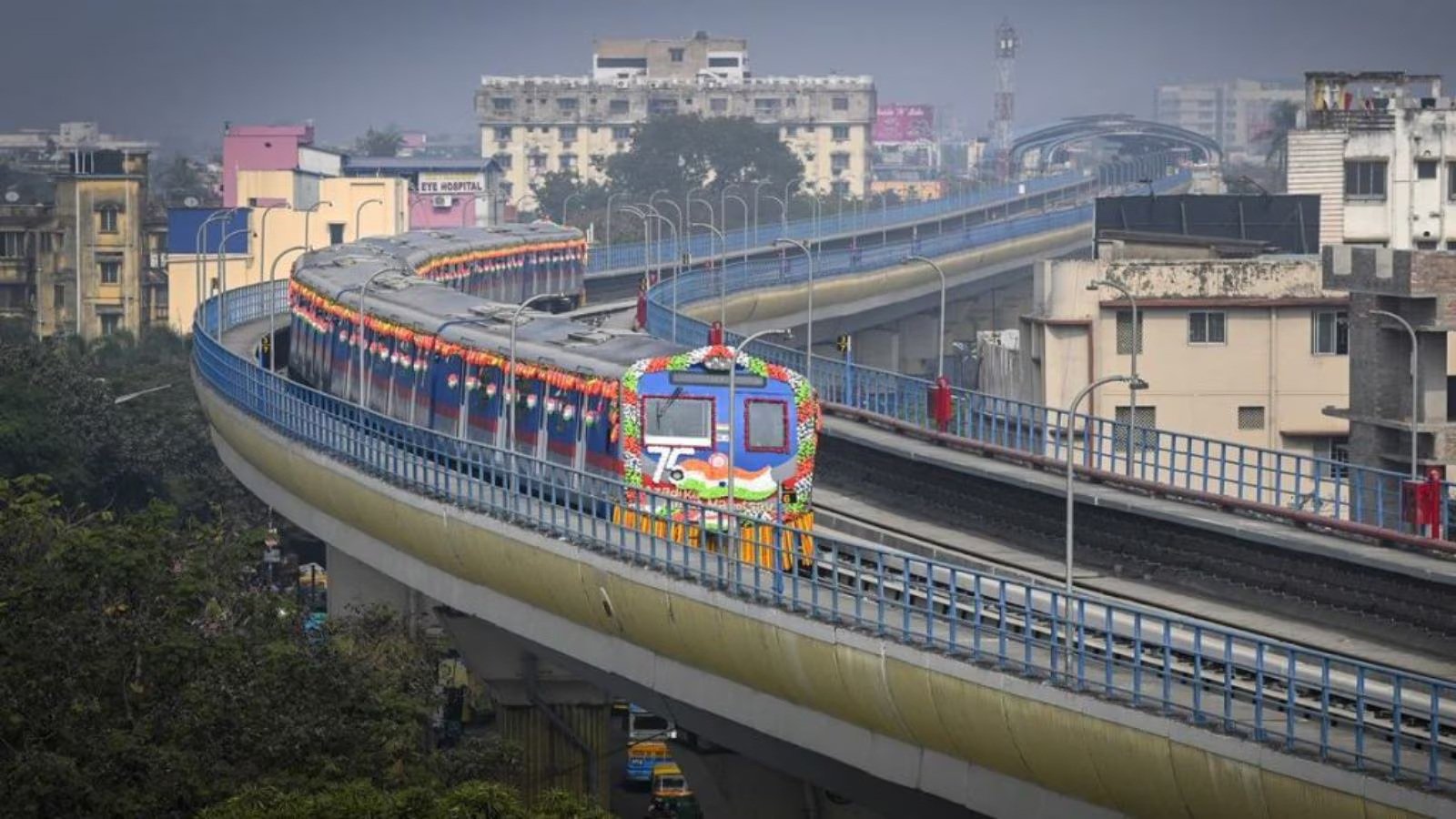
Kolkata’s rapid transit network will operate on a curtailed timetable on Tuesday as the city observes Holi, with services across all corridors beginning only in the afternoon. The temporary reduction by Kolkata Metro Railway affects thousands of daily commuters and highlights how festival-linked mobility planning continues to shape transport demand patterns in Indian metros.
Under the revised Holi schedule, the Blue Line, the city’s busiest north-south corridor linking Dakshineswar and Shahid Khudiram, will run just 60 services, split evenly in both directions. On a regular weekday, that number exceeds 270. Trains on this corridor will begin operations from around 2.30 pm, replacing the early morning departures that typically serve office-goers, students and small traders. Other corridors will follow a similar pattern. The east-west Green Line connecting Howrah Maidan and Salt Lake Sector V will operate 45 services, significantly lower than usual weekday frequencies. Services on this stretch are set to begin shortly after 3 pm. The airport-bound Yellow Line, the Purple Line serving the southwestern suburbs, and the Orange Line in the eastern flank will also operate reduced afternoon-only schedules. Transport planners note that festival days see sharply lower morning ridership as commercial establishments and offices remain closed. However, evening mobility tends to rebound as residents travel for social visits and community gatherings.
By retaining standard last-train timings, the metro authority appears to be balancing operational cost control with commuter convenience. For a dense urban region such as Kolkata, where public transport is central to economic inclusion, even a single-day schedule revision carries implications. Informal workers, hospital staff and airport passengers often rely on early services. Reduced frequencies may push some commuters towards road-based modes, potentially increasing traffic congestion and emissions, a challenge at a time when cities are striving to lower carbon intensity. Urban mobility experts say such calibrated holiday scheduling is common in global transit systems but requires clear public communication to avoid last-minute disruptions.
As Kolkata expands its metro footprint with new corridors under construction service predictability will remain critical to building trust in mass transit as a reliable alternative to private vehicles. The Holi timetable underscores a broader question for rapidly urbanising cities: how to maintain operational efficiency without compromising equitable access. With metro rail positioned as the backbone of low-emission transport, even festival-day planning decisions play a role in shaping commuter behaviour and the long-term sustainability of the city’s transport ecosystem. As Kolkata continues to invest in rail-based infrastructure, aligning service design with evolving travel patterns will be key to ensuring that growth remains both climate-conscious and commuter-friendly.