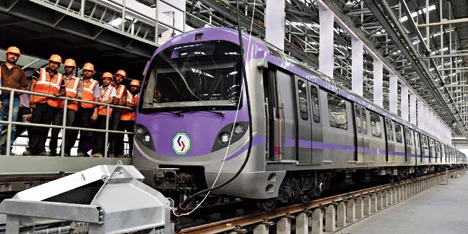
A boundary structure at a New Town residential complex has partially collapsed after excavation along a peripheral canal linked to an ongoing Metro depot project, raising concerns over construction oversight and stormwater management in one of Kolkata’s fastest-growing townships. Residents of a housing complex in Action Area IIB say a stretch of their rear boundary wall began tilting outward during the monsoon after earth was removed along the canal embankment. The weakened base gave way, leaving the upper section propped up temporarily. The site lies adjacent to land where Rail Vikas Nigam Limited is developing infrastructure connected to Kolkata Metro Railway operations. The canal works fall under the jurisdiction of the New Town Kolkata Development Authority.
Residents argue that excavation near the canal edge destabilised soil supporting their boundary foundation. They also point to incomplete installation of precast box culverts along the water channel, alleging that temporary barriers used during construction failed under heavy rainfall, allowing water to backflow and saturate exposed clay. Urban planners note that canal-edge works require careful geotechnical assessment, especially in low-lying, reclaimed landscapes like New Town. “Peripheral drainage channels are critical for monsoon resilience. Any modification without coordinated retaining or slope-protection measures can compromise adjoining properties,” said an infrastructure consultant familiar with township drainage design.
Beyond structural damage, residents fear disruption to the complex’s stormwater outlets. Several discharge pipes that previously drained directly into the canal now appear misaligned with culvert openings. Accumulated silt and backfilled clay have narrowed flow paths, raising the risk of localised flooding during peak rainfall. In high-density townships, even minor drainage bottlenecks can translate into basement seepage, road waterlogging and public health risks. A senior official from the development authority confirmed that repair work to the boundary structure has been included in the next execution phase and indicated that contractors have been instructed to undertake masonry restoration. The authority also plans to create an integrated side-drain network to channel runoff into the covered section of the canal.
The canal-covering initiative is part of a broader effort to prevent solid waste dumping and mosquito breeding while reclaiming land for landscaping. Similar pilot interventions have been attempted in other parts of New Town to balance sanitation goals with open-space enhancement. However, urban governance experts caution that infrastructure upgrades must not undermine adjacent private assets or hydrological flows. As New Town expands with Metro-linked growth and real estate densification, coordination between agencies overseeing transit, drainage and township planning will be crucial. For residents, the immediate priority remains structural safety before the next monsoon cycle. For the city, the episode underscores a larger lesson: climate-resilient urban development depends not just on new projects, but on how existing systems are protected in the process.