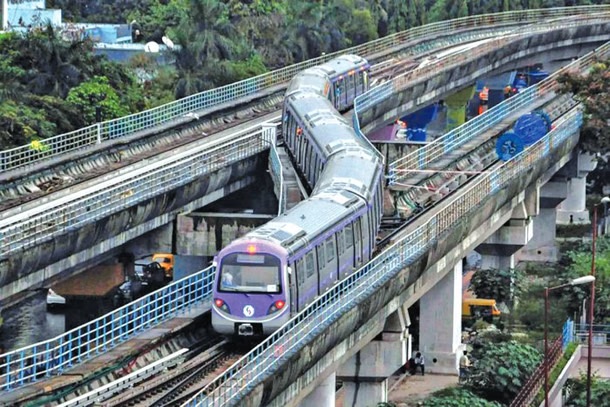
Kolkata’s underground metro network has introduced a Battery Energy Storage System (BESS) along its busiest corridor, marking a first for Indian Railways and strengthening operational resilience during grid disruptions. The system, installed on the Blue Line’s subterranean stretch, is designed to ensure trains can reach the next station safely in the event of a sudden power failure, a move that carries implications for commuter safety, energy efficiency and urban sustainability.
The 4 MW Battery Energy Storage System is supported by a 6.4 MWh lithium iron phosphate battery array, a chemistry known for thermal stability and longer life cycles. According to railway officials, the system functions as an on-site microgrid, capable of supplying traction power sufficient to move a stranded train at moderate speed from a tunnel section to the nearest platform. Simultaneously, it maintains ventilation and environmental control systems inside underground stations, a critical safety function in a dense, high-footfall network. For a city where peak-hour ridership runs into hundreds of thousands, uninterrupted mobility is more than convenience; it underpins economic productivity. Transport economists note that even brief service disruptions can cascade into city-wide delays, affecting workplaces and commercial activity. By reducing dependence on diesel-based backup generation, the Battery Energy Storage System also signals a shift toward cleaner contingency infrastructure.
Urban energy planners say such systems are increasingly relevant as Indian cities grapple with fluctuating grid loads and extreme weather events. Battery storage can stabilise voltage, manage sudden demand spikes and improve power factor all of which translate into lower transmission losses and potentially reduced energy bills for public operators. Over a projected lifespan of more than a decade, lifecycle emissions are expected to be significantly lower than conventional generator backups. The project aligns with the national push for advanced battery manufacturing and domestic energy storage ecosystems. It also reflects a broader rethinking of transit resilience, particularly in underground environments where evacuation challenges are magnified during outages.
Kolkata, home to the country’s oldest metro system, is gradually modernising legacy infrastructure to meet contemporary safety and climate benchmarks. Experts suggest that integrating storage-backed microgrids into mass transit could become standard practice as metro networks expand in other Indian cities. For daily commuters, the upgrade may remain largely invisible. Yet its impact could be decisive during emergencies ensuring trains move, tunnels remain ventilated, and one of India’s most storied urban transport systems operates with greater certainty in an era of growing energy volatility.