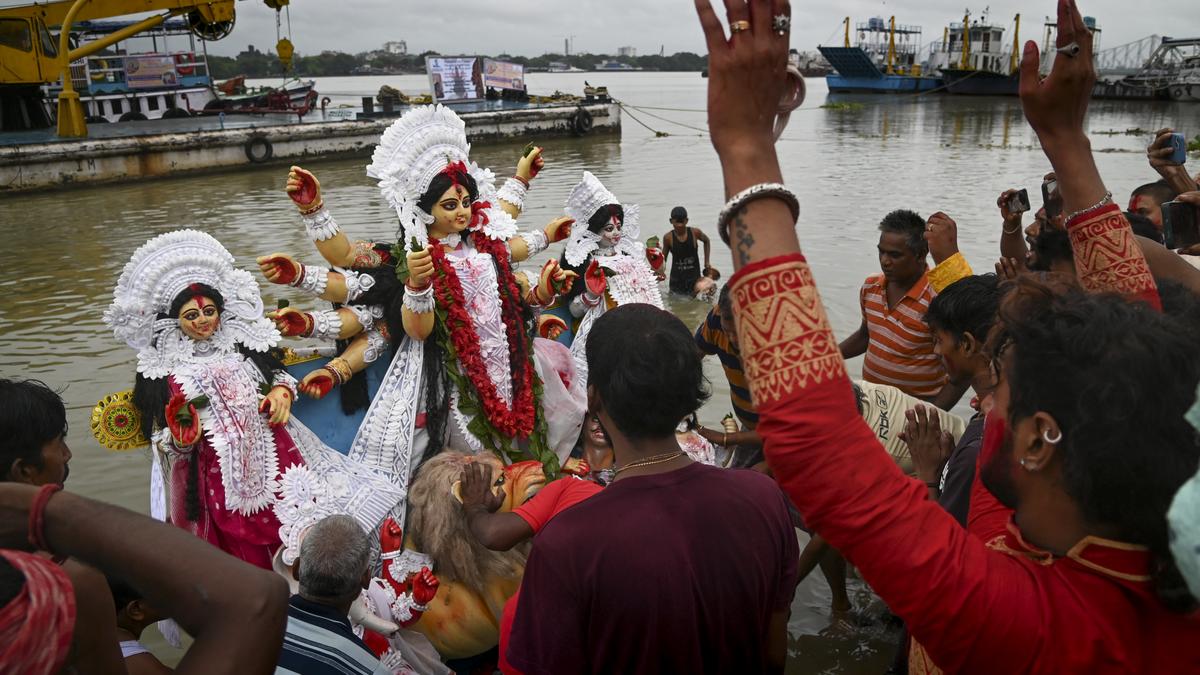
Kolkata Immerses 4300 Durga Idols Across Ghats Safely This Year
Kolkata witnessed one of its largest annual ritualistic congregations as nearly 4,300 Durga idols were immersed across the city’s Hooghly ghats and surrounding water bodies. On the main day of Dashami, approximately 3,000 idols were carried to the river, with another 1,300 immersed the following day, representing nearly a quarter of the city’s Puja installations. Authorities mobilised extensive measures to ensure safety, traffic management, and environmental mitigation throughout the process.
The Kolkata Municipal Corporation (KMC) and Kolkata Police coordinated efforts across 34 major Hooghly ghats and more than 30 water bodies. River Traffic Police patrolled the stretch until Sunday, supported by 18 life boats and 62 disaster management teams stationed along the ghats. Officials also deployed police boats with divers to manage large crowds and respond promptly to emergencies. Bajekadamtala Ghat, popularly known as Babughat, emerged as a focal point of activity, hosting around 450 idol immersions, with 60% contributed by housing complexes and individual households.
Other suburban water bodies, including ponds in Patuli, Layelka, and Sarsuna College jheel, collectively received roughly 1,200 idols. Despite rain intermittently affecting the process, immersions proceeded late into the night, with local porters tirelessly ferrying idols into the river. Safety and operational efficiency were central to planning, especially to protect women and children navigating underground corridors and blind spots at ghats. Officials highlighted that enhanced security protocols and careful monitoring prevented major incidents, ensuring that celebratory traditions continued without significant disruption. While central Kolkata benefited from immersion tanks, cranes, and water-jet cleaners, suburban stretches in the Kolkata Metropolitan Area faced challenges. Unregulated immersions in Howrah and other zones released chemicals into waterways, underscoring the ongoing environmental impact of festive activities.
Environmental experts stress that unless a metropolitan-wide approach is adopted, the Hooghly River will continue to bear significant ecological strain despite city-level mitigation efforts. Kolkata Port provided additional support by deploying clean-up machinery at major ghats including Babughat, Judges, and Nimtala, reflecting collaborative measures between civic authorities and state agencies. The concerted effort highlights the city’s attempts to balance cultural tradition with public safety and environmental responsibility. This year’s immersion schedule reaffirmed the city’s logistical capabilities, showcasing coordination between municipal authorities, police, and disaster management teams while spotlighting the environmental consequences of mass religious celebrations. Citizens and authorities alike are being urged to adopt more eco-friendly practices in future Puja celebrations to protect the Hooghly and neighbouring water systems.