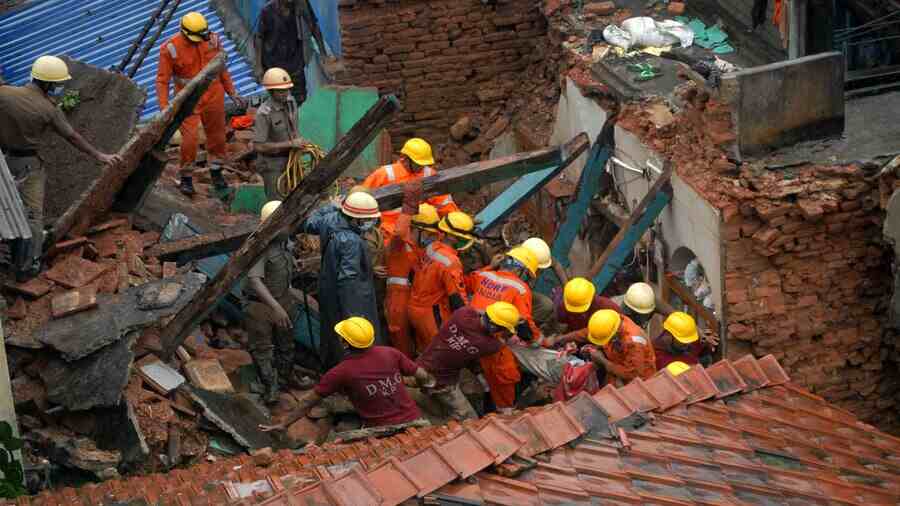
Kolkata’s municipal administration has initiated a citywide enforcement drive to remove structurally unsafe buildings, signalling a tougher approach to ageing urban infrastructure as the monsoon season approaches. The move follows a recent building collapse in south Kolkata and underscores growing concern over public safety in some of the city’s oldest and most densely occupied neighbourhoods.
Officials from the municipal buildings department confirmed that a special legal provision is being used to fast-track action against structures deemed beyond repair. The mechanism allows senior civic authorities to issue immediate orders for partial or complete demolition where delays could pose a serious risk to life. The strategy reflects an acknowledgement that conventional inspection and notice-based processes have struggled to prevent accidents in a city with a large stock of pre-independence buildings. A recent technical assessment identified close to 300 properties across multiple boroughs as potentially hazardous, with more than half requiring urgent intervention. Many of these structures are concentrated in north and central Kolkata, where narrow streets, mixed residential-commercial use and heavy footfall amplify the danger posed by weakened buildings. In several cases, residents may be required to vacate entirely ahead of demolition, particularly where monsoon rainfall could accelerate structural failure.
Urban engineers involved in the assessment process note that the challenge lies not only in visible decay but in internal deterioration that often escapes routine checks. Ageing load-bearing walls, corroded reinforcement and unauthorised alterations have left many buildings vulnerable despite outwardly intact façades. Recent collapses have prompted the civic body to review inspection protocols, with a renewed emphasis on access to internal structural elements rather than surface-level evaluation. The safety drive also intersects with broader questions of housing supply, heritage conservation and inclusive redevelopment. In neighbourhoods such as Burrabazar, Pathuriaghata and Ahiritolla, ownership disputes, absentee landlords and long-term neglect have stalled repairs for years. Tenants, many from lower-income groups, have repeatedly sought civic intervention as private maintenance efforts proved unsustainable.
To address resistance linked to displacement fears, the municipal authority has paired enforcement with redevelopment incentives. Property owners whose buildings are removed under safety orders are being offered additional development rights if they rebuild in compliance with current regulations. Urban planners view this as an attempt to align risk reduction with responsible densification, allowing safer housing to emerge without pushing residents to the city’s periphery. From a climate resilience perspective, the timing of the drive is significant. Intensifying rainfall patterns linked to climate change increase the likelihood of sudden structural failures in weakened buildings.
Proactive removal of high-risk properties could reduce emergency response burdens and prevent loss of life during extreme weather events. As Kolkata grapples with the legacy of its ageing built environment, the success of this initiative will depend on transparent execution, fair rehabilitation mechanisms and sustained follow-through. If managed carefully, the effort could mark a shift from reactive crisis management to long-term urban renewal rooted in safety, equity and resilience.
Kolkata civic body targets unsafe buildings before monsoon